Showing posts with label Colonialism. Show all posts

Tuesday, June 20, 2017

From Nasser to Mubarak: Part 1. The Rise and Fall of Arab Nationalism

By Kamran Nayeri, March 10, 2011
Gamal Abdel Nasser

The Middle East and North Africa has never been like this before;  waves of mass protest against autocracies and monarchies have been shaking the region.

Street mobilizations, spearheaded by the youth, has brought down president Zine El Abidine Ben Ali in Tunisia in January and then, more importantly, president Hosni Mubarak in Egypt on February 11.  Libya is in state of civil where the 41 year rule of Colonel Muammar el-Qaddafi is threatened.  The revolt has now spread to most Arab countries.

This essay will review the post World War II Arab history to draw attention to the class forces at work and to shed some light on how the new generation of Arab revolutionaries may find a way forward and in the process advance not only their own future but also those of humanity. 

It is a great lesson in history that yesterday’s nationalist leaders have become today's tyrants.  That the autocratic regimes that arose after the defeat of the bourgeois Pan Arabism of the post World War II period are collapsing in the face of a new generation that reaches out to the world at large while re-imagining its own role in history. 

The Pan Arabism of the Post World War II

It can be argued that the weave of bourgeois Pan Arabism began with the Free Officers Movement coup in Egypt that brought down King Farouk in 1952 and ended in the overthrow of King Idris in Libya on September 1, 1969.  The leadership came from the ranks of the Arab middle classes, especially junior military officers, who became its leaders: from Jamal Abdel Nasser, who came to dominate the Free Officers Movement by 1956, to Colonel Muammar el-Qaddafi in Libya in 1969.  A major exception was the Algerian revolutionary war of independence led by the National Liberation Front against the French imperialism and the Palestinian resistance to Zionism that continues to this day. 

The Arabs were subjugated by the Ottoman Empire, and after its disintegration, by the European imperialism; hence the rise of bourgeois Pan Arabism. Two factors help explain the leadership role of junior officers and middle class intellectuals in the Arab upsurge of that period.  The Arab bourgeoisie developed too little too late in the process of formation of the capitalist world market. Hence it has been dependent on the international capital and intertwined with landed property.  It has been too afraid of the emerging working class to mobilize the Arab masses for a national democratic revolution to establish a bourgeois republic.

At the same time, the Arab working class and socialist movements proved too young, inexperienced, and dominated from the outset by the reformist Communist parties subservient to Moscow, to provide a revolutionary socialist alternative.  The Arab Communist parties either dissolve themselves inside the bourgeois Arab nationalist movement or took a sectarian attitude towards it.

While each country’s experience is special, there is an overall pattern. The rise of the movement with a nationalist leadership often personified by a charismatic leader; identification of the movement with its leadership, therefore justifying repression of all potential rivals, in particular the labor and socialist movements; decline of the mass movement and consolidation of the nationalist regime and finally degeneration of the regime into an autocratic oligarchy.

A brief review of Nasserism (perhaps the most often cited example of Pan Arabism) illustrates this process.

Nasser, who succeeded Muhammad Naguib as the second President of Egypt in 1956, moved to nationalize the Suez Canal and fought a war fought a war with Israel which was supported by the British and French warplanes.  While in military terms the imperialists had the upper hand, Nasser came through as a central figure in the anti-imperialist Arab and African struggles. He was instrumental in founding the Non-Aligned Movement.  He encouraged Pan Arabism and won mass following in the Arab world.  However, on practical matters he fell short of the ideology he preached. For example, the formation of the United Arab Republic (UAR) with the junior officers in power in Syria on February 1, 1958 was motivated by his desire to offset the influence of Saudi Arabia. In Syria, the Arab Socialist Ba’ath Party was founded in Damascus, in 1947 by Michel Aflaq and Salah al-Bitar, both intellectuals. It mixed Arab nationalism with Stalinism.  The Baathist movement was able to attain state power in Syria (where it still holds power) and Iraq (where the U.S. invasion overthrow the baathist party headed by Saddam Hussein).  Nasser pushed for a purge of socialist sympathizers in the Syrian army. Syrian officers who resented taking orders from their Egyptian counterparts took power and the UAR collapsed in September 1961.

Domestically, in January 1953, the Free Officers Movement had banned all political parties, creating a one-party system, the Liberation Rally party. The Communist Party and Muslim Brotherhood were banned and their members persecuted.

In October 1961, Nasser began a major nationalization program. It has been argued that Nasser’s motivation was to undermine Baathist influence in Egypt.  Nasser initiated The Charter for National Action, creating youth groups, socialist study institutes, laws limiting acquisition of wealth, and a land reform focused in cooperatives.  However, these measure were accompanied by more repression; thousands were imprisoned including dozens of military officers. The Communist Party that had been persecuted earlier dissolved itself in the Nasser’s party while some of Nasser’s close aides resigned because of his alleged closeness to the Soviet Union.

In January 1964, Nasser attempted to establish the Palestinian Liberation Organization (PLO) as an umbrella organization of various Palestinian factions under his own control. He nominated Ahmad Shukeiri to head the PLO and befriended George Habash's group to isolate the main Fatah faction that was not part of the PLO. Fatah had dedicated itself to the liberation of Palestine by armed struggle carried out by Palestinians themselves. This differed from other Palestinian political and guerrilla organizations that adopted the ideologies of existing Arab nationalist regimes and relying on their unified response to repel Israeli occupation of Palestine.  In contrast Arafat's organization did not embrace the ideologies of major Arab national governments of the time. In December 1967, after the Arab defeats in the Six-Day War, Shukeiri resigned as the Chairman of PLO as the Palestinian liberation movement gradually adopted the Fatah’s independent strategy over reliance on Arab regimes.

Nasser died on September 28, 1970 of heart attack, still a popular nationalist Arab leader in Egypt and the Arab world.  However, his nationalist and Pan Arabic vision did not and could not succeed.  And the repression he leveled against the Egyptian labor and socialist movements did not allow a radical class alternative to take form.

His Vice President, Anwar el-Sadat, was officially elected as President on October 5, 1970.  He had been a close confidant of Nasser and a senior member of the Free Officers Movement.  Sadat began to shift to a more Egyptian bourgeois nationalist position. After the Egyptian and Syrian military victories against the American-backed in the October 1973,  Sadat used his gained prestige to initiate a series of peace agreement with Israel that resulted in the 1978 Camp David Accord with Israel and normalization of the relations with Israel. 

On October 6, 1981, Anwar Sadat was assassinated.  Hosni Mubarak, a career air force officer who served as its commander in 1972-75, became Egypt's president. Mubarak continued Sadat's initiatives resulting in formation of an oligarchy closely tied to the United States and in working relations with the Israelis.   The transformation of the bourgeois nationalist regime to a neocolonial regime was completed.

Other Arab countries that had a nationalist regime experienced a similar trajectory. These include regimes that came to power in coups in July 1958 in Iraq (led by Abdel Salam Aref), in 1963 in north Yemen (led by Abdullah as-Sallel that deposed King Muhammad al-Badr), in 1963 in Syria (led by Luai al-Atassi), and in 1969 in Libya (led by Muammar el-Qaddafi). These were all inspired by the Egyptian Free Officer Movement and Nasser.

Two exceptions where the Fatah leadership led by Arafat and Ahmad Ben Bella’s government in Algeria. The former was a revolutionary nationalist leadership; basing itself on the Palestinian masses, it took control of the PLO in struggle against Nasser and other Arab governments.  However, under hostile conditions of exile, pressures from imperialism and Arab regimes, and lack of even a modest rise in a revolutionary workers movement in Israel who would have joined the PLO in its call for a Democratic Secular Palestine,by the 1980s the Arafat leadership also gave up a revolutionary perspective for Palestinian self-determination and hoped for a compromise with the Israeli regime.  This gave rise to the sympathizers of Muslim Brotherhood among Palestinians who organized the Hamas. 

Ahmeh Ben Bella was a leader of FLN in the revolutionary war of independence from France. He was elected president in 1963. Ben Bella responded positively to the popular demands by Algerian landless peasants for a land reform and initiated a series of popular reforms that benefited the working people of Algeria.  However, the rise of the power of working masses frightened sections of FLN, the army and the bureaucracy. In 1965, Ben Bella was deposed by army strongman and close friend Houari Boumédiènnein 1965, and placed under house arrest until 1980, when he was granted exile in Switzerland.

To be continued. 

Film Review: The Battle of Algiers

By Kamran Nayeri, March 24, 2015
A scene from the movie: The French colonial settlers set up roadblocks for Algerians.  


The Battle of Algiers (Italy, 1966) is a must-see classic if you have not seen it yet or have not seen it in light of the post 9/11 events.  In a cinematic sense, it is artfully done in a Rossellini-inspired newsreel style—in black and white with documentary-type editing—is often associated with Italian neorealismcinema.  The film was banned in France for five years until it was shown in 1971. 

French Algeria—as it was called from 1830 to 1962—was a colony that from 1848 to independence in 1962 was administrated as part of France much like much like Corsica and Réunion are to this day.

One of France's longest-held overseas territories, Algeria became a destination for hundreds of thousands of European immigrants, known as colons and later, as pieds-noirs. However, indigenous Muslims remained a majority of the territory's population throughout its history. Gradually, dissatisfaction among the Muslim population with its lack of political and economic status fueled calls for greater political autonomy, and eventually independence, from France. Tensions between the two population groups came to a head in 1954, when the first violent events of what was later called the Algerian War began. The war concluded in 1962, when Algeria gained complete independence following the March 1962 Evian agreements and the July 1962 self-determination referendum.

The Battle of Algiers reconstructs the events that occurred in the capital city of French Algeria between November 1954 and December 1957, during the Algerian War of Independence. The narrative begins with the organization of revolutionary cells in the Casbah

The film depicts rising levels of violence between the colonizing army and the Algerian resistance fighters.  The National Liberation Front of Algeria issues summary execution of criminals and collaborators and bombs French population centers while the French occupation forces routinely torture Algerian suspects and commit murder.  The French colonizers are seen as racists—they live in separate quarters of the town and refer to the natives as “dirty Arabs.”  

When under the increasing international public pressure, Lieutenant-Colonel Mathieu, the paratroop commander, the principal French character in the film, is asked whether he employs torture, he responds with a question: do the French want to maintain Algeria as a colony or not?  He adds that almost all French, including the pro-Moscow Communist Party, support colonization. He then adds: to maintain the colony the occupying army has to torture suspected “terrorists” in order to destroy their underground organization.  As he puts it: “To kill a tapeworm you need to cut off its head!”  

The film also depicts how popular resistance to the French was. A boy who is a street-peddler turns into a resistance fighter and a growing layer of women join the resistance using traditional Islamic Hijab or wearing French clothing and make-up to carry out armed assignments. 

Although the movie is about events of some 70 years ago the viewer cannot help to notice similarities with today’s Western colonial and imperialist campaigns in the Middle East and North Africa.  Just as the French were losing their colony in Algeria the Zionists with help from American and European imperialisms were carving slices of Palestine as a “Jewish State.” The viewer is bound to ask: The French colony in Algeria lasted 132 years.  How long will the Zionist colony last?  The viewer also learns that even the types of torture used by the Bush administration in its “war on terror” had been already used by the French in Algeria; the French imperialists lost that war.  There is a growing consensus even in the ruling circles in the U.S. that America had already lost its wars in Afghanistan and Iraq and in its broader  “war on terror.” 

The Battle of Algiers depicts a piece of history that resonates with our world today although it seems it belongs to the age of human savagery perpetrated by those who claim the mantle of Western civilization.  Alas, the imperialist nations are slow to learn. 

Frankenstein in the Promised Land

By Kamran Nayeri, August 1, 2014

Between 8 July and 27 August, Israeli forces killed more than 2,100 Palestinians in the Gaza Strip. According to the United Nations, the vast majority of Palestinian deaths were civilian, 504 of them children.  17,200 homes were destroyed as well as 244 schools, and 475,000 were forced to live in an emergency shelter or with relatives. The Gaza Strip is only 4,505 square kilometers but is home to 1.8 million Palestinians.  In contrast, only 66 Israeli soldiers and seven civilians were killed by Hamas forces.  In a just world, Israeli actions in Gaza Strip would have been condemned and prosecuted as war crimes. Not action against Israel has ever been taken. If fact the U.S. government resupplied Israeli air force during the Gaza campaign. 

Editor's note: In his parting speech, U.S. Secretary of State, John Kerry, publicly acknowledged that the Israeli government has shown no interest in pursuing a peaceful end to the bloody conflict with Palestinians and has consistently undermined all efforts for a "two-state solution."  A few days earlier, the Obama administration refused to veto a Security Council resolution that condemned newly planned housings in East Jerusalem.  Kerry and President Obama were roundly condemned by the Israeli government as well as the leaders of both parties in the U.S. 

The so-called "two-state solution" is nothing more than creating a Bantustan-type entity in parts of West Bank and Gaza Strip to forestall a majority Palestinian Jewish State which would be a reality if Israel annexes the rest of Palestine.  The Zionist movement and with it the United States imperialist elite are divided on how to maintain the Jewish State without openly creating an apartheid state where a large section of the population is disenfranchised. This crisis of Zionism, as well as imperialism, will intensify in the coming years--alas, it will also bring about much more misery for the Palestinian people.  Israel may be the last significant holdout of the nineteenth-century racist colonial-settler movement. But its end will come as its internal contradictions intensify and as the march of humanity forward continues. 


The following essay was written at the end of the Israeli murderous assault on the Palestinians in the Gaza Strip from July 8 to August 27, 2014.  It takes up a correspondence from a Zionist reader of OPITW that objected to the reporting of the Israeli war crimes.  The Jewish people who suffered discrimination throughout history and in the German fascist Holocaust bear the singular moral responsibility to denounce Zionism as a racist colonial-settler ideology that has murdered, wonder, jailed, tortured, humiliated and expropriated and displaced millions of Palestinians in and from their own homeland in order to build the Jewish State. Only when a significant section of the Jewish population in Israel and the world join the Palestinian struggle for self-determination can there be a possibility for a democratic secular Palestine where they can live alongside Palestinians and others as equals in peace and rejoin the march of humanity to live in harmony within itself and with the rest of nature. 
*     *    *

A reader of Our Place in the World (OPITW)—an older New York Jewish woman who lives in Costa Rica (let’s called her Judy)—has asked me to remove her from the OPITW weekly letters list because she disagrees with Jeff Mackler’s “Stop the Israeli Invasion of Gaza!” (post 1492).  

Those on the OPITW  “friends” list receive more or less weekly updates with a brief note and hyperlinks to the most recent posts. Judy got on the list mostly because of her expressed interest in the Cuban revolution.   


In her email, Judy complains that Mackler’s article is skewed in its treatment of what she saw as the conflict between Israel and Hamas which she calls “a longstanding terrorist organization.”  She also claims that Mackler’s article did not even mention “the horrific period of the Holocaust.” She ends by decrying that “The world only wants the Jewish people to be weak once again.” 

Of course, Judy could have expressed her concerns as a comment to Mackler’s article on OPITW, thereby encouraging discussion.  Disagreements are no reason to cut off relations in normal circumstance.  So, let's deal with her concerns here.  

First, Hamas is a relatively recent political formation among the Palestinians and the terrorist designation of it is the work of the Israeli and the American governments.  As we know after the collapse of the Soviet Union, the imperialist fear mongering campaign has shifted, especially after 9/11 terrorist attacks, from “Communism” to “terrorism.” As I will discuss below, in this conflict it is the Israeli regime that is the real terrorist. 

Second: how about the Holocaust? Jeff Mackler’s article, in fact, does mention the Holocaust but understandably its focus is on the current crimes of the Israeli regime against the Palestinian population in the Gaza Strip.  

Third, the outrage at Israeli criminal assault on defenseless Palestinians in the Gaza Strip has ignited a wave of protests across the world, including among a minority of Jews in Israel and in the United States.  The aim of these protests is not to make the “Jewish people weak once again” but to stop the Israeli government’s murderous war against the people of Gaza Strip and Palestinians in general.  This is crystal clear as the protest include a number of Jewish peace organizations, including in Israel and the United States. In Israel, the protest have been crushed by rightwing and neofascist physical attacks. 

Another Jewish woman who receives my weekly letters and learned about Judy’s views as I related them to those on that list wrote to me expressing her sympathies with the Palestinians. She wrote in part: 
“I've lived with this stuff all my life, from the time my parents sent me to my room, during the 1967 war, when I was 8, for questioning why they and an uncle were discussing the news and supporting violence against Arabs.
“I've found Israel to be one of those issues where liberals tend to go off the deep end and endorse the most hideous things, revealing that they are not ‘progressive' at all.   
“Last week I wrote on Facebook that it is beyond disgraceful to see fellow Jews, descendants of survivors of pogroms, waging pogroms in Gaza.”

Zionism and the Israeli Apartheid
Why would two Jewish women arrive at such different understanding of the reality of Israel state’s policies?  The answer is Zionism.  

Judy is blinded to the sufferings of the Palestinian people. The key to understating the crisis in the Middle East is to understand Zionism. That is why Jeff Mackler’s article is so valuable as it places the atrocities of the Israeli government in the Gaza Strip in its historical context. And that is why it has outraged Judy. 

The Zionist movement emerged in late nineteenth century as part of the general European colonialist movement.  It represented a major split in the Jewish community that endures to this day—one between the Jewish revolutionary socialists who combined the fight against anti-Semitism with the struggle for socialism and those who wanted to escape European anti-Semitism by establishing a Jewish State somewhere else as part and parcel of the world capitalist order.  

Despite the prevalent Zionist propaganda that tries to justify the occupation of Palestine on the basis of the Jewish mythology of The Chosen People returning to The Promised Land, the Zionist movement considered a number of other locations for colonization.  For example, in 1903 at the sixth Zionist Congress Theodor Herzl, the “Father of Modern Zionism,” proposed Uganda as the site for the Jewish State.  However, in the aftermath of the First World War and division of the Middle East and North Africa between the English and French imperialism, Palestine became the target of the Zionist movement. This was codified in the Balfour Declaration that was first proposed in a letter from the British Foreign Secretary Arthur James Balfour to the British Zionist financier Baron Walter Rothschild dated November 2, 1917 and later incorporated into the Sèvres peace treaty with the Ottoman Empire and the Mandate for Palestine.

Subsequently, the Zionist movement organized settlements of European Jews in the historical Palestine to lay the basis for a Jewish State.  Like in all European colonies, the process of land grab was pursued by any means necessary, including through the use of force and terrorist Zionist groups such as such as the Irgun, the Lehi, the Haganah and the Palmach.  In fact, Menachem Begin, a leader of the terrorist group Irgun, later became Israel’s Prime Minster (He was succeeded by another terrorist, Ariel Sharon). 

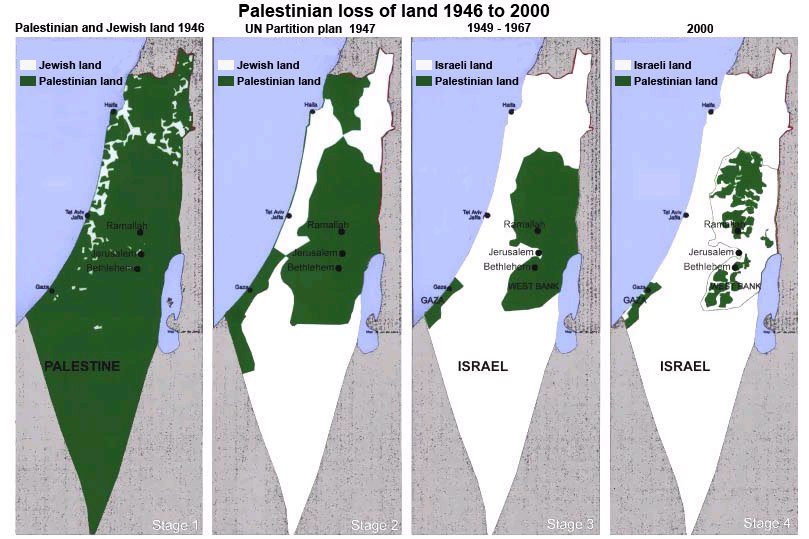
The Nazi persecution of Jews and the Holocaust caused the mass migration of European Jews.  However, key destination countries such as the United States limited Jewish immigration and encouraged their settlement in Palestine, a policy supported by the Zionist leaders.  By the end of the World War II, the United Stated had emerged as the undisputed imperialist power. As part of the consolidation of its empire, the United States moved to establish Israel as its outpost in the Middle East.   The recently formed United Nations very much under the sway of the Allies, especially the United States, drew the partition plan for Palestine voted for by the General Assembly on November 29, 1947.  On May 14, 1948, David Ben-Gurion, the head of the Jewish Agency, proclaimed the establishment of the State of Israel. U.S. President Harry S. Truman recognized the new nation on the same day.

Thus, Israel was established as the Jewish State in violation of the right to self-determination of the Palestinian people.  However, as Mackler points out Israel is no ordinary nation-state.  It has never defined its borders because the Zionist movement has always claimed the Greater Israel, shifting geographical designation, as its “homeland” that often extends well beyond the historic Palestine.  The history of the Jewish State has seen a relentless push to expand its territory and force Palestinians to flee their land. It has also been marked by war with its Arab neighbors (for a history see, Middle East Research and Information Project—MERIP).  

Israel has degraded the Palestinian people by dividing them into variously oppressed groups. About 20% of the population of Israel are “Arabs” (that is Palestinians). They have lived as second-class citizens.  Then there are Palestinians who live in the West Bank who were under the Jordanian administration from 1948 to 1967 and after the Six Day War have lived under Israeli occupation.  The Gaza Strip was mostly administered by Egypt (1959-1967) and then under the Israeli occupation from 1967 to 2005. In 2005, Israel unilaterally withdrew from Gaza Strip but placed it under a tight blockade that has remained in place, with Egyptian help, until today. In fact, one of the demands of Hamas and the people of Gaza Strip is the lifting of the Israeli and Egyptian blockade. Then there are Palestinian refugees who live in camps mostly in Jordan and Lebanon. Finally, millions of other Palestinians are scattered all over the world in hope of returning to their homeland. 

Frankenstein in the Promised Land 
Thus, the Zionist movement and its imperialist backers have created a Frankenstein in the Promised Land: a nineteenth-century European-inspired colonial-settler state founded on the basis of the ongoing ethnic cleansing of its native Palestinian population that is inherently racist and at war with its Arab and other neighbors.  As such, Israel has been the reliable key imperialist outpost, a garrison state, in the Middle East and North Africa. It is the only nuclear state in the Middle East with an estimated 300 nuclear devices. Although the Israeli government never denies having nuclear weapons it is shielded from international scrutiny by the United States that has supported it constantly with $3 billion dollars of military aid every year even as it curtails social programs for the American working people due to claimed budgetary constraint.  Although created by a U.S. inspired U.N. resolution, Israel has never abided by the decisions of the United Nations for its repeated violation of international norms, always shielded by the U.S. veto power in the Security Council.  Israel is a bulwark of international reaction; it was a staunch supporter of the South African Apartheid regime but has opposed every anti-imperialist and revolutionary movement in the Middle East and around the world.  It supported the United States in its Indochina war, opposed the Nicaraguan revolution of 1979, and is the only country in the United Nations General Assembly that consistently votes in support of the U.S. embargo of the Cuban revolution.  Thus, the Jewish people who fled anti-Semitism in Europe and Nazi Holocaust, especially those who came to Palestine with socialistic aspirations, have been betrayed by their Zionist leaders, and, in many cases have been transformed into racist oppressors that serve the interest of imperialism and oppose the Arab revolution.

As long as this Frankenstein exists in the heart of the Middle East there will never be peace.  There will never be a stable two-state solution to “the Palestinian problem” because of the very racist and expansionist nature of the Zionist regime as the failure of the Oslo Peace Accord has demonstrated.  The only possible solution to the 66-year-old crisis is the replacement of Israel (the Jewish State) with a democratic secular state with its historic name, Palestine, where Palestinians and Jews live as citizens with equal rights and opportunities.  Contrary to Judy's view (as quoted above), the Jewish people can be strong only when they learn to live alongside their Palestinian brothers and sisters as equals not as their oppressors.  That is the only road to peace in the Middle East.  (Of course, there are other monsters in the Middle East but that need separate discussion and analysis; see my three part article "From Nasser to Mubarak: The Rise and Fall of Arab Nationalism, Part 1Part 2Part 3). 

However, it is important to note that the demand for a democratic secular Palestine that was first raised by the Palestinian Liberation Organization in 1969 cannot meet the current requirements of the regional and global crisis that are also environmental and ecological (see my "Economics, Socialism and Ecology: A Critical Outline, Part 1 and Part 2).  The 1969 perspective of a national liberation movement did not concern itself with the ecological crisis of the Middle East.  Rapid population growth, pollution, degradation of land, rivers, natural habitats combined with the national, regional and world capitalist crises require urgent action that will transcend the artificial borders of countries created based on inter-imperialist negotiations in the aftermath of World War I and World War II.    The civil war in Syria, the rise of the Islamic State of Iraq and Syria (ISIS), the rise and fall of the Egyptian revolutionary movement, the sectarian and tribal wars in Iraq, Syria, Libya, and the conflict between Israel and Palestinians and Israel and its Arab neighbors are accentuated or in part originated by such environmental and economic crises.  

The most forward-looking Palestinian, Arab, Jewish and other peoples of the Middle East and North Africa would realize the need for a common effort to address ecological and social justice issues in tandem and across the bioregion.  A United Ecological Socialist Middle East and North Africa is the only truly viable perspective for the peoples of the region.  That, and not the nationalistic and religiously inspired formations, is the only perspective that can emancipate the peoples of the Middle East and North Africa and join similar struggles elsewhere towards an ecological socialist world. 

Is Palestinian Right to Self-Determination Compatible with the Israel's "Right to Exist?"

By Kamran Nayeri, March 1, 2017


In discussions and debates about the “Arab-Israeli conflict” the questions of Palestinian right to self-determination and Israel’s “right to exist” come up frequently.  It came up in a Facebook discussion I had with Mark (not his real name) the other day. What do these mean?  Mark has been a life long socialist and for years I rode the subway with him back to Brooklyn where we both lived from political events in Manhattan. A printer by profession, he is a book lover and reads voraciously.  When I knew Mark in the 1980s and early 1990s, he was a staunch supporter of the Palestinian right to self-determination and advocated a secular democratic Palestine where Palestinians, Jews and others would live as equals.  This idea was first raised in the late 1960s by the PLO leadership and was embraced by some Jews. But in our Facebook discussion Mark raised the idea of the “right of Israel to exist.”  This notion is part of the demands of the Zionist movement in the so-called peace process that began in 1993.  I pointed out to him that the two positions are mutually exclusive. The “right of Israel to exist” denies Palestinian right to self-determination. Palestinians have not "accepted" Israel unless when they are under to condition of duress. revolutionary socialist would continue to oppose any imposition of a colonial-settler occupation on any part of Palestine and Palestinian right to self-determination requires dissolution of the Israeli state.  In what follows I expand on the question of the right of self-determination for Palestinians and why it matters to the entire world to support, including the Jewish people, especially the Jewish working class. 

The historical basis of the state of Israel
Zionist ideology 
There are three claimed basis for the “right of the Israel to exist.”  The first is the Zionist ideology itself.  Zionists regularly claim that they have a “right to the Jewish people historical homeland.” By that, they mean when the Israelites inhabited historical Palestine some 3,700 years ago.  But Christians can trace their religious origins to the historical Palestine. Should they also claim to have a right to the historical Palestine?  And Judaism, like Christianity, is a religion open to anyone who wants and is admitted to join it.  To say a European Jew, a Japanese Jew, an African Jew all have a right to Palestine because they are all adherents to the same religion is unreasonable.  In fact, Zionism originated as a colonial ideology in the late nineteenth century in Eastern Europe and with expressed interest of finding a “homeland" for the European Jews who were facing anti-semitic prosecution in the countries of their birth, especially in Tsarist Russia. 

British imperialism and the Balfour Declaration
Despite the prevalent Zionist propaganda that tries to justify the occupation of Palestine on the basis of the Jewish mythology of The Chosen People returning to The Promised Land, the Zionist movement considered a number of other locations for colonization.  For example, in 1903 at the sixth Zionist Congress Theodor Herzl, the “Father of Modern Zionism,” proposed Uganda as the site for the Jewish State.  However, in the aftermath of the First World War and division of the Middle East and North Africa between the English and French imperialism, Palestine became the target of the Zionist movement. This was codified in the Balfour Declaration that was first proposed in a letter from the British Foreign Secretary Arthur James Balfour to the British Zionist financier Baron Walter Rothschild dated November 2, 1917, and later incorporated into the Sèvres peace treaty with the Ottoman Empireand the Mandate for Palestine.

American imperialism and partition of Palestine
Subsequently, the Zionist movement organized settlements of European Jews in the historical Palestine to lay the basis for a Jewish State.  Like in all European colonies, the process of land grab was pursued by any means necessary, including through the use of force and terrorist Zionist groups such as the Irgun, the Lehi, the Haganah and the Palmach.  In fact, Menachem Begin, a leader of the terrorist group Irgun, later became Israel’s Prime Minster (He was succeeded by another terrorist, Ariel Sharon). 

The Nazi persecution of Jews and the Holocaust caused the mass migration of European Jews.  However, key destination countries such as the United States limited Jewish immigration and encouraged their settlement in Palestine, a policy supported by the Zionist leaders.  By the end of the World War II, the United Stated had emerged as the undisputed imperialist power. As part of the consolidation of its empire, the United States moved to establish Israel as its outpost in the Middle East.  The recently formed United Nations very much under the sway of the Allies, especially the United States, drew the partition plan for Palestine voted for by the General Assembly on November 29, 1947.  All existing Arab countries opposed it. On May 14, 1948, David Ben-Gurion, the head of the Jewish Agency, proclaimed the establishment of the State of Israel. U.S. President Harry S. Truman recognized the new nation on the same day.

Thus, the establishment of Israel as the Jewish State in Palestine has been a violation of the right to self-determination of the Palestinian people by the colonial-settler Zionist movement with the support of the British and American imperialism.  No rational human being, no humanitarian, not to mention any revolutionary socialist, can accord Israel a “right to exist” because it’s creation and continued existence has been based on the use of violence against an entire people, the Palestinian people. The very existence of the state of Israel is the negation of the Palestinian people’s right to self-determination. The United Nations Resolution 181 that called for the partition was opposed by all Arab leaders and governments because they argued, it violated the principles of national self-determination in the UN Charter which granted people the right to decide their own destiny.  The Jewish Agency for Palestine that represented the Zionist movement accepted the portion.  The history of Israel as the Jewish State has been a relentless push to expand its territory and its ongoing violence against the Palestinians. It has also been marked by wars with its Arab neighbors (for a history see, "Primer on Palestine, Israel and the Arab-Israeli Conflict," Middle East Research and Information Project).  

Israel: Imperialism’s outpost in the Middle East and North Africa
Today, seven decades later, Israel occupies more of the historical Palestine as well as portions of land from its neighboring states, such as the Golan Height that belong to Syria. What has enabled this historical injustice is the unconditional military, political and diplomatic, and economics support for the Zionist regime as the outpost of imperialism in the strategically important Middle-East and North Africa. 

According to the Federation of American Scientists, Israel began pursuit of nuclear weapons right after its establishment in 1948. It began the search for uranium in 1949 and Israel Atomic Energy Commission (IAEC) was founded in 1952. On October 3, 1957, France and Israel signed an agreement to build a 24 MWt reactor (although the cooling systems and waste facilities were designed to handle three times that power) and, in protocols that were not committed to paper, a chemical reprocessing plant. This complex was constructed in secret, and outside the International Atomic Energy Agency (IAEA) inspection regime.  In 1968, the CIA issued a report about Israel’s successful production of nuclear weapons. Although United States was aware of Israel’s nuclear ambitions and activities it turned a blind eye allowing its strategic ally in the Middle East to join the Nuclear Club outside the purview of the IAEA.  Today, it is an open secret that Israel is armed with 300 nuclear weapons. Israel is the largest cumulative recipient of U.S. foreign assistance since World War II. To date, the United States has provided Israel $127.4 billion (current, in non-inflation-adjusted, dollars) in bilateral assistance. Almost all U.S. bilateral aid to Israel is in the form of military assistance, although in the past Israel also received significant economic assistance (for a detailed discussion, see, Jeremy M. Sharp, “U.S. Foreign Aid to Israel,” Congressional Research Service, December 22, 2016).  In his waning day, Obama administration that was shunned by the Israeli government ensured the Zionist regime gets a record $38 billion military aid package for the next decade.   

Today’s Zionist settlers movement
Those who speak of the right of the State of Israel to exist support this bloody colonial-settler and imperialist legacy that has denied the right to self-determination of Palestinians and has become a pillar of oppression and exploitation in the Middle East and North Africa. Seven decades after imposition of the State of Israel, and almost quarter of century after the Oslo Accord where the demoralized PLO leadership recognized the State of Israel in exchange for a promised Palestinian state, the so-called two-state solution, an estimated 400,00 Zionist settlers live on occupied land in the West Bank (there were only 480 in 1948), about 350,000 live in East Jerusalem (2,300 in 1948) , and 21,000 live in the Golan Height (it belongs to Syria and no Jews lived there in 1948 or in 1967).  No Jews live the Gaza Strip now but 30 lived there in 1948.

What do these Zionist settlers think about the Palestinian people whose land they forcibly takeover and what they foresee as the future of Israel?  In an Op-Ed piece in the New York Times (“A Settler’s View of the Future of Israel,” February 14, 2017), Yishai Fleisher who describes himself as the “ international spokesman of the Jewish community of Hebron,” offers some insight.  Mr. Fleisher marshals the same facts as noted above, wrapped in Zionist phraseology, to argue that the so-called “two-state” solution “will never come to pass”  “because Judea and Samaria belong to the Jewish people.” 

Now, this honest but openly racist expression of the Zionist ideology faces the reality of the Palestinian people who were the great majority of those who lived in Palestine before the Zionist movement to occupy it to build a Jewish State got underway.  The estimated number of Palestinians in the world at the end of 2012 is 11.6 million, of whom 4.4 million are in the West Bank, Gaza Strip and East Jerusalem and 1.4 million live inside Israel (Palestinian Central Bureau of Statistics, cited in Haaretz, “Palestinians to Outnumber Jewish Population by 2020, Says PA Report,” January 1, 2013)  Mr. Fleisher offers a catalogue of Zinonist  “solutions” to deal with this reality.
  • Proposed by two former members of parliament, Aryeh Eldad and Benny Alon, Israel would assert Israeli law in “Judea and Samaria” while Palestinians living there would have Israeli residency and Jordanian citizenship. That is, they are considered Jordanian living inside Israel as expats.
  • Proposed by Israel’s education minister, Naftali Bennett, Israel will annex Area C — the territory in the West Bank as defined by the Oslo Accords (about 60 percent by area), where a majority of the 400,000 settlers live — while offering Israeli citizenship to the relatively few Arabs there. But Arabs living in Areas A and B — the main Palestinian population centers — would have self-rule but no Israeli citizenship and continue to live by the "good grace" of Israel.
  • Proposed by Professor Mordechai Kedar of Bar-Ilan University, near Tel Aviv, seven non-contiguous “emirates” will be established in major Arab cities, as well as Gaza.  Israel would annex the rest of the West Bank and offer Israeli citizenship to Arab villagers outside those cities. Most West Bank Palestinians will not have Israeli citizenship and continue to live under occupation. 
  • Proposed by Caroline Glick, a Jerusalem Post journalist, “Judea and Samaria” will be annexed because new demographic research shows, she claims, that thanks to falling Palestinian birth rates and migration, combined with opposite trends among Jews, a stable Jewish majority of above 60 percent will exist between the Jordan River and the Mediterranean (excluding Gaza); and this is projected to grow to about 70 percent by 2059.  Israel’s president, Reuven Rivlin, and deputy foreign minister, Tzipi Hotovely, back a variety of this proposal.
  • Proposed by Israel’s deputy foreign minister, Tzipi Hotovely, Israel will annex “Judea and Samaria” but offers residency to the Palestinians there with a pathway to citizenship. 
  • Proposed by the head of the new Zehut party, Moshe Feiglin, and Martin Sherman of the Israel Institute for Strategic Studies, Israel will pay “generous” compensation for Palestinians in Judea and Samaria to emigrate “voluntarily.” 
I do not need to point out to the reader that all of these “proposals” to solve the “Palestinian problem” and to expand the Jewish State are based on the assumption of Israel’s right to exist and in open defiance to the principle of the right of the Palestinian people to self-determination. 

Palestinian right to self-determination matters to the world
It must now be entirely clear to the reader that Zionism and its state, Israel, is part and parcel of the history imposed on the humanity by colonialism and imperialism. If revolutionary politics concerns itself with the art and science of understanding and changing oppressive power relations in the interest of human emancipation (which also depends on harmony with the rest of nature) then defending the right to self-determination of all the oppressed and exploited, including the Palestinian people, must be evident as central to the progress of humanity.  While revolutionary socialists have concerned themselves primarily with social class power relations because of the centrality of the working class in the capitalist world economy and the potential and desirability of replacing capitalist social relations with socialist ones, they have also realized that to unite the working classes of the world it is absolutely necessary to educate the working classes of the oppressor nations to respect and defend the right to self-determination of the oppressed nationalities and nations.  That is why the wave of anti-colonial revolutions after the Word War II were of historic importance.   Notable in this context were two historic events: creation of Israel as the Jewish State in 1948 as the imperialist outpost in the strategically important Middle East and North Africa where most of the known oil reserve was located and the Cuban revolution of 1959 that demonstrated that any consistent fight for national self-determination in the capitalist world requires going beyond capitalist social relations in the direction of socialism.  Revolutionary socialism condemned the former without giving up its long-held position against anti-Semitism and upheld the latter. 

This is how the Socialist Workers Party, a revolutionary socialist current at the time, explained it in a 1971 political resolution:
“Our revolutionary socialist opposition to Zionism and the Israeli state has nothing in common with anti-Semitism, as the pro-Zionist propagandists maliciously and falsely assert. Anti-Semitism is anti-Jewish racism used to justify and reinforce oppression of the Jewish people. Marxists have been and remain the most militant and uncompromising fighters against anti-Semitism and the oppression of Jews.
“The source of the oppression of the Jewish people in this era is the capitalist system, which in its period of decay carries all forms of racist oppression to the most barbarous extremes. This was horribly illustrated in the holocaust directed against the Jews of Europe by German imperialism under the Nazi regime. Today, anti-Semitism remains widespread in all of the Western imperialist countries. Until the capitalist system is abolished in these countries there is the ever-present danger that a new variety of virulent anti-Semitism can arise.” (Socialist Workers Party, “Resolution on Israel and the Arab Revolution,” 1971). 
Seven decades later, we must add that Zionism itself is a source of anti-Semitism since the Jewish State has been an instrument of racist, colonialist oppression of the Palestinian people and directly and indirectly involved in a myriad of imperialist campaigns in the Middle East and North Africa and beyond.  To blame the existence of anti-Semitism among some Palestinians and Arabs and in groups that campaign for Palestinian rights ignores this reality.  

Revolutionary socialists confront prejudice in every social movement we participate in, including labor unions. Working people are not immune from racism, sexism, homophobia, xenophobia, Islamophobia or anti-Semitism.  But to turn one’s back to these social movements because some who participate in them are prejudiced neither helps to fight against such prejudices nor contribute to the fight to remove the root-cause of them, the class society in general and the capitalist system in particular. Why should we treat fight for the liberation of the oppressed nationalities and nations any differently?

By becoming the best builders of the solidarity movement with the Palestinian struggle, we can and must educate about the problem of anti-Semitism.  However, this educational and political campaign unfolds only in the context of unconditional support for the right of Palestinians to self-determination.  Any support for Zionism and for its institutional form, Israel, undermines both efforts. 

To root out anti-Semitism, Jewish people, especially Jewish workers, must become staunch supporters of the Palestinian right to self-determination and opponents of the colonial-settler ideology of Zionism. 

The rock solid support of the U.S. ruling class for Zionism certainly has its pragmatic reasons; it has served as the beachhead for imperialism in the Middle East and North Africa for decades.  But there is also an ideological synergy.  Having moved to the front and center with the rise to power of Donald Trump,  American White Nationalism is actually as old as the colonial-settler occupation of the Pre-Columbus America that eventually became the United States.  The entire Euro-centric narrative that has filled the history textbooks begining with the of “discovery” of the Americas by Christopher Columbus to today, as radical historians have pointed out (e.g. Howard Zinn’s A People History of the United States: 1494 to Present, 2003), serve the colonial-settler dominant power relations that has served the ruling capitalist class to this day.  In the United States, White Nationalism has been a movement to dispossess America Indians, plunder the ecosystems, super-exploit African slaves, and waves of immigrants that were brought in to do hard labor. Until 1965, immigration policy in the United States was a “whites only” policy (see, May M. Ngai, Impossible Subjects: Illegal Aliens and the Making of Modern America, 2014).

Thus, the unwavering support of the U.S. ruling class for Zionism is based on a shared common colonial-settlers ideology.  That is why Israel is the “best friend” of the ruling class the United States and the latter is the ultimate protector of the former.  How else can one explain the grip of the Zionist lobby on the U.S. politics where both Democratic Party and Republican Party outcompete each other in their support for Israel? 

Israel’s right to exist or Palestinian right to self-determination?
But why has Mark changed his mind about unconditional right to self-determination for Palestinians? Of course, only Mark himself can answer that question.  But allow me to make an educated guess.  Mark has been a dedicated active supporter of the Socialist Workers Party (SWP) for decades, the fact that the SWP has just recently fundamentally changed its position on Israel and the Palestinian fight for self-determination perhaps has something to do with it.

In its editorial of July 25, 2014, The Militant, SWP’s weekly paper, took an adaptationist position towards Zionism that essentially gave up its historic position of unconditional defense of the Palestinian right to self-determination. The editorial sums up its new position as follows: 
    “Recognition of a Palestinian state, as it is today, as a stepping stone to fight for a single, viable geographical homeland for the Palestinian people.
“Recognition of Israel, as it is today, both a Jewish and increasingly multinational secular state. This includes the right of return for the Jews, which will become increasingly relevant as the world crisis of capitalism kindles Jew hatred as a reactionary bludgeon against fighting labor.” (The Militant, July 25, 2014)
Notice that The Militant editorial comes in the middle of Israeli war against the 1.8 million Palestinians who are squeezed into less than 141 square miles in the Gaza Strip who have no army, no air force, no navy to defend themselves against the most modern and powerful air force, navy and army in the Middle East, courtesy of U.S. imperialism.  According to the United Nations, Operation Protective Edge (Israel’s name for its military offensive), at least 2,104 Palestinian died, including 1,462 civilians, of whom 495 were children and 253 women. Only 66 military personnel and 7 civilians were killed on the Israeli side.  Yet, the editorial places the primary responsibility on "Hamas terrorism and murderous retaliation of Tel Aviv’s armed forces." Thus, the Militant editors were following the Israeli propaganda by turning the victim into the criminal to justify a genocidal war. 

The Militant editors call for the "right of return" for Jews citing the capitalist world crisis but they fail to call for the right of return for Palestinians after seven decades of Zionist ethnic cleansing.  Are not Palestinians not affected by the capitalist world crisis?  This is how radically the editors negate the SWP's historical position.  But the entire idea of a supposed "right of return" for Jews to Palestine was cooked up by the Zionist colonial-settler movement after it gave up plans for creating a "Jewish Homeland" somewhere else after reaching an agreement with British imperialism after World War I to carve up Palestine for a Jewish State.  There is no other basis for any "right of return" of Jews to Palestine.  Jews have lived for thousands of years in many other countries of the world and they are from various races and ethnic groups just like Muslims and Christians. But the Palestinians were forced from their home and homeland in millions by the Zionist colonial-settler terrorism and war only in the contemporary history. The poorest are still living in refugee camps in the Middle East.  Those in the West Bank in effect live under military occupation and their land is gradually being taken from them for new Zionist settlements.  Those in the Gaza Strip are even worse off even though the Israeli army dismantled settlement and withdrew in 2005 because the Zionist State has then imposed a harsh land and sea blockade and has waged three murderous wars against its population in the last 12 years. In reality, the Gaza Strip is the largest open-air prison in the world.  The Palestinians who still remain inside Israel have been second class citizens subject to ongoing racism--how else can life be for non-Jews in the Jewish State?  In brief, the new SWP position is to support the Zionist colonial policy. 

Writing about the Second International Congress in Stuttgart in 1907, Lenin commented on the dispute in the Colonial Commission where a majority led by representative of the German Social Democracy included 
“…the following monstrous phrase appeared in the draft resolution: ‘The Congress does not in principle and for all time reject all colonial policy, which, under a socialist regime, may have a civilising effect.’ In reality, this proposition was tantamount to a direct retreat towards bourgeois policy and a bourgeois world outlook that justifies colonial wars and atrocities.   It was a retreat towards Roosevelt, said one of the American delegates. The attempts to justify this retreat by the tasks of a ‘socialist colonial policy’ and of constructive reform work in the colonies were unfortunate in the extreme. Socialism has never refused to advocate reforms in the colonies as well; but this can have nothing in common with weakening our stand in principle against conquests, subjugation of other nations, violence, and plunder, which constitute ‘colonial policy’. The minimum programme of all the socialist parties applies both to the home countries and the colonies. The very concept 'socialist colonial policy' is a hopeless muddle. The Congress quite rightly deleted the above-quoted words from the resolution and substituted for them a condemnation of colonial policy that was sharper than that contained in former resolutions.” (V. I. Lenin, "The International Soialist Congress in Stuttgart", Marxist Internet Archive, 1907), 
The revisionist SPW position is similarly proposing a “Marxist colonial policy” by recognizing Israel’s right to exist and thereby denying the Palestinian right to self-determination.  But why such a revision?  Part of the answer lies in a fundamental revision of the SWP’s historic program, strategy and tactics, as well as organization principles and norms, that began in the early 1980s and continues to this day (for a discussion of these see, Art Young, “Decline and Fall: The US SWP’s Final Embrace of Zionism,” 2014; John Leslie. “The U.S. Socialist Workers Party Accommodates to Zionism,” 2016; Kamran Nayeri, “The Historic Women's Marches of January 21, 2017,” 2017 that discuss particular cases of the political crisis of the Socialist Workers Party).  Why a majority of the SWP leadership and membership opted for this revision of the party’s revolutionary heritage is a more complex question.  The interested reader can find a number of arguments about the root-causes of the SWP’s demise of which I would recommend Paul Le Blanc’s incisive essays “Leninism in the United States and the Decline of American Trotskyism,” and “Trotskyism in the United States: The First Fifty Years,” in Trotskyism in the United States (Paul Le Blanc, ed., 2016).  

The pressure to cave into Zionism is greater today as the shift to the right in capitalist politics continues and political polarization puts small socialist groups to test. Some like the SWP are more prone to give in and embrace a pro-Zionist position. Others that have tried to maintain their revolutionary heritage have embraced the new generation of working people that are waking up to the plight of the Palestinian people as evidenced by the massive support for the Palestinian-led Boycott, Divest, Sanction movement. The conversation with Mark began with me posting a BDS-related news item on Facebook which he opposed initially with a myriad of excuses.  When the conversation continued a bit, he came out with the argument that the BDS undermines Israel’s right to exist, which he, to my surprise endorsed. 

For an ecosocialist Middle East and North Africa
Of course, unconditional defense of the Palestinian right to self-determination is as important today as it has always been as is the vision of a democratic secular Palestine where Palestinians, Jews, and other peoples residents in the historical Palestine to live as equals.  However, today as the world is becoming aware of the ecological crisis that poses a threat to human survival and much of other life on earth, we must envision an ecological socialist Middle East and North Africa.  That is why it is such a shame that the people who dedicated their lives to socialism are now caving in to the colonial-settler ideology of Zionism.  Zionism is not only the scourge against the Palestinian. It is also a barrier to the union of all peoples of the Middle East and North Africa who should unite in the fight for an ecological socialist region. Instead of fighting for a nineteenth-century colonial-settler racist ideology of a “Jewish Homeland,” Jews and all opponents of anti-Semitism must be fighting for our common humanity and the future of our true homeland, the planet Earth and life in all its magnificent variety.  It is time to contemplate that we are really one species that has been fractured by the rise of class societies since the dawn of Agricultural Revolution into many feuding social groups.  The promise of Marx’s socialism was to emancipate humanity. Consistent with Marx's own understanding (Paul Burkett, Marx and Nature: A Red and Green Perspective, 1999; John Bellamy Foster, Marx's Ecology: Materialism and Nature, 2000) ecological socialism promises to do so by returning humanity to the wisdom of ecocentriccultures that our ancestors shared for 95% of our existence, cultures that value and celebrate all life and the Mother Earth (Kamran Nayeri, "Economics, Socialism, and Ecology: A Critical Outline, Part 2, 2013).  

References:
Burkett, Paul. Marx and Nature: A Red and Green Perspective, 1999.
Fleisher, Yishai. “A Settler’s View of the Future of Israel,” The New York Times, February 14, 2017. 
Foster, John Bellamy. Marx's Ecology: Materialism and Nature, Monthly Review, 2000.
Le Blanc, Paul. Trotskyism in the United States. Haymarket Books, 2016. 
Lenin. V. I. “The International Socialist Congress in Stuttgart,” Marxist Internet Archive, 1908. 
Leslie, John. “Israel, Palestine, Anti-Semitism and the US Left,” Left Voice, September 13, 2016. Republished as “The U.S. Socialist Workers Party Accommodates to Zionism,” in Our Place in the World: A Journal of Ecosocialism. 
Middle East Research and Information Project. "Primer on Palestine, Israel and the Arab-Israeli Conflict." No date. 
Nayeri, Kamran. "Economics, Socialism, and Ecology: A Critical Outline, Part 2, Our Place in the World: A Journal of Ecosocialism, 2013.
-------------------.“The Historic Women's Marches of January 21, 2017,” Our Place in the World: A Journal of Ecosocialism, February 2, 2017. 
Ngai, May M. Impossible Subjects: Illegal Aliens and the Making of Modern America, 2014.
Palestinian Central Bureau of Statistics, “Palestinians to Outnumber Jewish Population by 2020, Says PA Report,” Haaretz, January 1, 2013.
Sharp, Jeremy M. “U.S. Foreign Aid to Israel,” Congressional Research Service, December 22, 2016.
Socialist Workers Party. “Resolution on Israel and the Arab Revolution,” Marxist Internet Archive, 1971. 
————————————. Editorial: "Chart Road Forward for Toilers of Palestine and Israel,” The Militant, July 25, 2014.
Young, Art. “Decline and Fall: The US SWP’s Final Embrace of Zionism,” Links International Journal of Socialist Renewal, September 18, 2014.  Republished in Our Place in the World: A Journal of Ecosocialism.