Showing posts with label Film review. Show all posts

Wednesday, May 6, 2020

A Note on the Controversy About "Planet of the Humans"


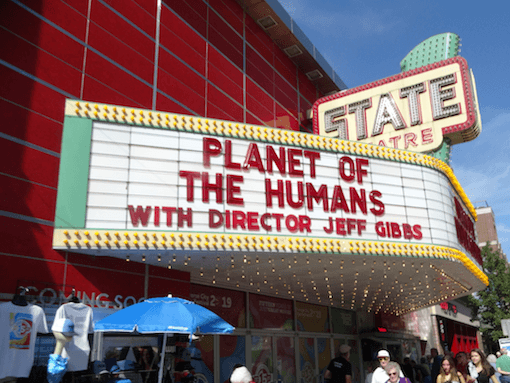
There has been much controversy surrounding “Planet of the Humans” (director Jeff Gibbs, producer Michael Moore, 2020) within the climate justice movement in the United States (For a sample, see, the Wikipedia entry for the film).  The reason is obvious.  The documentary takes a critical look at the leadership of this movement, in particular 350.org and its founder Bill McKibben, who thanks to the mass media has become the poster child of the climate justice movement, and some of the policies and practices they have supported.  In other words, Moore and Gibbs whose film is now seen by millions of viewers have brought to light an inconvenient truth: The climate justice movement which has a narrow technological view of the crisis hence its solution—replacing dirty fuels with “clean, renewable energy”—has become enslaved to a fictional vision of Green Capitalism that would never rid us of a catastrophic climate change.  That is the central message of the documentary which the critics do not like and would not discuss.

Instead, Moore and Gibbs have become subject of attacks by some in the climate justice movement.  Josh Fox, another liberal filmmaker, who attacks Moore and Gibbs as “the new flack for oil and gas” industry offers a typical response. He argues that Moore and Gibbs instead should have celebrated the “stunning” “achievements” of the climate justice movement. 

“The codification and structuring of the Green New Deal, the Fossil Free movement championed by Bill McKibben and Naomi Klein, which has led to universities, pension funds, and foundations to commit to divesting trillions of dollars from fossil fuels, huge advances in renewable energy efficiency, the proliferation of 100 percent renewable energy plans put forward by Stanford University Professor Mark Jacobson and others, a burgeoning youth movement inspired by Fridays for Future and Greta Thunberg; the remarkable successes of the anti-fracking movement—which finally reached the mainstream, espoused by progressives like Bernie Sanders and Alexandria Ocasio-Cortez but also by moderates like Kamala Harris and Pete Buttigieg. And the incredible civil disobedience uprising at Standing Rock against the Dakota Access Pipeline. What a decade for the environmental movement! Those achievements deserve celebration on film.” (Fox, The Nation, April 30, 2020)

Somehow, Fox who suggests the documentary falls short of good scientific evidence finds it inconvenient to ask himself why despite such “stunning achievements” carbon dioxide concentration in the atmosphere continues to rise.  On May 1, 2020, CO2 concentration was 418.03 ppm compared to 414.88 ppm on May 1, 2019 (CO2 Daily, accessed May 2, 2020). 

I will return to Fox’s “stunning achievements” in a moment. But let’s note the important criticism the film makes of the climate justice movement and its leadership.    

Natural limits to growth
The documentary is typical of Moore movies.  It is not a film about science of climate change or any scientific assessment of “renewable” energy although it does allude to them (some of these issues are in dispute even among experts, see, for example, the important topic of “energy returned on energy invested” EROEI discussion in Wikipedia) .  

A central and critical message of the film is natural limits to growth: on a finite planet infinite economic growth including of human population and consumption is impossible.  In other words, even if “clean, renewable” energy can be had, its manufacturing and use may still exceed the natural limits of the planet if we do not substantially reduce the drive for ever-more energy consumption. The film does not discuss this but it is common knowledge that the bulk of GHGs emissions are by the U.S., China, and European Union (Chinese emissions are in part due to demand for manufactured goods from the U.S. and E.U.). At the same time 850 million people in the Global South lack access to energy (International Energy Association, World Outlook, 2019).

Of course, over-consumption in Global North and by some in Global South is also pressing against other natural limits to growth (example: oceans are running out of fish and most fish in the market these days are farmed fish which require energy to produce). This feeds into factors that have caused the Sixth Extinction which is considered an existential crisis as it will lead to the collapse of the web of life perhaps by the end of this century (Wilson, 2016; see, also, Nayeri, 2017)

 A related important point the film makes is that “clean, renewable energy” is not entirely renewable or clean.  Construction of solar panel, wind turbines and related materials and infrastructure use fossil fuels and contribute to energy consumption and they have to be replaced on certain short intervals of time.  As someone who has installed solar panels for my home I know that I am still dependent on Pacific Gas & Electric (PG&E) for my power at night and when it did cut off power to northern California homes last fall because of wildfire, I too had not electricity. Thus, I am still dependent on fossil fuels and nuclear energy PG&E uses.  

Capitalism and the profit motive
Moore and Gibbs also go further than the climate justice movement and its leaderships in that in the documentary they holds “capitalism” responsible for the crisis and once refer to the “profit motive” as the source of quest for ever-more growth on a finite planet.  It was practically a conversation stopper in 350.org when I was briefly part of it and in much of the climate justice movement to speak of “capitalism,” not fossil fuels only, as the source of the crisis.  To put it differently, 350.org and all other prominent climate justice movement groups as well as all environmentalist groups refuse to consider that Our Way of Life, “capitalism,” has anything to do with the climate crisis or the broader ecological crisis. A very small current in the climate justice movement, including this author, has argued that the crisis is systemic and to overcome it we must work towards transcending capitalism.  

Green Capitalism 
Using these lenses, the documentary criticizes the leadership of the climate justice movement, especially 350.org and it founder Bill McKibben, as pursuing what is known as Green Capitalism, that is, some fictitious environmentally friendly capitalism.   The point Moore and Gibbs make is painfully clear: you cannot have capitalism and the pursuit of profit and infinite economic growth on a planet with finite resources.  Sooner or later, crises of all kinds will erupt.  The runaway climate change is the one most well-known.  But the Sixth Extinction is equally as important. The ongoing Covid-19 pandemic is yet another facet of the same crisis. Even if the whole world transitions to "renewable energy" but capitalist growth continues, humanity may still go extinct. 

Which way forward for the climate justice movement?
While supporting every mass mobilization of the movement, I have been an outspoken critic of the reformist Green Capitalism politics of its leadership as the list of essays below written over a number of years show.

My criticism of the movement’s leadership has never focused on their relationship with the various capitalist groups or their sources of funding. But is it not troubling that major environmentalist groups like Sierra Club, Nature Conservancy, Environmental Defense Fund, and the Natural Resources Defense Council have had a cozy relationship with the major capitalist groups with an interest in environmentalist policy? Isn’t it a conflict of interest? Isn’t it troubling to Mr. Fox and others who are attacking Moore and Gibbs as oil and gas flake that Bill McKibben when asked on camera to disclose the funding sources of 350.org draws a blank? 

Still, my criticism of McKibben is based on his misunderstanding of why we have climate crisis and who is responsible for it and how we can resolve the crisis.  

In an April 2016 interview with an Australian website, McKibben candidly recounts the evolution of his own strategic thinking: “I spent a lot of years getting it wrong…I thought we were engaged in an argument” with the fossil fuel industry. “We waited far too long to realise what a fight it was, and that there was an adversary on the other side.” 

At that time McKibben appeared to argue that politicians are “pawns” in the hands of the fossil fuel industry and he decided to go after the “real bosses” (the fossil fuel industry).  But isn't he still "getting it wrong?" Isn't the problem capitalism and not just oili and gas industries that serve industrial capitalism? 

Not only McKibben wasted “a lot of years” unable to form a critical conception of the fossil fuel industry and the dynamics of the capitalist economy, he also has never ever took the trouble to find out. By narrowly defining the problem that the climate justice movement faces, he continued to come up with a deficient strategy.  

As he was granting that interview in Australia, 350.org  was preparing for its failed “Break Free from Fossil Fuels” campaign which used a series of civil disobedience actions targeting the “worse polluters” by a small group of activists. At the same time, McKibben was favoring Senator Sanders campaign in the 2016 elections to reform the Democratic Party, that is a capitalist electoral strategy. When Sanders lost in part due to the machinations of the Democratic Party bosses, McKibben and 350.org threw their support behind the establishment's Hillary Clinton’s bid for presidency even though she openly embraced natural gas and fracking (Fox and current critics of Moore and Gibbs seem to have forgotten that episode). Read McKibben's own account of this experience in his New Republic essay. The electoralist illusion is not unique to 350.org but is widely shared in the climate justice movement, the ecology movement, and social justice movement.  Why that is can only be explained by a lack of critical thinking. Just consider the balance sheet of other once mighty movements such as the labor movement, the movement to defend abortion right, and the African American movement who relied on a similar electoral policy and the Democratic Party who have been reduced to small mariginalized groups.  

In summary, McKibben and 350.org and all other climate justice groups such as The Climate Mobilization have no other strategy.  Thus, they help initiate, fund, or promote various other groups such as the Sunrise Movement and Justice Democrats to elect “climate friendly” (typically) Democratic Party politicians. After Alexandria Ocasio-Cortez was elected to Congress in 2018 with help from Justice Democrats and proposed a non-binding Green New Deal Resolution it caused widespread jubilation in the climate justice movement and some even envisioned a a rapid transition to a fossil fuel free economy through a massive U.S. government devised and funded plan.  

Of course, nothing of the kind ever happened. The non-binding GND Resolution is largely forgotten and the most significant action Ocasio-Cortez has been to endorse Sanders’ bid for nomination by the Democratic Party in this primary season.  When Sanders's bid became highly unlikely to succeed, he ended his campaign and endorsed Biden’s nomination. It was a Déjà vu of the 2016 experience. It is an understatement that the climate justice movement has become disoriented.  There is little doubt that 350.org and other prominent climate justice and ecology group will support the Biden bid for presidency as a matter of the lesser evil politics.  Biden does not seem to have any campaign program of his own but promises a return to the "Golden Age" of Obama administration policies. We know how effective the Obama presidency was in addressing the existential climate change crisis. 

The interested reader can find my detailed critique of the Green New Deal and its proponents (Nayeri, March 2019; Nayeri, January 2019).  But let me point out one aspect of both the Sanders’ program and the GND of Ocasio-Cortez that is relevant to the movie's central message: They are both Keynesian vision of some Green Capitalist future with the promise of prosperity to the U.S. working people when in fact what is unfolding is the systemic existential crisis of capitalism.  In his 2016 campaign, Sanders promised a 5% a year GDP growth, a really fast rate of economic growth for a mature capitalist economy.  If Sanders were elected president in 2020 and his program adopted and implemented it would certainly have cause a similarly fast rate of economic growth. Ocasio-Cortez’s proposed GND is also a Green Keynesian program that would cause rapid economic growth. 

Presumably, both Sanders and Ocasio-Cortez plans would have redistributed income from the super rich to the working people and would have tied to enact programs that would have benefited them in the short run.  But their proposals would also contribute to the ecological crisis by pressing against the limits to growth while they would also increase the gap between the rich United States and the global poor who currently constitute almost half the world population— more than 3 billion people — who live on less than $2.50 a day.  Surely, the prosperity Green Capitalist politicians like Ocasio-Cortez and Sanders promise the American working people could not ever be extended to the poor regions of the world as it will certainly amount to suicide for humanity as catastrophic climate change and the collapse of the web of life will result.

Thus, Moore and Gibbs are correct to point to natural limits to growth and to the problem of unceasing capitalist economic growth fueled by ceaseless pursuit of profits as the cause for climate crisis.  To fault them for pointing out the fact that United States cannot solve the climate crisis simply by transitioning to “clean renewable” energy sources while continuing to produce and consume ever more energy and all other stuff of the American ways of life is at best ignorant. 

A culture of being, not a culture of having  
Humanity’s salvation lays only in whether billions of us can undertake a course to transcend the anthropocentric industrial capitalist civilization in the direction of an Ecocentric Socialist future where a culture of being will replace the present culture of having, when humanity will finally undo all power relations on which the current civilization rests by disempowering those who hold power.  For the past five thousand years, all civilizations have been class societies in which the ruling classes have dominated and exploited the working masses to extract wealth from nature.  This has been the root cause of ecological and social crises that have resulted in the collapse of many civilizations.  It would be foolish to disregard the fact that the anthropocentric industrial capitalist civilization is an exception. We must end the paradigm of wealth generation, radically reduce the human population over a number of generations democratically through empowerment of women, and radically reduce the size of our economies by refocusing on local economies geared to production of basic necessities of a life consistent with human development in harmony among ourselves and with the rest of nature.

To be sure, Planet of the Humans has shortcomings. But the central message it communicates deserve the full attention of and discussion by the climate and ecological movements.  Likewise, I would appreciate any critical discussion of this commentary. 

A list of my earlier writings on climate change follows:

“Challenges Posed by the ‘Green New Deal’” January 16, 2019.


“Who Can Stop the Climate Crisis?” June 27, 2017.


References
Nayeri, Kamran. “How to Stop the Sixth Extinction: A Critical Assessment of E. O. Wilson’s Half-Earth.” Our Place in the World: A Journal of Ecosocialism. May 14, 2017.
————————. “Challenges Posed by the ‘Green New Deal’.”  Our Place in the World: A Journal of Ecosocialism. January 16, 2019. 
————————. “A Future for American Capitalism or The Future of Life on Earth?: An Ecosocialist Critique of the ‘Green New Deal’.” Our Place in the World: A Journal of Ecosocialism. March 25, 2019.
Wilson, E. O. Half-Earth: Our Planet’s Fight for Life, 2016.

Acknowledgement: Thanks to David McDonald for his suggestions on a draft of this commentarry. 

Sunday, August 20, 2017

Film Review: Les Saisons (Seasons)

By Kamran Nayeri, August 20, 2017


Les Saisons (Seasons) is a 2015 French-German nature documentary film directed, produced, co-written, and narrated by Jacques Perrin, with Jacques Cluzaud as co-director.  The documentary is centered on the natural history of Europe beginning with the Ice Age c. 110,000 – c. 11,700 years ago. The film depicts this period focusing on animals who survived in Europe at the time, it opens with a herd of bison that look like frozen statues.  As the climate warmed, the ice retreated, and the geological epoch Holocene began, a forest covered Europe and new and more varied life thrived there. This part is rich wildlife cinematography. The film succeeds so well in drawing the audience into viewing the forest from the perspective of its animal inhabitant, that when the camera rolls onto a scene of hunter-gatherers we see them from the eyes of onlooking animals, with curiosity. This part constitutes the majority of the film coverage and is most beautiful of all. 

Then the next episode in the film is the rise of first farmers, with hints at domestication of animals and plants.  Gradually, the audience views with alarm the expansion of the realm of farmers and their ever more learning of the forest and domestication of wildlife as the forest retreats to ever smaller parts of the continent.  The wildlife that survives is forced up the mountainous regions. 

In the last part of the film, we see the arrival of industrialization with the devastation of forests and wildlife that had survived, increasingly being forced to live in the ever-expanding human settlements.  Finally, we see the European wars that destroyed not just millions of humans but also an untold number of non-human fauna and flora. 

The director and co-director are well-known for their earlier nature documentaries: Winged Migration (2001) and Oceans (2009).  Seasons is definitely as beautifully produced as their earlier films. Where it is lacking is in its final message, which blames humans for the ecological crisis since the Agricultural Revolution, especially for the current Sixth Extinction, and in its naively expressed hope that somehow we will change our ways, to bring peace in human relations with nature.  

Of course, we humans are part of the animal kingdom, hence of nature itself. What the film depicts as the rise of early farmers, required a world-historic break with the long history of our hunter-gatherer ancestors who did not differentiate themselves from the rest of nature in their ecocentric worldview.  The first farmers were pioneers of the anthropocentric worldview as their mode of production required domestication of plants and animals. In effect, they adopted an alienated view of nature in their new mode of life with their presumption that humans are separate and morally superior to other species. This drive for increasing domination and control of nature eventually produced an economic surplus through the exploitation of domesticated species which formed the material basis for the early class-based civilizations that were formed through subordination, oppression, and exploitation of humans.  

Taking notice of the world ecological movement that has been actively searching for ways to stop and reverse the planetary crisis would have been a fitting ending to the film.  Yes, there is hope, but only if billions of us realize what five millennia of class societies, especially the anthropocentric industrial capitalist civilization of the last 250 years, has done to the life-support systems of the planet, and organize and mobilize to transcend it in the direction of an ecocentric ecological socialist world.  

Still, Les Saisons is a treat to your senses and will open your heart to the love for Mother Nature, an absolutely necessary ingredient for saving the world.  

Wednesday, June 21, 2017

Film Review: Avatar

By Kamran Nayeri, Januray 10, 2010


James Cameron’s “Avatar” is a hot topic in popular culture these days. Its 3D technology offers a scenic delight and, as of this writing, it has brought in $1.4 billion in ticket sales. There also are reports of “Avatar” blues in the media. Thousands are reported to have become depressed after seeing the movie, some contemplating suicide. Typical is Ian Hill, a 17 year old student from Sweden, who told CNN: “"One can say my depression was twofold: I was depressed because I really wanted to live in Pandora, which seemed like such a perfect place, but I was also depressed and disgusted with the sight of our world, what we have done to Earth. I so much wanted to escape reality.”

A similar, milder, yet milder reaction is probably more common among millions of viewers. A middle-aged friend from Costa Rica wrote to me that she cried when U.S. Marines destroyed the “Tree of Life” where the Na’vi people resided. A biologist, she identifies strongly with the “Tree of Life” on this plant currently under siege. I too felt choked up when the U.S. Marine forces set the beautiful Na’vi habitat ablaze. Millions probably identified with a fictional ecocenteric humanoid society and wilderness that Pandora represents. These depart radically from our daily grind of our society at war with itself and with Mother Nature.

Let me explain in more detail.

It is clear from the outset that Cameron wanted “Avatar” to speak against U.S. exploitation of native people and their natural resources. The movie also speaks against corporate greed and militarism.

The story is set somewhere in the space in 2154, some years after Earth has been destroyed by plunder, climate change, and disease. However, capitalism survives in the outer space. A space station circling Pandora includes a scientific group and a military command assisting the corporate staff preoccupied with putting its hand on a highly prized mineral found in Pandora. However, Pandora is inhabited by beautiful, blue-skinned, 10 foot tall, dreadlock wearing Na’vi people. It so happens that the region the Na’vi people reside sits on top of the much-prized mineral. The corporate strategy is to move the Na’vi people using “carrots,” or if need be, “sticks.” To get this done, a technology is employed by which human DNA is mixed with Na’vi DNA to create a Na’vi body that can be controlled by the donating human when placed inside a special chamber in the space station. These avatars are to help the corporate strategists reach their goal.

Jake Sulley, a Marine who has lost his legs in a previous war, is part of a group that serves as avatars. Two others are Grace (the head scientist) and her assistant Norm. In his first adventure on Pandora, avatar Jake gets lost and has to spend the night in the forest. He is soon besieged by various animals and finds himself in mortal danger. However, Neyriti, the daughter of Na’vi tribal leaders, saves Jake’s life and takes him to her people.

The Na’vi tribe appears similar in many ways to Native Americans and other indigenous peoples. They have a deep spiritual bond with their land and all its beings. Through the medium of 3D technology, the audience in drawn into the Na’vi’s world. Jake and others who are exposed to the Na’vi and their world are similarly drawn to it. In contrast, the culture in the space station is a repulsive mixture of corporate greed and brute militarism with no respect for the beautiful Pandora and its species. Their instrumentalism is even echoed when Grace, the scientists, responds to every wonder of Pandora by a command: “take me a sample of that!” Life on Pandora appears as means to the space station’s groups’ goals and not an end in itself.

While this is clearly a dream world, the movie does not really depart much from life on present day Earth. Yes, technology appears to be much more advanced. But human relations on the space station are very similar to the capitalist world we live in, in the U.S., but also elsewhere. Upon closer inspection, Pandora’s nature is also very similar to what we can find on Earth—animals and plants included.

The only significant difference lies in Na’vi life and how it relates to rest of Pandora’s nature. The notion of human superiority and the derive to control and dominate nature is scaled back. The Na’vi people live in harmony with their surrounding. Their tribal structure seems somewhat egalitarian or at least does not project social conflict. It is this that finally wins the hearts and minds of Jake, Grace and Norm and a couple of others from the space station. So, they willingly join in the defensive war of the Na’vi against the invading U.S. forces. Even though their arms a far inferior to the Marines, the Na’vi overcome them when Pandora nature rebels against the invaders. As Grace, the scientist, notices, it is as if the entire forest in one living organism. It is a familiar idea—like the Gaia theory of the planet Earth.

Depression sets in for some people when they return to the daily reality grind of capitalism and environmental destruction it brings and finds themselves politically helpless. This year we reach a watershed: about half the Earth’s population will be living in the urban center away from access to any significant natural setting. Otherwise, it is easy to see that Earth’s nature, where it has not been decimated, is far more beautiful than any fictional imagery.

What is needed is to find a way to replace capitalism with a democratic and egalitarian society, i.e., to radically transform our social relations, and to replace our anthropocentric approach to the rest of nature with an ecocenteric one. At the same time, we can begin this transformation by the way each and every one of us lives. The two process are intertwined and both necessary to change the world. And, this is the promise of ecosocialism.

Tuesday, June 20, 2017

Film Review: My Life as a Turkey

By Kamran Nayeri, July 21, 2014

I live in a two-acre house in the countryside west of Sebastopol, California. I choose this location because of its relatively low population density and wildlife presence.  Over the past few years, I have gradually made the land more hospitable to wildlife and began to observe their presence. Some have made this location their "home" as well, including groups of wild turkeys.  Wild turkeys require about 150 acres to roam around looking for food which is what they mostly do from sunrise to sunset.  They do take a rest from time to time, take naps and play. They are very curious birds and have a social life that I have just begun to understand. They compete, cooperate, make friends and fight. They have a unique mating dance with male turkeys spend weeks mostly posturing for females and compete among themselves for mating with females. They pick a location with tall trees their "home" for sometimes up to several weeks. At sunset, they fly up into tall trees. Their flight is very much like an airplane taking off--they require a runway and they do make a run from it. Depending on their age, weight and physical strength they succeed in getting up the tree with one or more tries. Once on the lower branches they fly up to higher branches until they are as high as possible. In this location, they prefer the pine trees that are 80 feet tall. Over time, I have come closer to groups of them and made friends with a few.  One older female turkey who I called Agnus became so close to me that she flapped her wings at my sight and would tolerate me as close as a foot or two.  Agnus was so old that she spent most of her time resting often close to the sliding door next to my home office.  Sometimes, her daughter would come and pecks her gently to urge her up. When her group moved on Agnus and her daughter stayed behind for a week or so more. One day, however, they stopped showing up. They had moved on.  
So, it was with great happiness that I came across My Life as a Turkey, a PBS production based on the documented experience of Joe Hutto.  Hutto who lived in Florida's Flatlands has a broad background in natural sciences and a deep interest in wildlife.  
After a local farmer left a bowl of wild turkey eggs on Hutto’s front porch, he decided to incubate them and waited for them to hatch.  As the chicks emerged from their shells and locked eyes with his, Hutto became their unusual but dedicated mother.
For a year and half, Hutto spent each day living as a turkey mother, taking on the full-time job of raising sixteen turkey chicks. Hutto dutifully cared for his family around the clock, roosting with them, taking them foraging, and immersing himself in their world. In the process, they revealed their charming curiosity and surprising intellect, even affection towards him.  He became particularly close with one female turkey he named Sweet Pea.  A male turkey he named Turkey Boy eventually become his "brother."  Hutto learned that wild turkeys already know a lot about their environment. For example, they instinctively can tell the difference between poisonous and non-poisonous snakes. He learned that turkeys have individual personalities and preferences. They took a friendly interest in some other species like the deer and squirrel and played games with them. They also teamed up to drive dangerous snakes away from their turf.  He also learned how vulnerable they are. Two of the wild turkeys died of infection and when Sweet Pea laid eggs and slept on the ground at night to protect and incubate them she and all her eggs were eaten by predators (a few weeks ago, a sick female turkey that lived here with her sister for a few days was eaten overnight by predators--here they would be raccoons, foxes or coyotes).  
Still, Hutto was able to teach the young turkeys a few things, like the lay of the land, and protected them from the dangers of the forest as best he could. In return, they taught him how to see the world through their eyes. Hutto says that the entire place came alive to him after he began to act as part of the turkey pack.   When the turkeys became old enough to go their separate way, they left all of the sudden. Hutto was heartbroken because his adopted family had left but also realized that somehow his window to the wildlife around him narrowed as well.  He did not see the lizards, snakes, deer, and others as often as he used to when he was part of the turkey pack. 
The film is done with beautiful cinematography displaying the lush beauty of Florida Flatlands. 
My Life as a Turkey is an hour long and was first aired on PBS on November 27, 2011.  
*     *     *
The following is from the question and answer period with Hutto after airing of the movie. 
Have you always been so connected with animals?
Yes, I suppose I was one of those kids who was born a little congenital scientist or some such thing. I was obsessively drawn to other living things– often to the exclusion of all other priorities. My parents were, if not supportive, at least indulgent to my obsessions. And bless their hearts! They just laid down a linoleum floor in my bedroom, and the rule was: any critter is OK, as long as it stays in the bedroom or outside, it must be well fed and clean, and absolutely no poisonous snakes inside the house! I rarely kept my animals in cages and almost all slept with me in the bed. The list was endless. Big, small, mammal, bird or reptile. I think at one point I had a small bobcat, a gray squirrel, and a seven-foot boa constrictor, all living in perfect harmony.
Where was the Florida Turkey piece filmed?
My Life as a Turkey was filmed on a large family ranch in south-central Florida. My original project was conducted adjacent to a National Forest and Wilderness Area southwest of Tallahassee in northern Florida. The ecology in the area of North Florida is very dense, swampy and jungle-like. The Ranch location was, in many ways, a very similar oak hammock ecology with sandy scrub-oak ridges. The plants and animals were basically the same with a few exceptions, however, there was open “savannah/prairie” like cattle land which was much more photo-friendly. The north Florida location would have been more of a continuous wall of green. The ranch also afforded better logistic accommodations for the crew, with complete privacy for the turkeys. All the wild animals filmed in the documentary were wild residents with the exception of one or two of the snakes that were obtained from a local snake “Wrangler”.
Did you ever find out who the person was that left the eggs and do you think they were all from the same clutch?
Yes, I knew the fellow who brought me the eggs. He was actually an employee on a very large quail hunting preserve. The eggs were from two separate nests, which allowed me to immediately make discriminations between the family groups according to size, coloration, and variations in subtle markings. For example, the color of the legs was distinctive at the time of hatching. Even the eggs looked slightly different in color and speckling. Overall the two family groups were quite different in appearance. And yes, I did have the experience of encountering two of my adult hens when they had 10-week old poults of their own. It was an awkward encounter in the forest where the hens recognized me and were quite unafraid, but of course, their poults had never seen a human, and like all wild turkeys, were horrified at my sight and flew in panic. The mother hens were obviously confused but of course had to quickly follow their brood. A lady living miles away had one of my hens living in her place. The hen was relatively tame, would bring her young poults into her yard and garden, but again, the young poults were intolerant of the woman’s company.
Do you think the birds and especially Sweet Pea, were more vulnerable to predation being raised by a human rather than a real turkey mom? Perhaps in the way of being too trusting?
I have been very concerned about this familiarization/ habituation issue that would cause an animal that knows me to somehow be at greater risk of predation or other humans. In the case of the turkeys, I quickly found that 20 million years as a prey species has honed their survival skills to a razor's edge and my proximity was essentially inconsequential in the face of any predator. As for other humans, I found that the turkeys were, in fact, suspicious of other people even at a great distance and could in fact, with their keen eyes, discriminate between me and anyone else from a quarter of a mile! I have found these powers of discrimination as evident and perhaps even keener in mule deer.
Did you have a sense that the males from your two clutches of eggs might be segregating at all (i.e. hanging out more with genetic relatives)? Did you notice any traits of the males that were socially dominant?
I think Lovett Williams, et al. established or suggested that sibling male wild turkeys tend to stay fraternal throughout their lives– certainly in the first couple of years. That has been my observation as well. However, I think these bonds are somewhat tenuous and involve constant minor conflict to ensure the dominance of one particular male. Mature brothers will often display beside an actively breeding dominant gobbler without ever suggesting that they would try to participate in the breeding activity. I have photographed this phenomenon many times while concealed in blinds with wild spring flocks. It was not until I lived with the gobbler flock that I raised, that the more subtle dynamics of the male fraternity became obvious. These brotherly hierarchies are generally well established prior to maturity and are formed on the basis of innate individual aggressiveness as well as superior size and strength. A dominant gobbler was probably a dominant poult. Gobblers of course, rarely live to a ripe old age, and so “lone older gobblers” quickly become the norm, but it would be interesting to know how sibling gobblers would preserve their fraternity over many years. And as you probably know, old males will on occasion abstain from all Spring breeding activity and conflict, living a quiet solitary life. I have also observed on several occasions a younger “apprentice” jake, form attachments to an older lone gobbler. I don’t think a fraternal group would ever allow this, but if Jake and older gobbler have each lost their family group, I think there is a mutual need for companionship that allows some sort of bond to occur. A conjecture, of course.
Were you shocked that “turkey boy” attacked you or was that normal behavior for a tom turkey? Was it a territorial issue? Do you think Turkey Boy was hurt over you leaving?
Hand raised male turkeys to have a history of eventually becoming aggressive towards humans. I always thought it might be a possibility– but I was still surprised that my buddy– Turkey Boy– wanted to harm me! It was not so much a territorial issue as just an unfortunate “male thing”.
Turkey Boy and I actually resolved our differences after his breeding season ended. The film had to abbreviate our rather complex relationship for the sake of time. Eventually Turkey Boy left on his own and I never saw him again, and I address this in the book in some detail. So, it was me who was hurt over HIS leaving. After all these years I still miss them. This film is hard for me to watch.
What are the top 3 surprises in your studies?
Top three surprises? Getting the eggs, of course, was the biggest surprise but at the top of the list would be the overwhelming complexity of these creatures that I encountered. I was already somewhat of a casual authority on these birds– but I found so many interesting surprises. In particular, an extraordinary intelligence characterized by true problem-solving reason, and a consciousness that was undeniable, at all times conspicuous, and for me, humbling. It should come as no surprise to any of us, considering what we now know about the universe– the closer you look into reality, whether the microcosm or the macrocosm– whether the particle accelerator or the Hubble telescope– things don’t become less complex– and not just more complex but– infinitely more complex. Even the familiar laws of physics break down and no longer apply and we find ourselves searching for new models and paradigms to explain nature. So too with the nature of living things. We need to see the world once again, with new eyes. The wild turkeys have taught me to never see the world the same way again. You look at any living thing closely enough and sooner or later you realize the complexity is beyond comprehension.
If you could teach the turkeys a human thing, what would you teach? If you were to ask them one turkey question, what would you ask?
Wow, I don’t know of one thing wild turkeys could learn from us that would be useful or helpful. Stay away from the road? I still, of course, believe wild turkeys to be in many ways, a vastly superior creature. (not entirely tongue-in-cheek). One question I could ask them? What must it be like to exist in a state of complete wakefulness? To be the definition of Sentient. That’s got to be, at the very least, some serious fun!
Why do you think that people always seem surprised that animals show intelligence, reason, use tools, show affection, and emotions?
As far as humans finding it difficult to recognize a higher order of experience in other creatures — First, most people honestly don’t have the contact and are not having opportunities to pay attention. We are way to busy just trying to keep it together. The good news-bad news answer is, we are also “evolving” out of a darker consciousness, in which humans assumed they were completely removed from the natural world and were entitled to have absolute dominion over it. Even now, we refer to the earth as possessed of our “natural resources”– implying that the natural world is merely the repository of all things consumable by “man”. Humans are, as an evolutionary species, defined in part by an element of aggressive arrogance– highly adaptive for a small creature trying to employ reason rather than overwhelming physical prowess. Because obviously, intelligence is a double-edged sword that can turn on us as we become paralyzed by recognizing our conspicuous vulnerability. The old, “none of us is getting out of this alive!” phenomenon. However, is it possible that this arrogance, as seen in the light of our very recent and now overwhelming lack of vulnerability, can and has become, more of an evolutionary artifact? Has it now become maladaptive and merely a highly destructive form of ignorance? The good news is, it is possible for us all to become wakeful– pay attention. I think we simply must now become a creature that is truly characterized by reason and consciousness– and perhaps we had better hurry.
What has it been like to reimmerse yourself into human society? Life with the turkeys seems so fulfilling and spiritual, I imagine it would be so difficult to be a part of the human world.
In fact it was rather difficult to re-enter my old life and culture. Living with the turkeys was a very intense emotional experience and yes, as you say, spiritual. I had some difficulty, for a year or two, trying to reintegrate and attach significance to other things. Perhaps like a touch of “PTSD”. I also experienced something very similar when I finally had to leave the mountain after several months living alone with the bighorn sheep above timberline in Wyoming. Living in a wilderness environment for months or years, tonnes and heightens your awareness. All the associated physical stress also raises the level of intensity. In both cases, the thought of having to return to my “normal” life and just having to be boring old me again was a dreadful notion. Who was it? Byron or someone who said, “I love not man the less but, nature more”, well it’s sort of like that I suppose.
Do you keep in contact with friends and family while doing your studies (via phone or online)?
Not really, and I have a fundamental dislike of the things– don’t know why. When I conducted the turkey study in the 90s, cell phones were not around yet. On the bighorn sheep study, cell phones would not work in a remote wilderness at that time. There is no question that a cell phone will save your life on occasion in the backcountry. I do carry one now in remote places but refuse to ever turn it on, except in an emergency. Wilderness is more of a romantic notion than a reality anyway, and a fragile notion at that, so when I have a chance to fulfill the illusion, I would never choose to interrupt, or worse destroy, a magic that is so hard to achieve!
In this re-enactment, was it necessary to have a new brood of poults imprint on you and was it necessary to relive the entire year-plus experience with its intense immersion? Did you find that the “actor” birds naturally assumed the roles of the 1991 birds, one clingy, some adventurous, and so on, and finally one who hung around long enough to emphatically chase you away? Did you find that re-enacting this experience allowed you to have somewhat more detachment the second time around, knowing how the course of the project would unfold? Was the experience much changed by the presence of the cameras and camera operators?
The American PBS version of the film tried to make it clear that this was a “reenactment”, as it says in the opening credits. In fact, the film was a genuine “recreation”– a complete replication of an experiment. It served as a vindication for me, in the sense that if an experiment cannot be replicated it is considered to be of no scientific merit. I, of course, had no way of knowing if other young wild turkeys would behave as mine did. So, the simplified explanation is: After permitting was accomplished, the State of Florida trapped wild turkey hens, installed radio collars in Spring, robbed nests when they started laying, and the backwoods savvy actor, Jeff Palmer incubated and began “imprinting” the eggs. (Hens, by the way, will nest a second time or even a third if they are unsuccessful on the first try.) My roll was strictly on-screen and off-screen narration. The guy you see with the birds is always Jeff. They did in fact film for over a year in order to record all the development and life cycle. Wild turkey personalities vary wildly, so conveniently, there were similarities in the group that approximated a Sweet Pea and a Turkey Boy– and yes, poor Jeff got butt kicked by the Turkey Boy character. To my absolute amazement, this film crew– mostly legendary British cinematographer, Mark Smith– managed to actually recreate many events in the book that I considered impossible. He and Jeff were incredible! Jeff had to be with those poults, as I was, and my hat is off that they pulled this project off. I frankly was very pessimistic that this “recreation” was a possibility. I felt that I had been impossibly lucky in the first place and there was probably no way their luck would hold out as well. There were about a thousand things that could have gone wrong at any point along the way that would have killed the entire project. This was a heroic effort by Passion Pictures from London, PBS, BBC, and of course Jeff. And such lovely people– all. I will always be grateful.
The end of the film said you were now living with mule deer, how did you become involved with them?
Leslye and I live on an old historic ranch in Wyoming. We back up to the Wind River Mountains with unbounded wild lands surrounding us. The location is prehistoric winter range for mule deer (and so of course, mountain lions and other large predators), and our winter herd usually averages between 35 and 40 individuals. We have a number of year-round residents as well. I have been studying these deer and developing extraordinary relationships with them for over six years now. They have volunteered and chosen us, by the way. It is suggested that mule deer may have the largest brain of any deer in the world, as well as a number of other unique characteristics. They are in fact– profoundly intelligent, and capable of remarkable communication and have shown an overwhelming curiosity and willingness for human contact and interaction. We are multiple generations into this herd, they allow me to accompany them on excursions into the backcountry, and once again, I am being treated as just another, “perhaps rather odd”, a member of the family. A book is in the works.
Are you filming your life with the Bighorns?
There has been some talking about a “bighorn” film. However, unlike the turkey documentary, it is a very complex story involving a large ecosystem with issues that are being studied and explored by a small army of gifted researchers. It has been suggested that a 50-minute documentary would not do justice to such a broad study. There have been rumblings about a full-length feature film that could treat the subject matter more appropriately.
I personally think it would make a profoundly beautiful and timely film, with many compelling elements in a drop-dead-gorgeous place on the planet.
Are you going to have some turkey this Thanksgiving?
Well, I must say I would be a hypocrite if I disapproved of people eating turkey at Thanksgiving or any other time, as I was born into a hardcore turkey hunting family and culture. But, it’s probably obvious at this point, that I could never kill a wild turkey. And also, I must say I’m very conflicted and largely disapproving of the commercial meat industry in general. But, I live in Wyoming– defined in part by the livestock industry, and many people here don’t always rely on other people to kill their animals for them. So, as you can see, I’m skirting around the question. We are joining some friends for Thanksgiving and I’m guessing we’ll have elk tenderloin. I’ll rely heavily on the greens and cornbread!
*******

Joe Hutto is a nationally recognized naturalist and wildlife artist. He now lives in the Wind River Mountains of Wyoming and is currently studying the largest wild sheep herd in North America: the bighorn sheep of the Whiskey Mountain Herd. He is the author of Illumination in the Flatwoods, the book that inspired the film, My Life as a Turkey.