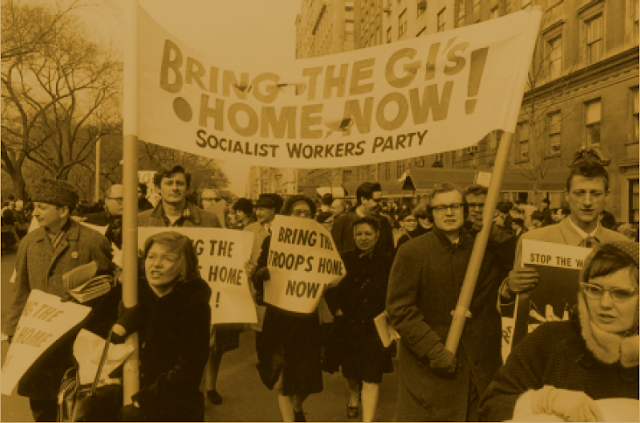
Showing posts with label Socialist Workers Party. Show all posts

Wednesday, December 31, 2025

How Jack Barnes' SWP Tried to Build a Supporters Group in Iran

 By Kamran Nayeri, December 31, 2025


Jack Barnes. Photo credit: The Militant. 

Introduction: On October 2, 1992, I submitted a brief letter of resignation to the Executive Committee of the New York branch of the Socialist Workers Party (SWP):

“Due to the circumstances that I have detailed in my letter to the Political Committee, I find it necessary to resign from the party effective today. I am enclosing a copy of that letter for your information. I am in good financial standing and plan to pay all my pledges to the party on schedule. I am also enclosing my set of keys to the headquarters as well as a key to the bank deposit box.”

I am making the text of that letter public now to shed light on an important aspect of the consolidation of Jack Barnes' cult and the degeneration of the SWP: his attempt to develop followers in other countries, in this case, in Iran (I have slightly edited the text, and I have bolded text for emphasis. The letter is signed as Nader, my party first name; party policy at the time was to use only the first name).

In this letter, I recount how the Barnes leadership sidelined SWP members Amir Jamali, Samad Irvani, and me, while privileging Mahmoud Sayrafizadeh in the party’s work in Iran. Sayrafizadeh and I were former members of HVK Political Committee, Irvani was the organizer of its Tabriz branch and National Committee member, and Jamali was the director of HVK finance.

By the summer of 1982, the Islamic Republic had dealt the final blow to the 1979 revolution by attacking the workers' shoras, arresting and in some cases torturing and executing their leaders. By year's end, practically all socialist organizations had been forced to dissolve, destroyed, or forced into exile.

When I returned to New York in August 1982, I immediately applied to and joined the SWP branch and its Jobs Committee. In addition to my branch activities, I soon began collaborating with Cindy Jaquith on various Iran-related projects. By the end of the fall season, I discussed with Jaquith my desire to return to Iran and rejoin the HVK. After consulting colleagues in Iran, Jaquith advised me not to return. Within a couple of weeks, Jaquith informed me that HVK had been dissolved.

Jacquith and I discussed my intention to return to Iran to continue the effort to build a communist organization there. We agreed that the best course for rebuilding a communist organization in Iran would be for me to remain in the SWP and recruit other Iranians who wanted to do so to the SWP, so that at a more appropriate time, we could return to Iran. Amir Jamali, who visited the U.S. on a personal visit and stopped in New York on his way back to Iran to see me, decided to remain in the U.S. and joined the New York branch. A while later, Samad Irvani, who lived in Vienna, moved to New York to join the SWP and work in the party’s print shop (later he moved to the L.A. branch). 

Our branch activities included taking the party’s campaigns, including selling its literature to leftist Iranians in the New York area.

In 1986, Mahmoud Sayrafizadeh arrived in New York, joined the SWP, and was quickly incorporated into SWP leadership. They even assigned Barbara Bowman to work closely with Allieh, Sayrafizadeh’s new partner from Iran, to recruit her to the SWP. An Iran Committee was formed. Sayrafizadeh’s primary responsibility became Iran work, which now included annual participation in the Tehran International Book Fair and (re)publication of Farsi-language books by Pathfinder.

At the same time, other former HVK members who had been involved in the Iran work were sidelined. All this without a discussion.

To understand the reasons for Barnes’s leadership's differentiated behavior toward former HVK comrades, we should begin with Sayrafizadeh’s history with it. As I have detailed in my political biography of Sayrafizadeh (Nayeri, 2019), he had joined the SWP a decade before the formation of the Sattar League, the Iranian section of the Fourth International. Sayrafizadeh, who came to the U.S. in 1953 to attend college and earned his doctorate in mathematics in Minnesota, was in the same cohort as Jack Barnes and others who formed the new generation of SWP leaders in the early 1970s, when Barnes became National Secretary in 1972.  

Even after the Sattar League, the Iranian section of the Fourth International, was constituted in the U.S. with the help of the SWP, Sayrafizadeh maintained political ties with the Barnes leadership. His appointment to the International Executive Committee (IEC) facilitated this relationship.

I have cited two instances of SWP’s intervention in the Iranian Trotskyist movement, as documented by Sayrafizadeh (Nayeri, 2019). In 1977, SWP leadership intervened to discourage Babak Zahraie’s push to split the Sattar League (Nayeri, 2025, pp. 29-40, pp. 77-88). In May 1982, Sayrafizadeh unexpectedly urged the Political Committee of HVK to organize classes to study Lenin’s strategy for the Russian Revolution! HVK was in crisis, and seven months later, after the authorities briefly detained him, Sayrafizadeh himself proposed its dissolution to the Political Committee, which approved it. It was only after I joined the SWP and participated in the  New York branch’s Lenin classes that it dawned on me where Sayrafizadeh must have received his inspiration to propose Lenin classes for HVK!

The Barnes’s leadership relied on Sayrafizadeh’s political assessment of the Iranian revolution. Thus, The Militant’s reports of the Muslim Students Association's occupation of the universities, purging of students, faculty, and staff that were deemed non-Islamic, the Islamic Cultural Revolution to “cleanse” the universities of non-Islamic influences, which Sayrafizadeh (and Babak Zahraie) supported as an “anti-imperialist advance, were reported similarly in The Militant.

In the late 1980s, I discovered the theoretical underpinnings of Sayrafizadeh’s non-Marxist view of the history of the Iranian revolutions in the twentieth century. In fact, the SWP and the Fourth International had incorporated the non-Marxist Dependency Theory, which was developed in the 1950s and 1960s in response to anti-colonial revolutions. It held imperialism responsible for the backwardness of countries in the periphery of the world economy (Nayeri, 2025, Chapter Eight). Nationalist economists, especially in Latin America, developed Dependency theories. Paul Baran, associated with Monthly Review, developed a “Marxist” version of it (see Nayeri 2023, Chapters 3 and 4 for a critique of these theories). Even Ernest Mandel’s theory of late capitalist development was influenced by Dependency theories (ibid., Chapter 8). Sayrafizadeh’s Nationality and Revolution in Iran (1974) argued that revolutions and counterrevolutions in Iran were centered on the fight against imperialism; he similarly viewed the 1979 revolution through an anti-imperialist lens.

Thus, in the same May 1982 HVK Political Committee meeting, Sayrafizadeh was in the minority of one when he supported Khomeini’s call to continue the Iran-Iraq war to overthrow Saddam Hussein with the slogan “The road to Jerusalem goes through Karbala [a holy Shiite city in Iraq].” The majority of the HVK Political Committee favored ending the war, and six years later, after much bloodshed and destruction, Khomeini himself relented and accepted an end to the war. Thus, Sayrafizadeh reduced the anti-capitalist Iranian revolution to a struggle against imperialism and viewed Khomeini as an anti-imperialist leader.

Sayrafizadeh’s view aligned with Jack Barnes' wishful thinking that to break with SWP’s “semi-sectarian existence” it should break with Trotskyism in hope of becoming acceptable to the Cuban Communist Party that was burdened by Stalinism (See, Nayeri, 2025, Chapter Five) and other political currents including Sandinistas, the New Jewel Movement of Grenada, the African National Congress of South Africa, and guerrilla movements such as the Farabundo Marti Liberation Front in El Salvador to found a new international.

Finally, Sayrafizadeh had a cliquish relationship with Amir Maleki, who also shared Sayrafizadeh’s views on the Islamic Republic and the Iranian Revolution. Thus, Barnes hoped Sayrafizadeh would develop a group that would follow his political whims, as he had with a few such small groups in other countries. As far as I know, almost 40 years later, the Barne group in Iran still only includes Sayrafizadeh, Maleki, and his companion.  

During these four decades, Barnes’s view of Khomeini and the Islamic Republic as the center of revolution in the Middle East has changed radically. He has decided that the SWP’s longstanding view of Israel as a colonial-settler state and imperialist outpost in the Middle East, and the vision of a Democratic Secular Palestine where Palestinians, Jews, and others live as equals, was wrong; that there is no longer a Zionist movement. Furthermore, the SWP now thinks the central problem in the world is rising antisemitism, and Israel must be supported as the only haven for Jews.

Sayrafizadeh’s group in Tehran has followed these twists and turns in Jack Barnes' SWP.

Barnes began his political and theoretical retreat from revolutionary socialism to Zionism by claiming to seek a superior theoretical standing; he justified his denunciation of Trotsky and Trotskyism by asserting that he was a follower of Lenin and Leninism. He then organized leadership schools for SWP leaders to study Marx. How did he end up as an enthusiastic supporter of the colonial-settler Jewish State and the apartheid state of Israel and its ethnic cleansing genocide in Gaza?

The seed of this bizarre course is theoretical. Barnes's leadership precisely normalized Israel when its colonial character had become undeniable. To do so, he broke with historical materialism, colonial analysis, and dialectical thinking on nationhood. I cannot provide empirical evidence, but I suggest that Barnes’ leadership shifted to the right on a range of issues to accommodate his small group of conservative workers whom he sought to recruit.

Sayrafizadeh in Iran faces the same problem; today in Iran, it is the supporters of Reza Pahlavi, the son of the Shah, who was deposed by the 1979 revolution, who support Israel and the United States when they attacked Iran in June 2025 in the 12-day war.

This political degeneration, which began in the 1980s, was accompanied by a degeneration of revolutionary socialists as individuals. Just consider this fact: James P. Cannon (1890-1974) was the son of socialist Irish immigrants who joined the Industrial Workers of the World (IWW) and Socialist Party as a youth and was a leader of the Communist Party and a delegate to the Six Congress of the Communist Interntional who was won over to Trotsky's critique of Stalinsm, expelled with co-thinkers from the Communist Party and founded the SWP in 1938. Cannon was elected as the National Secratary and served in the post until 1953, that is, for 15 years. Farrell Dobbs (1907-1983) was from a working class family. Initially, he voted Republican but during the Great Depression while working for a coal company radicalized, joined the Teansters and helped initiate the general strike in Minnapolis. Dobbs was won over to Trotskyism by Dunne brothers. In 1939 Dobbs went to work full time for the SWP. Together with Cannon, Dobbs served 16-months in jail for opposing the imperialist World war II. His term as the National Secrtary of the SWP lasted 19  year when he retired as Jack Barnes was elected in his place in 1972.  Jack Barnes born in 1940, radicalized as a student at Calton college and quickly became a leader of SWP's youth group. Barnes has been National Secratary of SWP for 53 years! He is 85 years old.  While by all counts the SWP grew and developed under the leaderships guided by Cannon and Dobbs as a revolutionary socialist party, during Barnes' leadership in the last half a century it rurned into a rightist Zionist cult with a tiny follwing. All oppositions to Barne's rightist course have been silenced or expelled. The "ranks" that remain are faithful followers of what Barnes decides.    

My letter to the SWP Political Committee documents how they tried to frame me, an activist in the New York branch for a decade, as “disloyal” to the party, allegedly collaborating with Babak Zahraie, whom together with others fought in 1975-77 and in 1980 for his wrong policies and whom they called “the enemy of the party” as part of their attempt to frame up. My political life as a socialist, which they knew well, would have belied such an accusation. That alone showed how once revolutionary socialists had turned to schemes Stalinist used against their opponents. 

References:

Nayeri, Kamran. “Mahmoud Sayrafizadeh: The Father of Iranian Trotskyism.” Our Place in the World: A Journal of Ecosocialism. 2019.

_____________.  Toward a Theory of Uneven and Combined Late Capitalist Development. 2023. 

_____________.  Between Dreams and Reality: Essays on Revolution and Socialism. 2025.

Sayrafizadeh. Mahmoud, Nationality and Revolution in Iran, 1974. (in Farsi)


*      *     *

                                                                                                            October 2, 1992

Political Committee

Socialist Workers Party


Dear Comrades:

On Saturday, September 12, comrades Norton [Sandler] and Steve [Clark] delivered to me three decisions of the Political Bureau. Since these decisions were delivered verbally, I can only restate their essence.

First, t[Zahraie] he discussion which was opened with your letter [of June 2] is now closed. We had a discussion about Pathfinder’s participation in the Tehran International Book Fair. We are not doing any kind of systematic work in relation to Iran. This is our policy.”

Second, “you have contacted Babak when you were in Iran. This is contrary to our policy as you were warned in an earlier meeting. Babak is an enemy of the party. This is the final warning. Cease and desist from any contact with Babak.”

Third, “cease and desist from any political contact with anyone in Iran. This is the final warning.”

I find the last two decisions and how the Political Bureau had arrived at them outrageous. The first decision, although a prerogative of the leadership, is unfortunate. It is necessary to respond to these decisions of the Political Bureau in writing.

*      *     *

I should begin with the serious assertions of my alleged disloyal behavior towards the party. What circumstances have led our Political Bureau to conclude that I have been disloyal to the party? More specifically, how has the Political Bureau concluded that I have an ongoing political relationship with Babak, “an enemy of the party,” and with other individuals in Iran behind the back of the party?

Norton Sandler. Credit: The Militant


When I asked the latter question of comrades Norton and Steve, they cited as “evidence” my report to the Political Committee regarding my recent trip to Iran. This was drafted at the urging of comrades Joel [Briton], Malamud [Mahmoud Sayrafizadeh], and Norton during our meeting in Oberlin. There is one last paragraph in it, which, according to comrades Norton and Steve, serves as evidence of my breach of party discipline. This is the paragraph:

“There is a specific opportunity which we must pursue. While I was in Tehran, I happened to run into Babak Zahraie, who headed a group that ran Hambastegi publishers Zahraie is now the chief executive of Hafez Computer Services Company in Tehran. Hafez is housed in a beautifully designed building in a northern corner of Tehran. I had occasion to visit the enterprise. It is one of several dozens of computer companies that sprung up in Iran in the recent period. Zahraie told me that they have a 300 million Toman contract with the Ministry of Agriculture to design and develop a computerized project management package for a sugarcane agribusiness in Khuzestan. He offered to give me translations of Fidel and Che in Farsi on computer diskettes (including Che’s writings on the transition period). He said he has retired (meaning from politics).  I deferred taking [the] diskettes to a later date so there be a chance to consult in New York. When I asked about the availability of Trotsky’s writings in Iran, he offered to give me a set of such writings. He showed me a heap of books of Fidel’s speeches and the book on South Africa rotting in his yard. He said there are no markets for them anymore.”

This paragraph was drafted to report two facts that I considered important for the Political Committee to know. First, that Babak Zahraie has “retired from politics” and that he is now in fact a businessman. Second, he has offered to give us some Farsi translations of books published by Pathfinder. It did not occur to me that I was preparing a legal document or one that it could cast suspicion on my loyalty to the party. Still, this paragraph does not state that I have or have had at any time since I have been in the SWP, any relationship with Babak Zahraie. It only says that I had an encounter with him and that I visited his computer business.

Steve Clark. Photo credit: The Militant. 


If someone unfamiliar with my political history and the history of my relationship with Babak Zahraie were to read the above text, I can understand how he/she might misinterpret my statement. But how can our Political Bureau take that paragraph as evidence of my relationship with Babak given their knowledge of the history of my political conflict with Babak Zahraie [since 1976]?

This issue was once raised in a meeting on August 7 in Oberlin, where comrades Joel, Malamud, and Norton were present. I reported the same two facts to the comrades. Comrade Norton raised some general objections along the line that we should be careful in dealing with “an enemy of the party.” I explained to him that my encounter with Babak did not damage the party’s interests. This was a very brief discussion, and no one else appeared to share comrade Norton’s sense of alarm. No one, including Comrade Norton, discussed any party policy that barred contact with Zahraie or anyone else. No one suggested that I had violated any party instructions. Comrade Joel thought that there might be some merit in considering Babak’s offer of the Farsi translations. I assumed the matter to be closed.

In my written report to the Political Committee, I did not seek to offer a detailed account of my encounter with Babak. Still, in the cover letter to my report to the Political committee dated August 20 and addressed to the same comrade Norton, I wrote: “You might also find that the composition [of this report] is somewhat rough. I had to prepare for this in a rush while events remained fresh in my mind. Meanwhile, we have been rather busy with petitioning in New York, as you well know.”

Anyone who has read the 15-page report can testify that it was prepared in a bit of a rush. There are grammatical errors, even misspellings, including in the same now “incriminating” paragraph. My attention was focused on reporting what, in my opinion, was politically significant, and I refrained from addressing what I considered side issues and matters of style.

However, I also wrote to comrade Norton that “I would be glad to clarify further any issues that are discussed in this report or you might think I possibly know but have left out.”

If anyone was alarmed by my possible breach of the party’s discipline based on my own volunteered statement, was it not a bit rash not to have asked me in for an explanation before

branding me with a violation of party discipline?

I encountered Babak Zahraie while visiting a friend’s rented music studio in Zahraie’s parents’ basement. As the building door opened, Babak walked out. This was my first encounter with the man in more than 11 years. Surprised, he greeted me and began talking.

He asked about [Mark] Curtis’ parole, told me that he is now in the computer business, and, pointing to a large stack of books in his parents' yard, he explained that there is nothing he can do with them anymore and offered to give us Farsi translations of many works on computer diskettes. This encounter lasted perhaps ten minutes. He also offered to visit his computer business to examine the purchase of his company's Farsi word processor, Aassannevis.

A few days before my return, I did go to his business office to examine their word processor. I had been shopping for one and found it reasonable to consider their product as well (which as I discovered was non-existent).

I decided not to pursue Babak’s offer of digital copies of translation of books (whether genuine or fraudulent) until we have had an opportunity to discuss it in New York.

I did, however, inquire about the availability of Farsi editions of Trotsky’s History of the Russian Revolution and The Revolution Betrayed. Comrade Malamud had recently asked me whether I knew of sources for obtaining copies of these books. 1 had searched many bookstores in Tehran for them. They were not available. Babak offered to give me these books. I told him to leave the books with my friend, who rents a space in Zahraie’s parents' house. As it turned out, I was unable to receive this book. I left Iran a few days later.

This is the full extent of my meetings with Babak Zahraie in the past 12 years. There has not been any ongoing relationship for me to cease and desist from. There has not been any violation of the party’s interest or security.

Did I breach the party’s discipline in these encounters? The Political Bureau should think so, judging from its second decision cited earlier.

Comrade Norton appeared to assert that, in the June 24 meeting, I had been warned not to meet with Babak. Comrade Steve suggested that there is a party policy on this matter. Obviously, if I were warned not to contact Babak, and if there is a party policy that instructs party membership not to contact Babak, then I am guilty of disloyalty. I would suggest that disciplinary action may be warranted to protect the party. However, I contend there is no basis for either claim.

First, the only meeting I had with any party leadership before my trip to Iran was with comrades Greg [McCartan] and Malamud on June 24. I do not recall either of them telling me not to meet with Babak or anyone else specifically (I rely on my rather extensive notes from that meeting, which I put to paper later that same night). Furthermore, there was no discussion of any policy regarding Babak. And why should the party leadership have felt a need to have instructed me as such or organize a discussion on such an alleged party policy? Were there any grounds to believe that I had had any contacts with Babak before or any suspicion that I might have one in my trip to Iran?

In that meeting, however, another discussion developed. I asked whether there was anything I could do for the party during my visit to Turkey and Iran, such as newspaper clippings and other materials for an article on the recent riots in Mashhad, Arak, Shiraz, and elsewhere [in Iran]. This question seemed to have irritated comrade Greg, who raised his voice to instruct me: “You will not do anything political in Iran!” I found this difficult to understand. I asked: “Would you ask the same of a comrade who travels to Canada?” Comrade Greg did not respond. Comrade Malamud changed the tone and offered an explanation: “You should be careful, next to South Africa, Iran is a very unstable place.”

I explained to these comrades that as a political person [it was basically to visit my family]. Still I will be political wherever I go, especially in Iran. My trip was on my own initiative and not on behalf of the party. I was not assigned to go to Iran, but my trip (the second in ten years) would not be for leisure either. I very much wanted to learn about political life in Iran, as I am sure any communist would, especially those who wished to one day return there to help build a communist party and participate in another revolution.

Thus, comrade Norton’s claim that I was told not to meet with Babak before my trip is simply false. Perhaps he wanted to say that I should not have acted politically, as comrade Greg seemed to have asked at one point during our meeting. Assuming this is what comrade Norton might have had in mind; he should know that I was not by any means unambiguously instructed as such. In fact, during a happier moment of our conversation, comrade Greg suggested that if an opportunity arose, I should get subscriptions to The Militant or seek support for Mark Curtis’s fight.

How about the second concern: the party’s decision to bar contacts with Babak, the enemy of the party?

The only party directive that I can recall in this relation dates to 1983. At that time, a member of the Revolutionary Workers Party (HKE) named Khalil was in New York. He approached the party to help him organize a defense committee for Babak, who was a political prisoner in Tehran at the time. The party leadership correctly decided that there was no objective basis for a broad defense effort in the U.S. at the time, and that Khalil's proposals would harm rather than help the cause of the Iranian revolution and the defense of Zahraie. We had written about the case and we had gotten a few prominent individuals to write letters of appeal for Babak’s release in the framework of the defense of the Iranian revolution, which was under attack by the U.S. government.

Khalil and the HKE leadership, however, decided to go ahead with their plans. He contacted several organizations in New York, presenting his case as if it had the SWP's support. Once we learned about this, the party leadership decided to educate the ranks in the branches affected or potentially affected by the HKE's campaign and to centralize our relations with Khalil and HKE. This was a brief episode; Khalil’s activities dwindled quickly. The HKE as such was dissolved. Some of its former members founded a publishing house called Hambastegi, which published a few books of speeches by Fidel Castro and Sandinista leaders, and Nelson Mandela and Oliver Tambo on the struggle against apartheid in Southern Africa. This activity also ceased a few years later. As I have reported to the Political Committee, Zahraie, who was released from prison some four years ago, has started a computer business which he runs with others including former his former political associates. The fact that a group of former HKE leaders and members still hang around together does not make their enterprise political but merely reveals the personal nature of their long-term relationship.

The 1983 party’s directive, then, was not a ban to talk to Babak “as the enemy of the party” in the abstract but a decision to protect the party against a specific hostile campaign by an opportunist organization. I am not aware of any further encounters the party may have had with Zahraie (other than our carrying Hambastegi publications in some of our bookstores) or any subsequent decisions made to protect the party from this individual.

Any reasonable comrade who assesses the nature of my encounter with Babak and the nature of the 1983 decision will find that I have not violated any party directives or communist norms. The world has changed a lot since 1983. The HKE anti-party campaign is long dead. Khalil, who decided to remain in New York, became involved in solidarity work for Nicaragua, and comrades of the (now-dissolved) Brooklyn branch sold The Militant to him for a brief period. The party recruited at least two former HKE members. One of them, who was a member of the New York branch for a brief period, still held the HKE's general views. One of Babak’s brothers, who did not hide his sympathy for the HKE (as it once existed), attended the New York Militant Labor Forum for an extended period of time. Here in the New York branch, we have not had a policy of rejecting contact or political discussions with former HKE members. Babak has turned his talents to business, which I have long considered more in line with his character. My encounter with him was as brief and businesslike as I have described.

I should briefly address the other assertion by the Political Bureau: that I have had political relations with others in Iran behind the party's back. Comrades Norton and Steve did not offer any evidence of such disloyal acts. 1 feel compelled to deny such a charge and cite for the record a case that illustrates my disciplined conduct.

A few years ago, I met an Iranian supporter of the party in Los Angeles during a party conference in Oberlin. We discussed Guevara’s ideas on the transition to socialism, particularly the distinction between religious and materialist approaches to volunteer labor. She remained a supporter of the Los Angeles branch for a period, left for Europe about two years ago, and finally moved back to Iran.

During this entire period, she wrote me a few letters. Until recently, these letters were sent to the New York SWP headquarters. Before she left for Iran, she wrote me a letter from Spain asking whether the SWP has any co-thinkers there with whom she could collaborate. I raised this with comrade Malamud, a member of the Iran Committee, and upon his suggestion, translated the letter into English and sent it to that body for instructions. Comrade Malamud later met with me to inform me that the Iran committee believed we should not pursue any political relations with this individual. I complied. At first, I decided to restrict my correspondence to her to non—political topics, i.e. issues of history, economics, and culture. However, because she continued to write to me about political matters, I was forced to discontinue all communication with her. She wrote twice since, and I have not responded. She also called me from Spain once, and I did not return her call. I have not seen her since our original meeting in Oberlin a few years ago, including on my trip to Iran.

There is therefore not a grain of truth to the assertions of the Political Bureau about my alleged disloyalty to the party.

Comrades who attended the August 7 meeting in Oberlin, including comrades Malamud, who had also attended our June 24 meeting, should remember that no one suggested that I had been told before my trip to Iran not to talk to Babak or any other individual.

These comrades, including comrade Norton, should also recall that we did not discuss any party policy that barred such contact with Babak or anyone else in Iran. As of this writing, no one has discussed any specific party policy with me, despite my having been served a final warning to cease and desist from such contacts. No one, including comrade Norton, has explained to me why there is a sudden alarm about Babak or why, specifically, this individual is deemed “the enemy of the party!” Bearing this in mind, the worst possible scenario is that there is, in fact, a party policy against speaking with Babak (or others in Iran) and that I have inadvertently violated it. What would be the normal leadership response? In any ordinary circumstance, such a situation calls for a comradely effort to explain to me whatever decisions the leadership might have made which I should have known about and an explanation of how my actions might have endangered the party’s interests. This should be sufficient in any normal circumstance.

The decisions of the Political Bureau, the way they were reached and delivered, however, indicate a different course. They reveal a certain lack of comradely trust and respect, a course which has been based on the conviction that I have been disloyal to the party for a period; that I have had ongoing political relations with Babak Zahraie, and that 1 have had ongoing political relationships with others in Iran behind the back of the party.

How and when the party’s central leadership has arrived at such an estimate of my political character and conduct is unclear to me. There certainly were never any discussions with me to ask straightaway about any of this,

While I have no explanation for the conduct of the Political Bureau, it is abundantly clear to me that similar leadership conduct has contributed to my failure to seek and secure a candid discussion with our party leadership on the task of building a communist organization in Iran. Instead of a productive political discussion that could lead to greater clarity and improved collaboration, I can only report a pattern of erratic conduct and hostility by the party leadership toward me. The decisions of the Political Bureau then come as the culmination of a process which began nine months ago.

*     *     *

In early January I asked Comrade Malamud, then the organizer of the Iran Committee, for a discussion about party’s thinking on how we can help to build a communist organization of Iranians. 1 did not know whether this request would fall in the domain of responsibility of the Iran Committee. I only knew that for any work concerning Iran, I had been asked to write to that body.

I also told comrade Malamud of my plan to travel to Iran in the summer of 1992 and explained that I would be happy to carry out any assignments in this trip. Comrade Malamud agreed to have such a meeting at a later date when he would have more time. This took us to late April. Once or twice, I reminded comrade Malamud of my request, and each time he delayed the meeting to a later date when he would have more time. He told me on one occasion that I should go ahead with my trip “because the Political Committee is too busy to discuss this issue at the moment.”

One day, during a late April Pathfinder Building mobilization, on a lunch break, I asked comrade Malamud about our long-postponed meeting. He replied that he had thought the matter over and that he is not qualified to meet with me. He recommended that I talk with my branch executive committee organizer. I found this somewhat perplexing. Why a four-month delay in coming to this conclusion? Is the Iran Committee not the national leadership body to contact regarding these issues? If for any other work concerning Iran I was told to write to this committee, why should I be referred to my branch executive committee organizer to discuss party’s perspective in helping to build a communist organization in Iran?

This is why I wrote a letter to the Political Committee on June 2. The letter said: I am very much interested in understanding what leadership attention is given to the problem of the development of a communist nucleus of Iranians by the SWP and our world movement. I am aware that the party has had a functioning Iran Committee for several years now. However, I am not sure what those functions are and how they are intended to help in the reconstruction of a communist organization of Iranians. I would therefore like to request a discussion on these issues with an appropriate leadership body of the party.

There was no response for 22 days. Then, just two days before my trip to Iran, comrade Malamud asked me to meet with him and comrade Greg.

The meeting took place in a bar and lasted two and half hours. We discussed the nature and role of the Iran Committee, exchanged some opinions on the perspective of building a communist organization in Iran, Pathfinder’s participation in the Tehran International Book Fair, and my impending trip to Iran. Although the topics are impressive the meeting was not.

In his opening remarks, comrade Greg talked about Pathfinder’s participation in the Tehran International Book Fair. He said that he was aware of the opposition to the trip by “the Iranian comrades.” These remarks seemed to place at least three comrades, Amir, Samad, and me into a common category of the opposition. I explained that I welcomed Pathfinder’s participation in that the Tehran International Book Fair. I stressed, however, that it does not seem strange if Iranian comrades with a history of struggle to build a communist organization in Iran may have strong opinions on this. However, to my knowledge, their views are neither uniform nor representative of any group. These comrades have joined the SWP without making a secret of their aim to work towards rebuilding a communist organization in Iran.

They have joined precisely because they were convinced that steps towards rebuilding a communist Iranian nucleus are best taken in the context of building the SWP. Their participation in any step taken under the direction of the party leadership towards that goal is not contrary but, in fact, part of their participation in building the SWP and our world movement.

Comrade Malamud found this view unacceptable. He counterposed another view. First, to build an Iranian communist organization, one has to become a communist. That requires one to give up all national identities, including political ones. It follows that to build the Iranian movement one needs to build the SWP. In due time, SWP leadership will assign specific Iranian comrades to go to Iran and carry out political work in Iran. Second, the party recognizes only Iranian communists who are already in Iran. (He later conceded that there were no Iranian communists in Iran today) .

What did comrade Malamud mean by this line of abstract deductions? First, did he imply that members of the SWP who are of Iranian origin--i.e., they are of an Iranian origin with specific life and political experiences-- are not communists? Did he mean that they should somehow go through a process of cleansing themselves of such national and political experiences?

I most certainly believe that building any existing communist organization, especially the one in the United States would help the future Iranian communist organization and revolution. But it was not my position but comrade Malamud’s that seemed to counterpose these two revolutionary tasks for those of us with a history of party building in Iran and a well-known ambition to continue that fight despite the immense roadblocks created by our class enemies. I do not think we have a problem with Iranian comrades not participating in the building of the SWP. Do comrade Malamud and the party leadership think otherwise?

The idea that building an independent communist organization in Iran is the task of the SWP leadership was a new one for me. While the role of the Socialist Workers Party, given the historical evolution of the communist movement, is essential to this process, our movement has always believed that the task falls to the revolutionary workers and youth of each country to forge their own organization.

Finally, I do not doubt that the future Iranian communist party will have to be built inside Iran. However, given the fact that it has not been possible to function as communists in Iran since 1982, and a few of the former leaders and cadre of the Iranian movement are today abroad and in the SWP.  How are we to move forward towards that goal? Are we asking these comrades to cease and desist from thinking about this task and wishing to be a part of the discussion on this issue? Are we to tell them, as comrades Malamud and Greg told me, that they are just like any other comrade in the party who is equally concerned about this problem and equally involved in helping to solve it. Is this not a refusal to move from an abstract non-discussion to a concrete discussion?

Our movement has a proposal for communists in countries with a bourgeois democratic regime, a trade union movement and a working class that can read English. What is the proposal for communists who are from countries with no bourgeois democratic openings, no trade union structures, and a working class that does not read European languages?

The substance of comrade Malamud’s argument aside, I was very much disturbed by his condescending tone as well as the implications of comrades Greg and Malamud that there is an unprincipled opposition in the party of “Iranian comrades,” which has manifested itself around the Pathfinder’s participation in the Tehran International Book Fair. This tone and this implication were serious enough to prompt me to ask these comrades whether they had any doubts about my loyalty to the party. They said they did not.

Similarly, there were other political issues that were raised during this meeting but not pursued and adequately explained. For instance, comrade Greg said that the Iran Committee was simply a way of recruiting former members of the Iranian communist movement and other Iranians to the party. But this contradicted my own experiences with the Iran Committee which tended to concern itself with any aspect of our work with Iran.

As for my trip to Iran, which was raised with the party six months in advance, I found a total lack of interest by the comrades and even some hostility from comrade Greg. He first argued that the leadership has learned of it too late to have any proposals. Later, he prohibited me “not to do anything political in Iran.” And, finally, he suggested that if I could get Militant subscriptions or support for Mark Curtis’ fight, it would be O.K.

When I returned from Iran, just before the Oberlin conference, comrade Mary from the National Office informed me of plans for a Political Committee-initiated meeting during the conference, which would include comrades Amir, Malamud, Samad, and me. The letter was written by comrade Norton on behalf of the Political Committee, dated July 20, and appeared to have been written in response to my June 2 letter. It proposed to have a meeting “to discuss the political situation in Iran and the surrounding region and the party’s propaganda work, including the recent Pathfinder sales trip there.”

While the meeting’s proposed agenda did not include an item on the party’s views on how to help build a communist organization in Iran, I was delighted by the Political Committee’s decision to convene this meeting. It represented, I believed, a positive turn in the situation arising from our June 24 meeting. I thought it was a significant step forward to involve Iranian comrades in thinking out the political situation in Iran. This would be an essential part of the discussion of our tasks towards building a communist organization of Iranians.

This meeting took place in Oberlin on August 7. Comrades Joel, Malamud, Norton, Samad, and I attended it. Comrade Amir was invited but was out of the country and unable to participate in.

Unfortunately, we did not get a chance to discuss the political situation in Iran and the surrounding region, as promised in comrade Norton’s letter. Instead, the bulk of the time was devoted to a debate of differences, perceived or otherwise, with comrade Samad on the way Pathfinder’s participation was organized. Although there seemed to be a difference of opinion on the tactics, I tend to think that the contentious tone of the discussion exaggerated the arguments made by the comrades involved. More important, however, was a total disregard for the fact that any discussion of tactical issues, like the Pathfinder sales effort, must take place within a general agreement on the political situation in Iran and the tasks we hope to accomplish. These, of course, were not discussed in our meeting.

During the over two-and-a-half-hour meeting, I found it necessary to speak for no more than 20 minutes. Once, I offered a summary of my impressions of political life in Iran. Another time I spoke about Babak’s proposal. 1 also expressed my disappointment that no time was devoted to fill in some of the gaps in our understanding of the situation in Iran. We could have also used a discussion on how to proceed with the task of helping to rebuild a communist organization of Iranians. This discussion was initiated in our June meeting and needed to involve comrades Amir and Samad.

At any rate, while the meeting was not very productive, it was a positive step by the party leadership. I hoped that, in the future, a similar leadership initiative might be undertaken to help involve these comrades in our Iran work.

I do not need to say that these hopes were proved futile. On September 12, 1 was called in to receive the Political Bureau’s decisions, which closed the discussion and branded me as a disloyal member of the party.

This episode, which began with my request in January to meet with comrade Malamud to discuss the party’s perspectives on how to help forge a communist organization of Iranians, has now ended on September 12. My balance sheet of this experience is that the leadership has proved (at best) hesitant to have a discussion with me (or other comrades in a similar situation) on this question. During the entire nine-month period, I was given the run-around, told conflicting statements, promised unmet agendas, received with indifference and even hostility, and never actually provided with a cordial discussion of the issue. This conduct of the party leadership has actually hurt my pursuit of political clarity. Thus, today I remain faced with more questions about the course of our leadership than I did nine months ago.

Other issues have arisen. How can I interpret the party leadership's conduct? Why has our party leadership displayed such a hostile attitude towards me?

*     *     *

I joined the party 10 years ago. I had just resigned from the Workers Unity Party (HVK), our sister organization in Iran, a few weeks earlier, where I had been a member of its Political Committee since its founding. I had resigned because of problems of a personal nature, including a period of struggle with depression. These problems made it increasingly difficult for me to function effectively in the best interest of our party In retrospect, it is clear to me that I was not alone in experiencing such difficulties. At least five other members of our National committee of fifteen visited psychoanalysts and a few others probably needed professional help. These problems were related to the deepening crisis of the Iranian revolution and its impact on our small and weak organization. Soon after its founding we began to experience a deepening crisis in our leadership. At first, this took these took the form of organizational disputes. Political differences began to appear. Leadership’s capacity to respond to events was gradually reduced.

Communist norms of functioning began to break down in the organization. Finally, the very same political tendencies that we had fought against as we founded the HVK—ultra-left sectarianism of the Socialist Workers Party (HKS) and opportunism of the HKE —surfaced in our Political Committee. I found myself increasingly unable to confront these problems. I therefore explained my situation to the HVK Political Committee a year earlier and submitted my resignation to the party’s plenum in July 1982.

I joined the SWP in September of 1982 and immediately went on the Jobs Committee. My health improved substantially in New York, and I decided that I can return to Iran to rejoin the HVK.

The party leadership, aware of my intentions, contacted the HVK leadership and informed me that comrades in Iran had advised against my return. A couple of weeks later, I was also informed that the HVK had been dissolved. This was in January 1983.

I agreed with the party leadership that the best way I could contribute to rebuilding the Iranian communist movement was to remain in the United States and continue as a member of the SWP.

In addition to my regular branch activities, I was also asked to contribute in various capacities to the party’s work regarding Iran. The nature of these assignments changed. Earlier, I was involved in discussions that led to tasks. Later, I was simply given assignments to carry out various decisions the party leadership bodies had agreed upon. The objective conditions for rebuilding HVK or a new communist organization did not improve over time. The revolution was in decline, and the working class was in retreat. My best hope was to help preserve our revolutionary continuity by grouping former HVK leaders and cadre who still held a communist perspective. I hoped this would place us in a position to help build a communist organization in Iran as soon as opportunities presented themselves. The best way to do this, I believed, was to ask any revolutionary-minded Iranian to join the SWP or our sister organizations elsewhere in the world. This would provide us with ways and means to participate as communists in world politics. At the same time, we could have a chance to reorient and reorganize ourselves to help rebuild a communist movement in Iran. This appeared to be the only way to maintain the continuity of the communist continuity in Iran. I simply assumed that the leadership of the SWP and our world movement would play an indispensable role in the collaborative effort to think through politically the difficult process that lay ahead. There was significant progress along these lines. We recruited three other former leaders and cadre of the HVK, as well as a few other Iranian revolutionists. There was now a small number of communists who hoped to build an organization in Iran.

There was a qualitative change in the party’s work regarding Iran when comrade Malamud joined the party some five years ago. He was soon nominated and elected to the National Committee. The party created the Iran Committee, and comrade Malamud became centrally involved in its work. He was also assigned to follow the course of the Iranian revolution, to write articles for The Militant on the events in Iran, headed up Pathfinder Farsi publication project, to carry on his study of the 1946 Azerbaijan revolutionary government, to offer class series on the Iranian revolution and the history- of the communist movement in Iran, to represent Pathfinder at the Tehran International Book Fair, and most recently to tour the U.S. educating the party and its supporters on the history and politics of Iran and the surrounding region, as well as many other similar projects.  I think all this helped the party as well as the more distant aim of building a communist organization in Iran.

However, the decision to involve comrade Malamud and, indeed, to identify Iran's work with him has also coincided with a a decision to exclude other former HVK cadre from this aspect of party work. To avoid a possible misunderstanding, by the word policy. I mean it as a mode of conduct rather than a well-worked-out, deliberate plan. There is plenty of evidence for the former, and I have no way of knowing about the latter. Furthermore, I should also explicitly state that this work has been done and should be done under the direction of the elected leadership of the SWP and our world movement.

But I will think it is an instance of formal thinking if we conclude from this that former HVK cadre who are not represented on these leadership bodies must be excluded from discussions of our Iran work. There is no doubt in my mind that this formal and mechanical mode of conduct has prevailed in our party leadership and has led to confusion, estrangement, and further political mistakes. Let me offer a few examples.

Consider the case of the Pathfinder’s sales trip to Iran. The it was conducted reflects a certain ambiguity on the part of the leadership in handling Iran's work and a problem in their attitude towards comrades who were former HVK cadres in the party.  One day, comrade Malamud called to have lunch together. During lunch, he announced plans concerning the Tehran International Book Fair. I was glad about this decision, which I considered to be a bold move. I obviously had many questions about the trip, but I did not raise them. And why should I? I have never been interested in hallway discussions of serious political issues. If the leadership had considered my views on this question necessary, they would have called upon me to be included in the discussions leading to the decision. I only expressed some concern over the safety of the comrade involved. As I learned later, comrades Amir and Samad were also approached to be told of this decision. But why? Why was it necessary to tell these three specific comrades about this decision? Are they different from any other members of the party? (We remember, only two months later, the same comrade Malamud attacked my proposal to include these three comrades in the party’s Iran work as somehow not communist and asked me to rid myself of national and political identities.) And if they are somehow considered a special category of comrades, what kind of category are they? (We again remember comrade Greg and Malamud called these comrades the opposition to Pathfinder’s participation in the Tehran International Book Fair) . If the leadership thought these comrades might have a particular (communist) interest in the matter, would it not be better to get them involved in such work and benefit from their opinions and experiences? Would it not be a better way to integrate them into the SWP (which seems to have been of some concern to our leadership)?

This policy of exclusion has been combined with political indifference and carelessness. I cite just one example. There are others. In 1988, The Militant carried a review article on the Iranian revolution, which asserted that the character of the 1979 Iranian revolution was democratic and the Shah’s regime was landlord-based. This represented a clear revision in our movement’s characterization of that revolution as anti-capitalist and the Shah’s regime as capitalist. This change was proclaimed and has never been explained to date. I immediately wrote a letter to the Militant editor asking for an explanation and offering some of my own thoughts on this question. I was told that a meeting will be organized to discuss the issue. That meeting never took place. There has never been any written explanation of this change. At the same time, comrades, including comrade Malamud, have presented similar views on various occasions. In his speech at the New York Militant Labor Forum last spring, Malamud claimed that the bourgeois-democratic tasks of the Iranian revolution were largely completed in the early months of 1979. He therefore took the earlier revision a step further. In our June meeting, I asked him about this. He told me that this was also Lenin’s opinion of the Russian revolution in April 1917! The tendency to model the Iranian revolution of 1979 on the Russian revolution is evident. But the differences far outweigh the similarities. Lenin’s statement, as we have learned in our study of Lenin as well as of Trotsky’s The History of the Russian Revolution was meant to win over the Bolshevik leadership and ranks to the perspective that the new reality of the workers’ and soldiers’s soviets posed a situation of dual power, an alternative power of workers and peasant alliance, that can and should take power into its own hands from the coalition of Menshevik and Social Revolutionary compromisers and the bourgeoisie: a realizable task as it was ultimately accomplished in October thanks to the now reoriented Bolshevik leadership. It was in this sense that we have understood Lenin’s argument that “bourgeois democratic tasks” of the Russian revolution were accomplished by April of 1917. Historical bourgeois democratic tasks of the revolution were carried out after the October revolution. Could comrade Malamud find an analogy between this situation and the 1979 Iranian revolution? Was there any form of dual power in place in Iran in the early months of 1979 or at any time after that? Was the February 1979 revolution similar to the February 1917 revolution in terms of its leadership? Was the transfer of power from the Shah’s regime to the Khomeini-Bazargan coalition government similar to the fall of the Tsarist regime and transfer of power to the Russian bourgeoisie through the medium of the compromisers? Which one of the historic bourgeois democratic tasks of the Iranian revolution was actually accomplished in the early months of 1979, and under whose leadership?

What is at issue here is not, of course, whether comrade Malamud or The Militant are wrong in their views, although I think they are. Here we are concerned with the party leadership’s method. It is politically counter-productive to float such important revisions in the party without an adequate (written) explanation and discussion. And this has not happened yet. I would very much welcome such a discussion. In fact, I would favor a critical re-examination of our entire experience in Iran. But it is precisely this discussion that has been postponed not only in the party but also with comrades who lived through that experience. I think the party as well as our entire movement can benefit from a serious discussion of the character of the Iranian revolution and its history, as well as our successes and failures to build a proletarian communist organization in Iran, as we have learned from collective discussions around revolutions in Grenada, Nicaragua, and South Africa (I do not wish in any way to ignore the leadership differences between the Iranian revolution and these revolutions. Still, there are valuable lessons for us in the Iranian experience).

Thus, I welcomed the decision by the party to print HVK’s position on the Iran—Iraq war in the New International number 7. I was glad to see that the party has organized a class on the history of the Iranian communist movement during the 1990 party convention in Chicago. I thought comrade Malamud, a founder of that movement, could illuminate important aspects of our experience for the party. I attended it myself with an open ear to learn a thing or two (We had never any occasion to discuss our past common party building experience together since we moved to the U.S.) . However, I found, to my surprise, comrade Malamud’s presentation factually deficient and politically mistaken. He left out entire aspects of our experience in which he did not participate, or where he did participate, that proved a mistake. For instance, he excluded the first political crisis in HKE entirely: the wholesale expulsion of 24 leaders and members of the HKE, who had just organized themselves in the Faction for Trotskyist Unification (FTU), in the Spring of 1980. They were, in the majority, workers, members of oppressed nationalities (i.e., the entire Tabriz branch), and youth recruited in Iran. Indeed, comrade Malamud did not agree with these comrades at that time when they protested HKE’s support for the Islamic Cultural Revolution, a fancy cover for purging the universities of opponents of Khomeini’s regime, which led to the closing down of the university for over two years and eventually destroyed all independent student organizations. But comrade Malamud later reversed his position and voted with the SWP leadership and the entire United Secretariat of the Fourth International to condemn these expulsions, and called on the HKE leadership to reverse them.

Comrade Malamud’s presentation also did not include any discussion of the HVK crisis. We were told that the HVK, led by a self-confident communist leadership, dissolved in the face of government repression. In fact, the HVK was destroyed as a communist organization well before its formal dissolution.

Again, what is at issue is not the inadequacy of comrade Malamud’s presentation. Our leadership’s policy has led to a situation in which it has become natural to view comrade Malamud's views on Iran as the party's official views and the voice of the communist experience in Iran. In our June meeting, when I expressed differences with comrade Malamud’s presentation on the history of the Iranian communist movement, comrade Greg found it necessary to tell me that I have therefore disagreed with the party leadership’s view of that history. But how could we have an official view of the experience to build a communist party in Iran? There are histories that we read, recommend, and promote, such as Trotsky’s The History of the Russian Revolution or Cannon’s various writings on the history of the communist movement in the U., S. But none of these are official histories of our class or our movement. They are authoritative histories written by leading participants, which we think actually reflect a communist appraisal of our class and our movement. What is more, these histories have emerged from discussion and debates and are based on documents. Comrade Malamud’s history has yet to be presented in written form. Why should we rush to make it the “leadership view” and “official”? Has there been any discussion in the party leadership on the experiences of the Iranian communist movement? If so, why have there not been any attempts to involve other comrades in the party who were leading participants in this experience?

These are just a sample of problems with our leadership’s conduct of our Iran work over the years. The party has taken a few important steps in its Iran work as I have already acknowledged. But the party leadership has increasingly excluded me (as well as other comrades) from participating as equals in this work. Comrade Malamud and other comrades in the party leadership have been aware of at least some aspects of this problem. I for one have raised some of these with comrades as they have occurred. But there have been no steps taken to correct or at least explain this course. In fact, my search for a discussion of this problem has led not to a comradely discussion but to an increasing level of hostility from leadership. The situation, therefore, has taken a turn for the worse.

*     *     *

I am faced with the following situation. First, the party leadership has increasingly excluded former HVK cadre, who have joined the party with an explicit intention to help build an independent communist organization in Iran, from our systematic Iran work. Second, in the past nine months, I have sought without success to gain an opportunity to discuss with the party leadership our approach to the building of a communist organization in Iran. Third, I have been subject to a pattern of indifferent, even hostile conduct that is not compatible with comradely relations based on mutual trust and respect. This has accumulated in the three decisions of the Political Bureau delivered to me on September 12.

What is to be done? Could I simply close my eyes and pretend the whole thing has just been a nightmare? Twice, in our meetings, it has been suggested to me that I could write about any of this in the party’s preconvention discussion bulletin. This would seem as reasonable as self- evident. However, this suggestion overlooks a fundamental fact: our leadership has systematically refused to address the issues in dispute. The party leadership has not documented its reasons for its revision of our earlier positions on the character of the Shah’s regime and the Iranian revolution. Comrade Malamud has not yet written anywhere about his history of the Iranian communist movement. The party leadership has not offered its views on how comrades like myself could go about the problem of building a communist organization in Iran while building the SWP in a written form or otherwise. Thus, to ask me to write in the preconvention discussion bulletins about my differences with the party leadership on any of these questions place the burden of what the leadership’s responsibility on the shoulders of a comrade who has approached the leadership because he did not know of their views (he obviously considered it essential to consult)!

In fact, the character of this letter (indeed, the letter itself) has been imposed on me precisely because of our leadership’s default to lead on a complex question. It is this leadership default that has forced me to document the verbal, erratic, and hostile conduct of what could have been a fruitful discussion. I hesitated to write this letter precisely because I had to cite comrades' verbal statements from such meetings. This is a daunting task, partly because of possible excesses on the part of comrades involved, which are inherent in such situations, and partly because it places undue responsibility on me to represent (as accurately as possible) the content and form of comrades’ views and actions. These are rather unusual circumstances in any communist organization.

Furthermore, if the party leadership has displayed such a lack of interest, indeed hostility, in dealing with this issue so far, how can I hope to have a better response from them in the discussion bulletins? Would there be a dispute on exactly what any given comrade said and did in this rather complicated process? Who would the party believe? Its leadership or a comrade who has been accused of disloyal conduct by its leadership. And how about my own sense integrity and self— respect? How about mutual trust and respect, the bedrock of any communist collaboration? This is a tall order that certainly inhibits anyone from taking the issues to the party. Let us not forget, I have been after political clarity and collaboration on how to move in the direction of building an independent communist organization in Iran not polemics with the party leadership or undermining its authority.

Finally, if the Political Bureau's first decision stands, then we are not doing any systematic work regarding Iran. This is our policy. This ends the discussion. Should I protest this decision?

I do not believe I should. The central task of any communist party is to help the entire class lead the revolution and transformation of society and economy. The coming revolution in the United States remains the central concern of the SWP. As an internationalist party, the SWP would help, if requested and possible, with the process of formation of any sister communist organization, including one in Iran. Meanwhile, building a communist organization in Iran remains the task of Iranian communist workers and youth.

In 1983, I, along with the party leadership, believed it was both possible and fruitful to devote some party resources to ongoing collaborative efforts to rebuild our fractured movement in Iran. I had been convinced that our experience as Iranian revolutionaries who organized ourselves separately from the SWP in the United States in the 1970s had reduced our participation as communists in the living U.S. politics to a minimum. This fact hurt our own goal of building a communist organization in Iran. It was on the basis of this experience that I supported the idea that all communists in the U.S. should join the SWP even if they belonged to other revolutionary organizations (e.g. the African National Congress) or even if they hoped to work towards building an independent communist organization in some future date (e.g. Iranian communists who live in the U.S.).

Ten years later, however, I am unsure if this experiment has proved successful. I have learned a great deal through the party’s participation in many struggles in the U.S. I have learned a lot about the party and how it functions. It was my first experience in a proletarian party with fractions active in major unions (Our experience in Iran with the turn was different in many ways and we have never drawn a balance sheet of that experience). These have been rich experiences that far supersede my earlier opportunities to learn about proletarian communist organization and politics.

I have identified myself and my political life with that of the party for the past ten years; serving as a consistent and reliable foot-soldier of the New York branch: taking part in every party campaign, a regular in branch meetings, plant—gate sales, circulation drives, weekly forums, financial efforts, Pathfinder Mural security, the fight to win justice for Mark Curtis, and so on. And yet, it seems the leadership does not view me as a fully qualified SWP comrade. This was implied in comrade Malamud's abstract deductions in our June 24 meeting, and comrade Norton explicitly suggested it in our September 12 meeting. In that meeting, faced with evidence of further leadership hostility, I asked comrade Norton and Steve what the party leadership suggests I should do, as I am not interested in challenging the leadership but in seeking its advice and collaboration. Comrade Norton offered his advice: “Integrate yourself in the party.” This in fact goes to the heart of the matter. I should have asked him exactly how. What does it take to satisfy comrade Norton and our leadership that I have passed the test and could finally be considered “an integrated member of the SWP?” How long has our leadership considered me “not integrated in the party?” Why has no one discussed it with me before? Has this assessment contributed to the leadership’s course to exclude me from our systematic Iran work? Does it help to explain its conduct in recent months?

As a member of the party, it is true that I have not been available to the jobs committee (except for the first four months of my membership, when I was active on the jobs committee in the midst of the 1982 recession), and I have been unable to relocate. I am aware that these decisions have limited my contributions to building a communist party in the U.S. I have taken this decision after carefully reviewing my situation and potential contributions I could make to the party and our movement, and I take full responsibility for my decisions. Is this why comrade Norton suggested that I am not integrated in the party? But there are other comrades in the party, indeed in my branch as well as in our National Committee [such as comrade Malamud], who are in a similar situation. Would comrade Norton and our party leadership treat them like they have treated me?

What has set me apart from the rest of the comrades has been my perspective to help build a communist organization in Iran. For me, and perhaps others former HVK cadre, everyday tasks of party building must have been combined with a systematic series of discussions and activities that would have led in the direction of building an independent communist organization in Iran. It is this aspect, my “integration” in the SWP party that has been lacking. Except for a brief early period, I have increasingly felt distant from leadership discussions and party activities concerning the task that has been central to me and a few other comrades in the party. While, I am sure this policy has been carried out with the best of intentions, i.e. , to help “integrate” comrades of an Iranian origin” in the SWP as members like everyone else, it has proved a formal and mechanical approach to the problem of integration of such revolutionaries in the party and helping to nurture the building of a self—confident communist cadre for the next Iranian revolution.

The case of comrade Malamud offers positive proof of my argument. Comrade Malamud, who was nominated and elected to our leadership almost as soon as he joined the party, is certainly considered fully integrated into the SWP. He has been centrally involved in what has been his life’s work, to help build a communist party in Iran. Could his “integration”; in the SWP have been as successful if he were barred from discussion and decisions to rebuild an Iranian communist organization?

The Political Bureau’s first decision states that the party has no systematic approach to Iran. This must be a new decision. The whole conduct of the party over the past several years, including Pathfinder’s participation in the Tehran International Book Fair, indicated otherwise. Even in our June 24 meeting, comrades Malamud and Greg did not deny systematic Iran work but merely argued that it is the concern of the leadership, but not the ranks, i.e., me. Comrade Greg went even further to tell me that there is, in fact, a select leadership body that directs this work. Still, the Political Bureau’s decision is the decision of our party leadership, and I must abide by it.

In this context, I have decided to resign from the party’s membership. This is not an act of “free will,” as comrade Norton seemed to imply in our September 12 meeting when I suggested this alternative, as I hope this letter explains. This is also not an easy decision, one that I take lightly. I consider the SWP as the communist party in the United States, and indeed, the most direct link to our communist heritage. I have also come to admire our comrades as selfless fighters for socialism. I will therefore remain an ardent party supporter despite the differences I have just expressed. I only hope to be able to join in the party's everyday activities as opportunities arise. Of course, this presupposes a return to the situation of mutual comradely trust and respect. I also hope to do as much as I can to contribute to the fight for the continuity of communism in Iran. It is necessary to help lay the foundation for the next generation of revolutionaries in Iran who will emerge out of the world capitalist crisis and its already heavy impact on the crisis-ridden Islamic Republic of Iran. Our experience in the party has proved how the vitality of such a determined layer of revolutionary youth can rejuvenate the party. Today, it is this revolutionary youth, standing on the shoulders of generations of fighters for socialism, who provide us will a glimpse of what the future can bring.

Comradely,

Nader


Thursday, October 22, 2020

A Critical Theoretical Assessment of the U.S. Socialist Workers Party: Past and Present

By Kamran Nayeri, October 20, 2020

1. An overview

In August 1982, within days after I arrived from Iran, I joined the New York (NY) branch of the Socialist Workers Party (SWP).  I had spent the last three and a half years as part of the Trotskyist movement affiliated with the Fourth International active in the Iranian revolution of 1979.  A deep-going revolution that began in 1978 against the U.S. installed and maintained the dictatorship of Mohammad Reza Shah Pahlavi and overthrew it in February 1979. It was one of the most massive urban uprisings in modern history. In two days in November 1978, as many as 17 million out 38 million Iranians protested in the streets of major cities in Iran against the Shah’s regime. It was also proletarian as the oil workers' general strike in combination with general strikes by other working people paralyzed the regime leading to its downfall. However, by the end of 1982 Ayatollah Khomeini and his clerical capitalist Islamic Republic managed to crush the revolution after a sustained counter-revolutionary campaign that began the day after the victory while the working people and the oppressed organized grassroots movements, most significantly the Shora (council) movements in workplaces, villages, and schools, resisting imperialist and monarchist plots, terrorism, and the counter-revolutionary invasion of Iran by the Saddam Hussein Iraqi army (Nayeri and Nassab, 2006). 


For a decade, I was a consistent activist of the NY branch participating in various committee meetings, educational classes, Friday night Militant Labor Forums, plant gate sales, Saturday tabling and sales, party campaigns such as subscription drives, election petition collections, fundraising campaigns, etc.  I resigned in October 1992, after a campaign of intimidation by the SWP Political Committee that threatened me with expulsion based on trumped-up claims of disloyalty. The real issue was my expressed disagreement with the party’s leadership about its analysis and activities regarding the Islamic Republic. 


The SWP was the most influential teacher in my political development as a young socialist in the 1970s.  In fact, the Sattar League (SL), the Iranian Section of the Fourth International, of which I was a part, was founded in the U.S. in the early 1970s in good measure thanks to the SWP.  


While I was not aware of it at the time, the SWP I joined in 1982 was in deep crisis.  Doug Lorimer (1985) reporting to the Australian Socialist Workers Party on the 12th World Congress of the Fourth International held in February of 1985 notes that the two groups purged by the US SWP leadership in the previous two years, Socialist Action (SA) and Fourth Internationalist Tendency (FIT), constituted 107 of its leaders and members. Of course, many others were also purged or had resigned who were not part of the SA or FIT either before or after February 1985.  


The crisis of the SWP has continued since not only because it has shrunk considerably in size to a few dozen members of Jack Barnes’s cult, but also because it has continued to drift to the right accommodating imperialism and Zionism (Nayeri, March 2017).  Just one example suffice here. In the past decade, it has become from a long time uncompromising opponent of the Zionist colonial settler regime and its co-creator and protector U.S. imperialism and a consistent supporter of the unconditional right to self-determination of the Palestinian people to a supporter of Israel and has been focusing its fire on the Islamic Republic of Iran as the main counter-revolutionary force in the Middle East! What began as a “return” to Leninism from Trotskyism, has become a clear indifference to theory, program, and history. Today’s SWP makes up “theories” that fit the latest whims of its leader of half a century, Jack Barnes. 


Others have written about the crisis of the SWP some with perceptive views about specific causes for the rise of the cult of Jack Barnes (for my own view, see, Nayeri 2012).  However, almost universally all these critics hold the SWP of the 1970s as their model.   While, I also agree that the SWP of the earlier decades was a revolutionary party and contributed positively to the movements of the working people, in this essay I will provide a deep-going criticism of theoretical lineage that formed the basis of the Fourth International of which the SWP was a leading party.  This criticism originated as a self-criticism, my own attempt to try to understand why the Iranian Trotskyist movement of which I was a leading member failed badly in the Iranian revolution of 1979.  On the eve of the February 1979 revolution there was a Trotskyist movement in Iran with close to 200 members which grew to 500 by the summer.  By the end of 1982, the movement was fractured into three parties of almost 60 members each that were irrelevant as a political force and had to dissolve as the revolution itself was crushed under a heavy wave of repression. If the revolution is the acid test for a revolutionary party, the Iranian Trotskyist movement failed the test.


While the crisis of the SWP has its unique features, all FI parties and other socialist currents have been in crisis for some time.  


Thus, my self-critical reflection which unfolded over a two decades period and is here presented as a (hopefully) coherent outline may be of interest to other socialists who are still trying to find our way forward in an increasingly dangerous and complicated world. 


The focus of this essay is on theory and history.  A theory is a simplified model of reality.  We need such models of reality to help us navigate our lives on many levels including in the movement for radical social change. All Marxian socialists would agree that the theoretical contributions of Marx and Engels, especially their materialist philosophy, dialectical thinking, and the materialist conception of history and its application to the critique of the capitalist mode of production, are foundational for the development of the socialist working-class movement.   However, what most socialists do not know or do not discuss is the fact that there is no consensus on these key theories of Marx among socialists, including Marx's theory of the capitalist mode of production. 


In section 2, I will briefly discuss Lenin’s revision of Marx’s theory of the proletariat and its revolutionary organization.  Section 3 will provide a brief discussion of the rise of the aristocracy of labor in the industrialized capitalist countries subverting Marx's theory of the proletariat and his expectation of the socialist revolution in Europe in the near term.  Section 4 will take up the problem of the detour world revolution to the capitalist hinterland as labor and socialist reformism postponed the socialist revolution in the industrialized capitalist countries, focusing on Trotsky’s theory of permanent revolution.   In 1910, Rudolf Hilferding published the highly influential Finance Capital in which he argued that Marx’s law of value no longer applies to the operation of the capitalist mode of production in the industrial capitalist countries.  This conclusion which was embraced by much of the revolutionary socialists, including Lenin, Bukharin, and Trotsky, as well as the reformist socialists of the Second International, implied that monopolies and the State can set economic and/or social policy because they can subordinate the market.  This key revision of Marx’s theory will be discussed in Section 5.   Section 6 will discuss Trotsky’s analysis of Stalinism and designation of the Soviet Union as a “degenerated workers’ state” and Section 7, the Bolshevik and Communist International demand for a “workers and peasants government” and how it was turned into an analytical device to designate the post-World War states headed by Stalinist parties as “deformed workers’ states.”  In Section 8, I will briefly discuss the Third Worldist influence of the non-Marxist Dependency School theories on the Fourth International.  I will then briefly discuss the theoretical unhinging of Jack Barnes’ SWP after according to Barry Sheppard (2012), he formed a cult in the leadership of the party to demand personal loyalty in Section 9.  Section 10, will touch on an outline of my own thinking about how to move forward. 


2. Lenin’s theory of the vanguard party


V. I. Lenin


In “What Is to Be Done?” (1902), a key element in Lenin’s argument for a democratic centralized working-class party is that without a revolutionary theory there can be no revolutionary movement.  What came to be called the Leninist party was in his view necessary to maintain and develop such a revolutionary theory.  To make the case, Lenin cites Engels’s July 1, 1874 “Addendum to the Preface” to The Peasant War in Germany (1850).  Engels had argued that the German workers have two important advantages compared with the rest of Europe. 


“First, they belong to the most theoretical people of Europe; second, they have retained that sense of theory which the so-called ‘educated’ people of Germany have totally lost. Without German philosophy, particularly that of Hegel, German scientific Socialism (the only scientific Socialism extant) would never have come into existence. Without a sense for theory, scientific Socialism would have never become blood and tissue of the workers.


“The second advantage is that, chronologically speaking, the Germans were the last to appear in the labour movement. In the same manner as German theoretical Socialism will never forget that it rests on the shoulders of Saint Simon, Fourier and Owen, the three who, in spite of their fantastic notions and Utopianism, belonged to the most significant heads of all time and whose genius anticipated numerous things the correctness of which can now be proved in a scientific way, so the practical German labour movement must never forget that it has developed on the shoulders of the English and French movements, that it had utilised their experience, acquired at a heavy price, and that for this reason it was in a position to avoid their mistakes which in their time were unavoidable. Without the English trade unions and the French political workers’ struggles preceding the German labour movement, without the mighty impulse given by the Paris Commune, where would we now be?” (Engels, 1874)  


In sum, Engels here argues for a well developed “scientific” theory of socialism which combines philosophy, socialist theory, and labor and socialist history.  However, Engels leaves out how this “scientific socialist theory” will be developed over time and preserved and shared across the generations of the world working classes. 


In What Is to Be Done? Lenin provides a possible solution with his theory of the vanguard party.  Thus, he writes:


“We have said that there could not have been Social-Democratic consciousness among the workers. It would have to be brought to them from without. The history of all countries shows that the working class, exclusively by its own effort, is able to develop only trade union consciousness, i.e., the conviction that it is necessary to combine in unions, fight the employers, and strive to compel the government to pass necessary labour legislation, etc. The theory of socialism, however, grew out of the philosophic, historical, and economic theories elaborated by educated representatives of the propertied classes, by intellectuals. By their social status the founders of modern scientific socialism, Marx and Engels, themselves belonged to the bourgeois intelligentsia. In the very same way, in Russia, the theoretical doctrine of Social-Democracy arose altogether independently of the spontaneous growth of the working-class movement; it arose as a natural and inevitable outcome of the development of thought among the revolutionary socialist intelligentsia. In the period under discussion, the middle nineties, this doctrine not only represented the completely formulated programme of the Emancipation of Labour group, but had already won over to its side the majority of the revolutionary youth in Russia.” (Lenin, 1902, 

emphasis in original)


It was this perspective that Trotsky eventually embraced in the late summer of 1917 when he joined the Bolshevik Party and subsequently became its best defender in the face of the Stalinist counter-revolution.  It was also this theory of the vanguard party that he felt was the crucial element missing in the world political situation in 1938 when he and others founded the Fourth International.  Thus, the first sentence of the founding document of the Fourth International reads: “The world political situation as a whole is chiefly characterized by a historical crisis of the leadership of the proletariat.” (Trotsky, 1938)  Building mass Leninist parties became the strategy of Fourth International. 


A brief history of Leninist party building

Lenin’s theory of the vanguard party was tested in the Russian 1917 revolutions and confirmed by the October revolution as the Bolsheviks rose to power at the head of the Soviets of Workers, Peasants, and Soldiers Deputies.  With the founding of the Communist International on March 2, 1919, it became the model to emulate worldwide. 


However, Lenin diverged from Marx’s theory of the proletariat and socialism which quite explicitly argued that not only the proletariat is capable of revolutionary self-organization and self-mobilization, but that its emancipation could not be otherwise achieved.  This was the central idea Marx advocated in the International Workingmen Association. Thus, he opened The General Rules of the association with a proclamation: 


“the emancipation of the working classes must be conquered by the working classes themselves, that the struggle for the emancipation of the working classes means not a struggle for class privileges and monopolies, but for equal rights and duties, and the abolition of all class rule;…” (Marx, October 1964)


Marx also emphasized this in his speech on the occasion of the seventh anniversary of the International: "What was new in the International was that it was established by the working men themselves and for themselves. Before ...all the different organizations had been societies founded by some radicals among the ruling classes for the working classes…" (Marx, 1871) 


The same theme is present in the Manifesto of the Communist Party (1848):


“The Communists, therefore, are on the one hand, practically, the most advanced and resolute section of the working-class parties of every country (see, endnote 1), that section which pushes forward all others; on the other hand, theoretically, they have over the great mass of the proletariat the advantage of clearly understanding the line of march, the conditions, and the ultimate general results of the proletarian movement.” (Marx and Engels, 1848)


Understandably, under the influence of the Communist International (both in its short revolutionary period and its Stalinist perversion) and the Fourth International, this central concept of Marx’s and Engels’s theory of the proletariat and socialist revolution was lost.  A minority tendency, however, continued to speak out about it (see, for example, Draper, 1971). 


The history of the “Leninist” parties has proven the uniqueness of the Bolshevik experience.  The 1905 revolution brought a wave of radicalized workers into the Russian Social Democratic Labor Party (RSDLP) which was largely a socialist propaganda group before. Trotsky (1938/1947) estimated that as the result the Bolsheviks had about 10,000 members and the Mensheviks 10,000-12,000.  With the defeat of the 1905 revolution, some members of the RSDLP left. Paul Le Blanc (1990, pp. 190-198) suggests that the intellegencia were highly represented among those who left the party, leaving the smaller party more proletarian in composition in the 1907-1912 period.  While reformist socialist currents had hegemony over the Russian proletariat on the eve of the February 1917 revolution both the Bolsheviks and the Mensheviks were proletarian parties, though still of modest size. However, thanks to the Bolshevik’s revolutionary socialist program by the end of 1917, the party had 300,000 members, heavily working class (Service, in Acton, et.al., 1997, p. 235).    This was a significant portion of the Russian working class which numbered between 4.2 to 4.4 million. The Bolshevik party also exerted much influence among soldiers and had some influence even among the peasantry. 


After the degeneration of the Russian revolution and the Communist International, some Stalinist parties became influential mass parties, no doubt in part thanks to the identification of the Kremlin with the Russian revolution in the eyes of working people of the world.  A few actually led revolutions to capture state power in China, Yugoslavia, Vietnam, and North Korea while others came to power in Eastern Europe occupied by the Red Army at the end of World War II. 


This development raised the question of the class character of these new states headed by Stalinist parties. On the other hand, those “Leninist” parties built on the basis of a revolutionary socialist program, in the Fourth International and outside of it never became large, influential working-class parties.  In the case of Fourth International, its largest section ever was Nahuel Moreno’s Socialist Workers Party in Argentina which at its height had about 10,000 members in late 1970s.  


Thus, Lenin’s conception of the vanguard party became reality in Russia only and for only two decades before it was turned into its opposite, a Stalinist party. It has been a brief historical exception.  Meanwhile, the mini-Leninist parties of the Fourth International isolated from the working class often turned into cults of personality. In the twenty years of my participation in the Iranian Trotskyist movement and the SWP, I had to deal with Babak Zahraie's cult of personality and then Jack Barnes's respectively. For much of this period, the parties I belonged to were in a morbid crisis.


3. Labor aristocracy


Eduard Bernstein


Marx and Engels who lived the latter part of their lives in England wrote about the rise of the English labor aristocracy which complicated their theory of the proletariat and socialist revolution (for a sample of their views on the question of the labor aristocracy, see here). In a letter to Karl Liebneckt, Marx wrote:


“The English working class had been gradually more and more deeply demoralised by the period of corruption since 1848 and had at last got to the point when they were nothing more than the tail of the great Liberal Party, i.e., henchmen of the capitalists. Their direction had gone completely over into the hands of the corrupt trade union leaders and professional agitators.” (Marx, February 11, 1878)


Engels who lived longer wrote more extensively.  In the 1892 preface to the German edition of the Condition of the Working Class in England (1845), Engels wrote about “[t]he engineers, the carpenters, and joiners, the bricklayers” whose conditions have improved remarkably in the intervening four decades. 


“They form an aristocracy among the working class; they have succeeded in enforcing for themselves a relatively comfortable position, and they accept it as final. They are the model working men….and they are very nice people indeed nowadays to deal with, for any sensible capitalist in particular and for the whole capitalist class in general.


“The truth is this: during the period of England’s industrial monopoly the English working class have, to a certain extent, shared in the benefits of the monopoly. These benefits were very unequally parceled out amongst them; the privileged minority pocketed most, but even the great mass had, at least, a temporary share now and then. And that is the reason why, since the dying-out of Owenism, there has been no Socialism in England.”(Engels, 1892)


In In 1893 Engels criticized the reformist socialist Fabians in the following words:


“The Fabians here in London are a brand of careerists, who have sufficient sense to be able to foresee the inevitability of the social upheaval, but who nevertheless find it impossible to entrust this gigantic work to the raw proletariat and are therefore disposed to place themselves at its head. Fear of the revolution is their fundamental principle ... their tactic: not to combat the liberals resolutely as opponents but to impel them forward to socialist conclusions; ergo, to maneuver with them, to permeate liberalism with socialism ... These people naturally have a large bourgeois following and therefore, money …. It is a critical period for the movement here ... For a moment it was close to landing .... under Champion’s wings ... the latter works, consciously or unconsciously, just as much for the Tories, as the Fabians do for the Liberals. But ... socialism has penetrated the masses in the industrial regions enormously of late, and I count upon the masses holding their leaders in check.” (cited in Zinoviev, 1916)


By 1913, both the United States and Germany had outpaced Britain as industrial capitalist powerhouses. This is captured in the annual average compound growth rates of real Gross Domestic Product in the 1870-1913 period: the United Kingdom 1.9, Germany 2.8, United States 3.9. (Maddison, 1991, p. 50).  It took two world wars (Immanuel Wallerstein persuasively argued that it was one war fought in two parts) for the hegemony of American capitalism to supplant the British.  The parties of the Second International mostly sided with “their own bourgeoisie.” 


In Social Roots of Opportunism (1916), the Bolshevik leader Gregory Zinoviev extended Marx’s and Engels’s analysis of the English reformism to explain why the German Social Democracy, the dominant party of the Second International, in its big majority sided with the German bourgeoisie in World War I.  In Germany, rapid industrialization not only improved the workers’ lot but also enabled the capitalist class to grant them concessions as one of the earliest cases of capitalist social policy.  These objective conditions gave rise to labor aristocracy and bureaucracy that favored a growing reformist current in the German Social Democratic Party (SDP) where the electoral policy was substituted for any extra-parliamentary strategy for the socialist revolution.  Zinoviev examined these trends using official SDP statistics. He argued the party was run by a layer of self-serving functionaries:


“According to our calculation, 4,000 functionaries occupy at least 12,000 – if not more – important party and trade union functions. Every more or less efficient functionary takes care simultaneously of two to three and often even more offices. He is at the same time a Reichstag deputy and an editor, a member of the Landtag and a party secretary, the president of a trade union, an editor, a cooperative functionary, a city councilman, etc. Thus all power in the party and trade unions accumulates in the hands of this upper 4,000. (The salaries accumulate, too. Many of the officials of the labor movement receive 10,000 marks and over per year.) The whole business depends on them. They hold in their hands the whole powerful apparatus of the press, of the organization of the mutual aid societies, the entire electoral apparatus, etc.” (Zinoviev, 1916)


By 1912, the SDP was the largest party in Germany.  Entanglement of the increasingly bureaucratic party with the regular affairs of the German imperialism had already begun to produce adaptationist policies.  For example, in 1907 a minority of delegates to the Second International Congress at Stuttgart broke with the socialist policy of opposition to colonialism to argue that it had a “civilizing effect” on the colonized peoples and proposed a “socialist colonial policy.”  While the minority position was defeated (Lenin, 1907; Riddell, 2014), the reformist majority of the Socialist International eventually supported colonial and imperialist conquests and they do so to this day.  It is only recently that the extent of the criminal German colonial policy in Africa has come to light (Taylor, 2016). Thus, the European socialists of all stripe somehow missed the mass killings of Africans by the European colonial/imperialist powers going on before their eyes.  


Eduard Bernstein (1899), a leader and theoretician of the SDP, is widely credited with presenting a generalized case for parliamentary reformism.  By trivializing and criticizing Marx, Bernstein claimed that capitalism had largely resolved its systemic contradictions paving the way for unfettered development allowing socialists to pursue their goals through electoral politics. In response, Rosa Luxemburg, one of the brightest and most courageous socialist leaders of the Second International, wrote Reform or Revolution (1900) in which she debunked Bernstein’s arguments and explained the revolutionary socialist view that underscores the importance of fighting for reforms as part of, not instead of, fighting for a socialist revolution.  


4. The Theory of Permanent Revolution


Leon Trotsky


Marx and Engels envisioned the socialist revolution in the near terms starting in France, spreading to Germany, and finally being settled in England. This expectation has not materialized well over a century later.  Instead, as Lenin famously said, world capitalism broke in its weakest link, in Russia in October 1917. 


Marx in his older age took an interest in the prospect of socialism in Russia.  He envisioned that the Russian peasantry would not have to go through a process of capitalist development in agriculture and that socialism can be built in Russia by incorporating the peasants’ communal life if (and only if) the socialist revolution triumphed in industrial capitalist Europe. 


The Russian Social Democratic Labor Party confronted this question as well. The Mensheviks basing themselves on Marx’s view of the economic basis of socialism, which required a high degree of division of labor and productivity increases, argued that the coming revolution would be bourgeois-democratic and led by the bourgeoisie (for a discussion of Marx’s view, see, Nayeri,  June 2018). They argued it was the task of the proletariat to support this revolution against Tsarist autocracy.  Lenin and Trotsky also agreed that the coming revolution would be bourgeois-democratic in character but they both argued that the proletariat must lead it.  Lenin proposed the democratic dictatorship of the proletariat and peasantry as the character of the government that will arise out of such a revolution.  


Trotsky's theory of permanent revolution was an application of his theory of uneven and combined development both significant contributions to socialist thought.  The theory of uneven and combined development asserts that societies do not advance in a predetermined stages of development and backward nations can skip stages of development of the more advanced nations. Thus, Russia was not destined to go through a stage of capitalist development before it could embark on a process of socialist revolution. 


“The permanent revolution, in the sense which Marx attached to this concept, means a revolution which makes no compromise with any single form of class rule, which does not stop at the democratic stage, which goes over to socialist measures and to war against reaction from without; that is, a revolution whose every successive stage is rooted in the preceding one and which can end only in complete liquidation of class society.” (Trotsky, 1931, p. 151)


Trotsky added:


“The Perspective of permanent revolution may be summarized in the following way: the complete victory of the democratic revolution in Russia is conceivable only in the form of the dictatorship of the proletariat, leaning on the peasantry. The dictatorship of the proletariat, which would inevitably place on the order of the day not only democratic but socialistic tasks as well, would at the same time give a powerful impetus to the international socialist revolution. Only the victory of the proletariat in the West could protect Russia from bourgeois restoration and assure it the possibility of rounding out the establishment of socialism.” (ibid., my emphasis) 


There has been some discussion and a lot of animosity between those who accepted the long-held Trotskyist argument that in his “The Tasks of the Proletariat in the Present Revolution” (aka, “April Theses,” 1917) Lenin essentially embraced Trotsky’s theory of permanent revolution and a revisionist current which has argued that the April Theses was simply an extension of Lenin’s long-held theory of the democratic dictatorship of the proletariat and peasantry which has adequately prepared the Bolsheviks for the 1917 revolutions. 


My interest here is to focus attention on what Lenin and Trotsky both definitely shared in their respective theorizing about the coming Russian revolution with the proletariat at its head: Its international dimension akin to what Marx also had argued. That the Russian revolution will be an important opening for the socialist revolution in Europe but without a successful socialist revolution in Europe, in the words of Trotsky quoted above, the proletarian Russian revolution will face “bourgeois restoration.”  


This counter-revolutionary backslide is exactly what happened in young Soviet Russia.  The Bolsheviks did their best to inspire and prepare for a revolution in Europe and beyond by founding the Communist International on March 2, 1919.  But by 1921, such revolutionary upsurges had all failed.  Young Soviet Russia became isolated and economically and physically ruined despite winning the bloody civil war which raged from 1918 to 1921. Out of this ruin and isolation and on the basis of Russia’s backwardness arose a conservative bureaucracy in the State and in the party organized by forces around Joseph Stalin.  Both Lenin and Trotsky had predicated this in their own way.  What they did not predicate was how quickly the counter-revolution set in.  If Marx’s idea of socialism is our guideline, the Russian socialist revolution died with the destruction of self-organized and self-mobilized workers’ organizations. 


The Russian revolution failed essentially for the same reasons Marx and Engels cited in their criticism of the British labor and socialist movements and Zinoviev documented in the case of German SDP: the spread of reformism in the working-class movement due to aristocracy of labor in the Western industrialized capitalist countries and labor and socialist bureaucracy in the young Soviet Republic.  


5. Monopoly capital theory 


Rudolf Hilferding


Another key revision was to replace Marx’s law of value as the regulator of the capitalist mode of production with a monopoly capital theory in which monopolist firms and trusts as well as the monopoly capitalist state can set policy by controlling the market. 


Surprisingly, prominent Marxist theorists had identified Marx’s theory of free (real) competition with the (bourgeois) neoclassical theory of Perfect Competition in their analysis and theorizing.  It is almost an article of faith among many Marxists that capitalism had a progressive “competitive phase” that ended before the twentieth century and a regressive “monopoly phase” since.  The credit for this revision goes to Rudolf Hilferding. 


Finance Capital

In his highly influential book, Finance Capital (1910), Hilferding argued that Marx’s labor theory of value (“law of value”) has been superseded by the rise of “finance capital” or monopoly capitalism. Hilferding offered a systematic analysis of the changing character of the nineteenth-century capitalist development, in particular in Germany. The analysis of competition is the chief aim of part three entitled “Finance Capital and Restrictions to Free Competition.” 


Hilferding argued that capitalist development had undermined competition for two reasons. First, capital concentration created larger firms. The sparse number of large firms seemed to make collusion and cooperation among them possible.  Second, the centralization of capital through the merger movement tended to produce cartels and trusts. The capitalist competition also seemed unstable due to barriers to entry and exit that hampered capital mobility across industries. Concentration and centralization of capital led to barriers to the equalization of profit rates. For Hilferding, differential profits rates implied a two-sector economy: one competitive and the other monopolistic.  He expected the monopolistic sector eventually to take over the entire economy: “The ultimate outcome of this process would be the formation of a general cartel.”  (Hilferding, 1910, p. 234).  Taking his criticism to its logical conclusion, Hilferding concluded that Marx’s labor theory of value would cease to operate:  


“Classical economics conceives price as the expression of the anarchic character of social production, and the price level as depending upon the social productivity of labour. But the objective law of price can operate only through competition. If monopolistic combinations abolish competition, they eliminate at the same time the only means through which an objective law of price can actually prevail. Price ceases to be an objectively determined magnitude and becomes an accounting exercise for those who decide what it shall be by fiat, a presupposition instead of a result, subjective rather than objective, something arbitrary and accidental rather than a necessity which is independent of the will and consciousness of the parties concerned. It seems that the monopolistic combine, while it confirms Marx's theory of concentration, at the same time tends to undermine his theory of value.” (ibid., p. 228; my emphasis)


What would replace Marx’s laws of motion of the capitalist system in finance capital? Hilferding believed a fusion of the general cartel with the capitalist state which will result in “organized capitalism” and argued for a reformist course for Social Democracy:


“Organized capitalism means replacing free competition by the social principle of planned production. The task of the present Social Democratic generation is to invoke state aid in translating this economy, organized and directed by the capitalists, into an economy directed by the democratic state. (Hilferding quoted in Green, 1990, p. 203)


The history of Marxist theorizing of capitalism after Hilferding has been characterized by a divide between those who have maintained that Marx’s theory of competition remains operative, hence his labor theory of value remains valid, and those that have argued for some variety of monopoly capitalism. (see, endnote 2)  Some in the latter category have openly argued that Marx’s law of value is no longer operative. Most have sidestepped this crucial conclusion of their theory.  


Politically, those who accepted the main argument in Finance Capital have in turn been divided between the reformists and revolutionary socialists. The former includes Hildferding and Kautsky (theory of ultra-imperialism) who have argued for a tendency for organized capitalism which can then be utilized by socialists through some form of democratization of the capitalist state.  The latter includes Lenin and Bukharin who have stressed “monopolistic competition” without clarifying what that means.  Still, revolutionary socialists who have accepted the monopoly capital theory have tended to ignore the corrosive influence of the law of value in the development of mass socialist consciousness. They also have tended to give the state a greater role in the transition to socialism than it actually can manage even when controlled by a revolutionary socialist party.  


Theories of imperialism

A key result was the dominance of theories of imperialism as monopoly capitalism, in large measure thanks to Lenin’s Imperialism: The Highest Stage of Capitalism: A Popular Outline (1916) that became popular among all Stalinists and Trotskyists and others who looked to Lenin as a leader.   Somehow, the socialist movement disregarded Lenin’s own humble subheading in the title: “A Popular Outline.”  


However, capitalist imperialism predates monopoly capital theories and is consistent with Marx’s theories of primitive capitalist accumulation and of capital as self-expanding value. That is, the use of force in capital accumulation has been international from its beginning and capitalists have always enlisted state power to protect and advance their interest. There has never been a need for a new theory based on a misreading of Marx to explain World War I.  Thus, the division of capitalist history into progressive and reactionary periods based on the monopoly capital theories is also misguided.  In the United States, capitalist imperialism has been built on by a colonial-settler state that largely wiped out the native population. (Dunbar-Ortiz, 2015) To consider this as a "progressive" period of capitalism is essentially a Eurocentric reading of world history. 


6. Stalinism and the class character of the Soviet Union


Marx and Engels fully expected the post-revolutionary society that would issue from a successful proletarian revolution in industrial capitalist Europe to be “in every respect, economically, morally and intellectually, still stamped with the birthmarks of the old society from whose womb it emerges (Marx 1875:85).” Thus, the theory of the transition from capitalism to communism remained the central issue for which no ready-made prescriptions were available. 

In August-September of 1917 in preparation for this transitional phase, Lenin wrote The State and Revolution. Contrary to the anarchists, Lenin argued that working people need their own state to advance the revolutionary transformation of society. Still following Marx, Lenin stressed: “The working people need the state only to suppress the resistance of the exploiters, and only the proletariat can direct this suppression (Lenin 1917: 408, my emphasis).” 


Against Social Democratic theories that advocated state socialism, Lenin emphasized that “the proletariat needs only a state which is withering away, i.e., a state so constituted that it begins to wither away immediately (ibid., p. 407).” Using Marx’s and Engels’ guidelines generalized from the experience of the Paris Commune, Lenin proposed political and administrative measures to guard against the growth of a bureaucracy in the workers' state constituted on the basis of the class struggle mass organizations of the working people formed during the revolution in place of the shattered capitalist state machinery, including its bureaucracy. 


However, the reality of a socialist revolution in the economically backward Russia besieged by capitalism prevailed.  In October 1917, Lenin also published The Impending Catastrophe and How to Fight it.  He began by predicting famine and the collapse of economic activity.  He called for the young Soviet State to take over key sections of the Russian economy creating a “state monopoly capitalism” modeled after what he believed, following Hilferding, existed in Western Europe, in particular Germany. Thus, he wrote:


“Large-scale capitalist economy, by its very technical nature, is socialised economy, that is, it both operates for millions of people and, directly or indirectly, unites by its operations hundreds, thousands and tens of thousands of families.”  (Lenin, 1917B)


War Communism followed and the economic activity collapsed. After the victory of the Soviet Republic in the civil war which came at great human and economic costs and largely destroyed class struggle organizations of the Russian proletariat, Lenin who had increasingly relied on the Bolshevik Party itself increasingly centralized to run the affairs of the state turned to the market to though the New Economic Policy (NEP) to rejuvenate the economy.  


However, neither the State nor the market saved the first workers’ state as the young Soviet Republic first became an instrument in the hands of the party and after Lenin’s death in January 1924, an instrument of the growing bureaucracy in the party and the State headed by Joseph Stalin.  


Still, in 1936, in The Revolution Betrayed: What Is the Soviet Union and Where It Is Going, Trotsky continued to insist that the Soviet Union remained a workers’ state, albeit, deformed by the Stalinist bureaucracy while admitting the obvious: “With the utmost stretch of fancy it would be difficult to imagine a contrast more striking than that which exists between the scheme of the workers' state according to Marx, Engels, and Lenin, and the actual state now headed by Stalin.”  (Trotsky, 1936) 


However, he then went on to argue that “the actual state…headed by Stalin” was still a workers’ state!  


Trotsky did a revision of Marx's theory, by arguing that the sphere of production “remained socialist” but the sphere of distribution was bourgeois apparently because the former was controlled by the bureaucracy and the latter was mostly operated through the market. 


“The state assumes directly and from the very beginning a dual character: socialistic, insofar as it defends social property in the means of production; bourgeois, insofar as the distribution of life's goods is carried out with a capitalistic measure of value and all the consequences ensuing therefrom. Such a contradictory characterization may horrify the dogmatists and scholastics; we can only offer them our condolences.” (ibid.) 


Trotsky’s last sentence is a smokescreen. A mode of production can only be considered socialist if and only if it is under direct workers' management and control not in the hands of the counter-revolutionary bureaucracy! 


Thus, Trotsky identified a workers’ state with the state ownership of the means of production, nationalization of international trade, and planned economy even though all these levers were firmly in the hands of the Stalinist bureaucracy who in Trotsky’s own telling murdered the leadership of the Bolshevik Party, destroyed its program and norms, drove the Russian proletariat and peasantry out of politics by violent means. In effect, he argued there can be a workers' stat without the dictatorship of the proletariat! 


This theoretical muddling led the Fourth International to misidentify a host of other states led by Stalinist parties after World War II as workers states, albeit deformed. 


7. Workers and peasants/farmers government: 

from a transitional demand to analytical lens


The fall of the Berlin Wall, November 8, 1989


In The Death Agony of Capitalism and the Tasks of the Fourth International (aka The Transitional Program, 1938), the founding platform of the Fourth Internal, basing himself on the Bolshevik experience in the Russian revolution Trotsky proposed the transitional demand for a “workers’ and farmers’ government” as a way to expose the dependence of the Social Democratic and Stalinist parties on the bourgeoisie to foster an independent working-class movement and to arrive at a working-class government and dictatorship of the proletariat. Trotsky concludes: 


“The sections of the Fourth International should critically orient themselves at each new stage and advance such slogans as will aid the striving of the workers for independent politics, deepen the class struggle of these politics, destroy reformist and pacifist illusions, strengthen the connection of the vanguard with the masses, and prepare the revolutionary conquest of power.” (Trotsky, 1936)


In 1940 the Soviet Union annexed the neutral Baltic states: Estonia, Latvia, and Lithuania and after the end of the war, Kremlin annexed or converted into “socialist republic” all countries it had occupied during the war: Poland, Bulgaria, Hungary, Czechoslovakia, Romania, Albania, and East Germany. Yugoslavia emerged as an independent state aligned with the Soviet Union. 


Faced with this new reality, the Fourth International turned the transitional demand for a workers’ and farmers’ state into an analytical device, characterizing the emerging governments as “workers’ and farmers’ government,” and after reconstituting their economy based on the Soviet model, they were characterized as “deformed workers’ state.”  A similar approach and characterization was adopted in the case of the Chinese revolution of 1949 and subsequently, in the cases of North Korea and North Vietnam (after April 1975 all of Vietnam).


Of course, this process was not without controversy as the FI parties continued to hold different interpretations of workers’ and farmers’ government, and Trotsky’s own writings were not free of theoretical tensions. For one thing, Trotsky himself had argued that Stalinism “became a reactionary force in the USSR [it] cannot play a revolutionary role on the world arena.” (Breitman, 1973,  p. 214).  Still, Trotsky himself had used state ownership of the means of production, monopoly of foreign trade, and planned economy to characterize the Soviet Union as workers' state, though a degenerated one.  


The controversy about the workers’ and farmers’ government has continued in the FT.   Lorimer’s report (1985) about the 12th Congress of the Fourth International includes a discussion of a number of counterposing resolutions about the class character of the Sandinista government through the lens of workers’ and farmers’ government.  As John Riddell (2010) notes the concept of “workers’ and farmers’ government” was murky even when debated in Communist International. (see, endnote 4)


If history is the test of socialist theories, the criteria Trotsky and Fourth International have used have failed. In 1991, the Soviet Union collapsed and together with the former East European “deformed workers’ states” embarked on capitalist privatization of their economies without any significant resistance by their working classes (in Poland, the independent trade-union movement, Solidarnośćit spearheaded capitalist privatization). China and Vietnam have also embarked on the road of capitalist industrialization.  All have since been integrated into the world capitalist market. 


In 1971 when I became a socialist, most socialists and all of the Fourth Internationalists, believed that one-third of humanity lived under workers states. By 1991 the whole world was considered firmly under the sway of globalized capitalism (some socialists still consider Cuba and North Korea workers states). 


8. Third Worldism

Paul Baran


The need for theorizing economic development of the hinterland of world capitalism, called the Third World after the founding of the Non-Aligned Movement in 1961,  increased with the anti-colonial revolutions after the collapse of the BritishFrench Dutch,  JapanesePortugueseBelgian and Italian colonial empires. A new set of theories collectively known as the Dependency School emerged that theorized the relationship between the early capitalist industrializers and the rest of the capitalist world still largely pre-capitalist. The socialist movement, including the Fourth International parties and the SWP, assimilated some form of Dependency theories.  However, Dependency theories were built on non-Marxist foundations, even by those written in the Marxist traditions such Paul Baran (1952; for a critique, see, Nayeri 1991, Chapter IV) and Arghiri Emmanuel (1972; for a critique, see, Nayeri 1991, Chapter III) as Elizabeth Dore summarizes:


“While the theory encompasses a large body of literature which incorporates many concepts and methods, the distinguishing feature of all dependency writers is that they treat social and economic development as being conditioned by external forces: namely domination of these countries by other, more powerful countries. This leads dependency theorists to adopt a circulationist approach. They posit that underdevelopment can be explained in terms of relations of domination in exchange, almost to the exclusion of an analysis of forces of production and relations of production.” (Dore, 1983, p. 183)


All dependency theories focused attention on “imperialism” as the cause of the economic backwardness of countries that entered the capitalist world market late. Among the socialist theorists, the Monthly Review writers such as Baran and Sweezy (1966) played a leading role thanks to their “updating” of the theory of monopoly capitalism. Their influence has been substantial among the socialist currents, including the Fourth International parties.  The SWP economics writer Dick Roberts provides advice to those who ask "what should I read to understand Marxist economics" in his book Capitalism in Crisis (1975). His response: “Capital, by Karl Marx, especially, the first volume.” But then he goes on to add that because of “its deep complexities…It is necessary to read towards this book.” He then offers a list of two dozen books to read before tackling Marx’s Capital.  Included in his list are authors who subscribe to the monopoly capital theory which as we know undermines Marx’s labor theory of value which is the basis of Capital. Thus, Roberts displays an astonishing lack of awareness of the difference between such authors as Baran and Sweezy and their influential Monopoly Capital (1966) and Marx’s Capital. Ernest Mandel (1972) who was far more knowledgeable about “Marxist economics” also held a monopoly capital theory and the labor theory of value at the same time, apparently unaware of their essential contradiction—you can have either one but not both. Both Madel and Roberts shared dependency theories as well (see, Nayeri, 1991, chapter VIII)


I have documented the damaging influence of the Dependency School on the Iranian Trotskyist movement elsewhere (Nayeri, 2019). 


9. Jack Barnes’s SWP


Jack Barnes


In his memoir as a leader of the SWP, Barry Sheppard (2012) who worked closely with Jack Barnes for years states that the Barnes’ cult was formed first in the Political Committee sometimes before 1978: 


“I became aware of this in 1978… [W]hen I first raised my concerns with Jack Barnes privately, he threatened me, demonstrating his concept that the leadership must be loyal to him personally and centered on him personally—one of hallmarks of a cult leader.  The concept was gradually accepted, at least implicitly, within the Political Committee. From there it spread to the National Committee and the broader leadership in the branches. Consequently, the party leadership was destroyed.  The destruction of the party as a whole followed suit.” (Sheppard, 2012, p. 322).


In what follows, I will outline how the Barnes leadership set out to decisively purge the SWP of its historic program, strategy, and norms as problematic as these were in light of my earlier discussion.  All cult leaders would do the same because that is how a cult operates: on the basis of the whim of its leader, not on the basis of historical precedence, program, or norms.  However, Banes’ decisions on how to do this purging must also be explained. 


The “tun to industry”

The process began with what is known as the “turn to industry.” The 1973-75 capitalist world recession signaled the end of the post-World War II boom, the capitalist Golden Age. As empirical studies of the Marxian average general rate of profit have shown, the crisis was caused by the decline in the mass of profits that followed a secular decline in the average. In the specific case of the United States on a less abstract level of analysis, its undisputed industrial hegemony, was challenged in particular by the German and Japanese capitalists who had rebuilt their economies and industries destroyed in the war from the ground up in the 1970s and the 1980s.  However, the decisive challenger has proved to be China which has become the workshop of the wworld. Figure 1 below shows how the manufacturing sector that led the economy in 1953 with 28.3% of the Gross Domestic Product has declined since 1977 except for two years, 1988 and 2004. 


Figure 1. Where Did All the Workers Go? 60 Years of Economic Change in 1 Graph. Thompson (2012)


Thus, it was no coincidence that the neoliberal capitalist offensive worldwide began in the U.K. , also declining, and the U.S. with the rise of Margaret Thatcher and Ronald Reagan. 


The SWP’s response to the capitalist crisis and ruling class offensive was the “turn to industry” which was the focus of the Political Committee report presented by the National Secretary Jack Barnes (1979) to the National Committee of the SWP.  In this report, Barnes discussed the initial working class resistance to the capitalist offensive and argued that the SWP should “fight to involve the working class more deeply in these struggles, in leading these struggles…” He also disparaged those on the left who had suggested a rightward shift in the U.S. politics. 


“The ‘country’s’ not drifting to the right—there’s a class polarization taking place within the country. There are signs of it every day. And the more you are part of the American industrial working class, the more you see it and understand it.” (ibid.)


Barnes correctly proposed the need to build solidarity within the working class and with the oppressed sections of society, fighting for union democracy, and working to loosen the grip of the Democratic and Republican parties on the working class.  Yet, he also asserted: “We can’t be waiting to find ways to build a new leadership [of the working class]. It is being forged in a thousand different ways through experience.” 


The 11th Congress of the Fourth International held in Italy in November 1979 also passed a resolution on the “turn to industry.” It was generally agreed that a majority of the leaders and members of the FI section take industrial jobs to be part of the worldwide working-class resistance to the capitalist offensive.  


While the assessment that the capitalist long-term prosperity has ended, that a capitalist offensive against the working people was underway, and that revolutionary socialists should be in the midst of working-class resistance were all correct, there was a strong sense of optimism and adventurism in Barnes’ leadership’s prognosis.  Forty years later, we know that the two-party system in the U.S. and bourgeois politics worldwide have shifted to the right and with them the electorate who habitually still vote for them. Barnes’s 1979 prognosis that there is a deepening of class struggle in the U.S. has not been born out.   However, instead of a political reassessment, Barnes's leadership has been treating the “turn to industry” and the “working class” as a workerist panacea ever since and as a cover for its drafting to the right of the spectrum of in bourgeois politics. 


At any rate, soon after the “strategic” decision to “turn to industry” Barnes envisioned an emerging new revolutionary proletarian international forming around the Cuban revolution.   


The vision of a new international

On December 31, 1982, at the Young Socialist Alliance convention in Chicago Jack Barnes (1983) gave a speech entitled “Their Trotsky and Our” which repudiated what in the Trotskyist tradition has been referred to as the “strategy” of the permanent revolution presumably in favor of Lenin’s formula of the “democratic dictatorship of the proletariat and peasantry.” It soon became clear that Barnes revisionism was not motivated by an interest in the socialist theorizing but to free the SWP from all its theoretical, strategic, and organizational lineage to make it acceptable to what at the time seemed to him to be an emerging new international. Hence the relaunching of the journal New International which featured his speech in its first volume as well as writings, some rather old, from leaders of this imagined new international in formation. 


Thus, Barnes said:


“What has happened since 1959 in Cuba, and since 1979 in Grenada and Nicaragua, is something that had not occurred since 1917-23 period in Russia – victorious revolutions led by forces consciously committed to organizing and mobilizing the workers and poor farmers to overturn capitalist property relations, reorganize society along socialist lines and aid others around the world by seeking to throw off imperialist domination and exploitation. This development represents the revival of the political continuity of Marxism on the level of political parties leading the toilers in the exercise of state power ...


“What has happened in this hemisphere is not only the opening of the American socialist revolution, which would be enough, but the re-emergence of proletarian revolutionists in power – for the first time since the Stalinist-led bureaucracy put an end to such leadership in the Soviet Union and expunged proletarian internationalism from the Communist International more than half a century ago.” (Barnes, 1983)


Soon the Barnes leadership left the Fourth International and New International focused on the publication of articles by the leaders of this supposed political convergence of "revolutionary proletarian leaderships."  As it is in such cases when a small party finds much larger forces are converging with it, in fact, it is really being drawn into the orbit of such leaderships. This happened in the Iranian revolution when the leadership of the Revolutionary Workers Party (HKE) followed an adaptationist course towards the “Islamic grassroots currents,” and their leader, Ayatollah Khomeini.  


In the SWP, I detected a similar adaptationist course.  In 1984, I attended an informal presentation by Edwin Fruit, a member of the New York branch who had just returned from a political tour of the Soviet Union. I do not recall how Ed’s tour was organized. But like some others in the SWP, Ed’s parents were both in the Communist Party U. S. A. which did organize tours of the Soviet Union. I still recall how Ed’s report of the institutions he visited in the Soviet Union was described similarly to those I had heard about from those who had visited Cuba.  To some extent, this was unavoidable as the Cubans copied some of these institutions from the Soviet Union undoubtedly due to the influence of leaders and members of the former pro-Moscow Popular Socialist Party (PSP) which merged with the July 26th Movement and the Student Directorate to found the Communist Party of Cuba in 1965.  But Ed’s report was very upbeat about life in the Soviet Union leaving us without any sense that the Soviet Union was about the collapse in eight years! 


The Young Socialist Alliance (YSA) meanwhile was similarly preparing its membership for the intensification of class struggle. Two of my friends in the YSA, Saeed, and Andrew, were excited about the coming civil war!  


In the New York branch, we were told to identify ourselves only with the first name (and if necessary, the first letter of the surname) in expectation of the anti-communist repression to come.  


Of course, I was not immune to any of this.  Under the direction of the national and branch leaderships, Amir Jamali and I (both former members of the Iranian Trotskyist movement) were assigned to carry the party’s campaigns among the Iranian leftist's community in New York.  I remember how in the summer of 1989 we convened a meeting in Manhattan to show a very long documentary of the Cuban contingent in the Battle of Cuito Cuanavale. That battle was decisive in ending defeating the rightist UNITA insurgency backed by South African apartheid.  The documentary was long war footage, much of it artillery fire!  Why the SWP leadership (and Amir and I) thought showing that documentary to an audience who did not share our perspective on the supposed unfolding world revolution was a suitable political intervention is lost to me in later years. 


These were combined with a jarring lack of interest in the theoretical underpinnings of successive “political resolutions,” expansive essays by Jack Barnes that were largely not backed up by any empirical facts.  I offer just one example.  In “What the 1987 Stock Market Crash Foretold,” Barnes (1988) built his entire argument on the proposition of the falling average rate of profit (repeated 11 times in the resolution). Yet, there is not a single empirical study he cites in this “resolution” which was approved by the 1988 SWP convention that backs up his claim!  


It is true that Karl Marx considered the falling average rate of profit to be the central cause for secular crises of the capitalist mode of production (Marx, Capital Volume III, 1894, Part III). But Marx also listed six countervailing forces (ibid. Chapter IV). That is, in Marx argued for a tendency for the average rate of profit to fall.  Whether a capitalist crisis is a secular crisis caused by the falling average rate of profit is an empirical question!   It as to be proven with empirical study!


However, there is no evidence that Jack Barnes or anyone in the SWP leadership has ever had the capacity to carry out such an empirical study to ascertain that the 1987 stock market crash was caused by the falling average rate of profit!  To do such an empirical study would require converting various data from the U.S. National Income Accounts into Marxian categories which requires clarification of theoretical issues such as what constitutes “productive labor” and “non-productive” labor, and so on. To appreciate the magnitude of the task, it took two well-respected Marxist economists, Anwar Shaikh's and E. Ahmet Tonak's (1994), a 380-page book, Measuring the Wealth of Nations: The Political Economy of National Accounts to provide a roadmap to making such transformations to empirically study a capitalist economy like the United States. Shaikh spent a few decades actually provide an empirical study of the U.S. economy using Marx's labor theory of value to demonstrate that the theory actually can explain historical reality (and in the process debunked the monopoly capitalist claims that the labor theory of value is not operational in industrial capitalist economies due to the dominance of monopolies). he also benefited from many very capable and dedicated graduate students to carry out his research.   


The problem is the Barnes leadership (and alas, other Fourth International leaderships at all times) either did not even know that one cannot simply assert a crisis is secularly caused the falling average rate of profit without actually conducting an empirical study to show that and even if they did, they did not possess the knowledge needed to carry out such studies.  


Worse yet, in the case of Barnes leadership, when I handed to them through Norton Sandler who was at the time part of the Political Committee a copy of Anwar Shaikh’s study that empirically showed a secular fall in the average rate of profit for the U.S. economy, he/they showed no interest. Mocking such a scholar was rather the order of the day. 


The party membership was similarly both uninterested or confused by all the claims made by Barnes in the political resolutions the SWP conventions passed dutifully year after year.  One example should suffice. On a ride with other members of the New York branch after the SWP convention in Oberlin College in August 1990, much of the conversation was focused on trying to understand what Barnes meant by the “U.S. imperialism has lost the Cold War” mantra repeated 49 times in the resolution. (Barnes, 1998)


The Barnes SWP has been a party where the undisputed leadership resides in one man aided by a small group of loyalist "leaders" who deal with the "big questions" and the ranks of the organization who take on the day-to-day party tasks. The political life of the branches revolved around how to carry out decisions made by the "central leadership." In the ten years, I was part of the NY branch, the largest in the SWP at the time, the branch membership hardly participated in the decisive theoretical questions that came up from time to time (such as in pre-convention discussions) but they came alive when larger day to day decisions was raised. One such lively debate took place when the question of where to relocate the headquarters came up three years before I resigned. The headquarter was moved from Leonard Street in lower Manhattan to the westside in midtown, near 38 Street between 7th and 8th Avenues. A much smaller space on the second floor reflecting the retrenching of the party. 


In the 1980s Barnes leadership’s optimistic political assessment failed on every level. The “turn to industry” did not produce the expected results even as it became clear that there were different interpretations of it not only in the Fourth International but also in the SWP itself.   The “turn to industry” was predicated on the working class fightback centered in the industrial unions. In 1979, 24.1 percent of workers in the United States, 21 million, were in unions in the private and public sectors.  As it turned out, that represented a peak.  Ever since total union membership has declined. In 2019, only 10.3 percent were in unions.  These figures mask an important difference: industrial unions have declined faster than these figures suggest.  The union membership rate in public-sector workers (33.6 percent) continued to be more than five times higher than the rate of private-sector workers (6.2 percent).


There were a few notable strikes in the 1980s— Federal air traffic controllers (August 1981), Hormel Meatpackers' Strike (1985), Eastern Airlines Workers' Strike (1989), Pittston Coal Company Mine Workers' Strike (1989), none successful. Ever since, the labor movement has experienced a rout, which is still continuing today. Yet, there has been no serious reconsideration of the 1979 assessment in light of four decades of experience.  On the contrary, Barnes's leadership has made “getting deeper into the class” as a magic bullet to solve the SWP’s deepening crisis which today consists of a few dozen senior citizens out of a working-class 150 million!


Of the “internationalist proletarian leadership” that Barnes leadership cited as the axis of the emerging new international all have disappeared save for the Cuban Communist Party which has become focused on solving the never-ending crisis of the Cuban economy still under U.S. embargo in the globalized capitalist world that is staring multiple existential crises for humanity and much of life on Earth. 


Maurice Bishop, the charismatic leader of the New Jewel Movement which came to power in March 13, 1979 was overthrown in a coup by his comrade and political rival Bernard Coard and then executed on October 19, 1983.  The coup paved the way for the U.S. invasion of Grenada.


On July 17, 1979, the Nicaraguan revolution triumphed under the leadership of Sandinista National Liberation Front (FSLN).  While the early years of the revolution provided an inspiration to the working people of the world, the FSLN proved unable to organize and mobilize the working people to defend and deepen the revolution in the face of domestic armed counter-revolution backed by U.S. counter-revolutionary campaigns. On February 25, 1990, the FSLN lost the election to the National Opposition Union by 14 points.  In 2006, Daniel Ortega who had refashioned the FSLN as a bourgeois party won the election and has since consolidated his rule as yet another Latin American strongman. 


The Cuban Communist Party has managed to defend the gains of the 1959 revolution but it has failed to pursue the socialist course advocated by Ernesto Che Guevara (Nayeri, January 16, 2015; Nayeri, February 27, 2015).  For a few years after February 4-7, 1986, Third Congress of the Communist Party of Cuba, it seemed as if the Cuban leadership was on the verge of a fundamental reorientation to the perspective of socialist transition advocated by Guevara in the Great Debate (Silverman, 1971; Tablada 1989, Yaffe, 2009) with Carlos Rafael Rodriguez, the former leader of the pro-Moscow Popular Socialist Party and a leader of Communist Party of Cuba, who advocated a Soviet-style approach to “socialist construction.” After the failed sugar harvest of 1970, the Cuban leadership embraced the Soviet “model of socialist construction” and fully integrated its economy into the Council for Mutual Economic Assistance (COMECON).  By the early 1980s, Raul Castro publicly complained about the demoralizing impact of the adopted Soviet model. At the 1986 Congress Fidel Castro even called the result of the adoption of the Soviet model “a system worse than capitalism.”  He called for the Rectification of Errors and urged a return to Ernesto Che Guevara’s alternative of building mass socialist consciousness.  This was followed for a couple of years with spreading volunteer movements in Cuba. 


However, by 1991, the Soviet Union had collapsed and COMECON which Cuba depended on for the bulk of its trade and finance. The country lost approximately 80% of its imports, 80% of its exports, and its Gross Domestic Product dropped by 34%.  The Cuban government declared the Special Period in Time of Peace.  Ever since the Cuban government has instituted various market reforms increasingly privatizing no-essential segments of the economy.  Also, the role Cuba played on the international scene has been drastically reduced partly due to an ebb in the world revolutionary outbreaks and partly because of the loss of what the Cuban leadership believed was the “Socialist Camp.”


Although the 1998 election to the presidency of Hugo Chávez of Venezuela became the beginning of the rise of populist government and a rise in the mass struggle in Venezuela, Bolivia, and Ecuador which brought some relief to Cuba, these did not last long. Today, only the Venezuela government remains outside the grip of Washington, although its economy is in shambles. None of these leaderships intended to break with capitalism and their best policies have fostered a form of welfare state capitalism in a less developed country.


The Barnes leadership also uncritically supported the ANC and held its Freedom Charter adopted in 1955 as the program for the coming South African revolution.  However, at the World Economic Forum at Davos in 1992 Nelson Mandela (1992) embraced neoliberalism: “We visualize a mixed economy, in which the private sector would play a central and critical role to ensure the creation of wealth and jobs.”


10. Concluding remarks


Soon after I became a socialist in 1971, I had to choose between Trotskyism or Maoism, the two socialist currents in the Iranian student movement in the United States at the time.


I choose Trotskyism and spent the next decade learning socialist politics primarily from Trotsky and the Socialist Workers Party leadership past and present.  


After joining the SWP in 1982 when the Barnes leadership was advocating reading Lenin to dispose of Trotskyism, I spent a better half of a decade as a Leninist learning about politics from Lenin and the Barnes leadership.


By the time I resigned from the SWP in 1992, I had already read Marx's Capital twice and begun to consider myself a Marxist.


By the end of the 1990, I was becoming aware of the ecological problems humanity faces and found the need to integrate humanity’s relation to the rest of nature into the socialist theory.  


Considering myself an ecological socialist, after I retired in April 2009 I immediately publishing Our Place in the World: A Journal of Ecosocialism as a way to post readings of interests to me and to begin writing about ecological socialism which gradually became a theory and practice I later termed Ecocentric Socialism.  


In each stage, I had to unlearn some of what I had learned earlier in life. Much of learning is also unlearning. 


This essay reflects part of this process of unlearning and learning. By its very nature, it raises more questions than it answers. A key finding is not just that socialist theories I and other SWPers and Fourth Internationalists accepted have proved wrong or inadequate but also that socialist theories are not scientific.  A scientific theory should be independently verifiable by any practitioner. But the very content of socialist theories is often in dispute and by their very nature, they are historical thus very difficult to test in practice in one lifetime or even several. 


For the development of the theories of the capitalist mode of production, the proletariat, and socialism, Marx and Engels relied on their philosophical materialism and historical materialism. Karl Kautsky turned these contributions into a "scientific doctrine" called "Marxism" and appointed himself as the key interpreter.  Thus, followed many branches, not only of socialism, but of socialist currents that cite Marx as their lineage (See Figure 2 below) Currently, Trotskyism in the United States is represented in the Fourth International by three parties: Solidarity, Socialist Action, and Socialist Resurgence, all tiny groups that admit to wide-ranging and sharp difference. 


Figue 2. Many brnaches of socialism


As the simmering ecological crises reached the level of existential crises—currently catastrophic climate change, the Sixth Extinction, recurring pandemics, and nuclear holocaust—some socialist currents have reevaluated their theories. However, Barnes's SWP with its workerist analytical view which reduces all social issues to "class" issues and its rightward drift into the orbit of the White Nationalist working-class base of the Trump camp ignores all of them. While other socialist groups have added "environmental" planks to their traditional programs, they have no theoretical interest and understanding of the ecological crisis. A third group has aimed to provide some form of ecological theory often as an add-on to Marx’s theory of socialism, like “natural limits to growth.”  


For the past decade, I have argued that Marx’s and Engels’s materialism and historical materialism developed in the mid-1940s were focused on the problems of emerging industrial capitalist society.  To properly understand the ecological crises, one needs to reconsider these foundations of Marx's theorizing in order to develop new materialism and the materialist conception of history where humanity is but one subject among many in the community of life on Earth (Nayeri, 2020; Nayeri 2018; Nayeri 2013).  In my view, humanity's detour to a clash with the rest of nature is rooted in the transition to farming that began roughly 10,000 years ago and requires systemic alienation from nature.  Thus, dealienation from nature is our only hope for survival and for human emancipation from all forms of social alienation. That, in my opinion, is being true to the basic idea of Marx's socialism. 


I am in the twilight of my life and walk on thin ice.  But if there will be an opportunity, I hope I would write about some of the questions I left unanswered in this essay. More importantly, I hope the reader, especially the younger readers who are by their very being more creative, can contribute to resolving the theoretical problems we need to address in order to find our way to salvation and emancipation. 


Endnotes:

1.  By the word “party” here Marx and Engels mean “political current” not an organizational form.  

2. Baran and Sweezy developed a consistent theory of monopolism by replace Marx’s labor theory of value with the neoclassical theory of price: “[T]he appropriate general price theory for an economy dominated by such [oligopolistic] corporations is the traditional monopoly price theory of classical and neoclassical economics.” (Baran and Sweezy, 1966, p. 59).  For a complete discussion and empirical evidence of the relevance of Marx’s law of value to U.S. economy, see, Anwar Shaikh, 2016. 

3. I placed “imperialism” in quotation marks because not all dependency theories call it so (for example, some used the Center and Periphery language) and that there was no agreement about what is meant by “imperialism” among those theorists who used the term. (see, endnote 3)

4. In the Iranian revolution of 1979, the Revolutionary Workers Party (HKE) headed by Babak Zahraie, began an accomodationst course towards the Islamic Republic after the occupation of the U.S. embassy in November 1979. They oriented themselves towards what they called "grassroots Islamic currents" and by April 1980 supported the takeover of the universities by some of the same "grassroots Islamic currents." All these despite intensifying repression against the working people's grassroots movement including the workers shoras (councils). By the end of 1982, the Islamic Republic had crushed the revolution and in January 1983 put Babak Zahraie in prison.   By July 1983, Siama Zahraie, Bababk's older brother, and a Political Committee member of the HKE published a book in which he argued the Islamic Republic was essentially a workers' and peasants' government.  While not everyone in HKE agreed, the party had routinely separated the capitalist class from the Islamic Republic regime which in its opinion was leading an anti-imperialist revolution, see,  The Leadership of the Revolution and the Islamic Republic: Critique of the HKE program” (“Rahbari-e Enghelab va Jomhori Eslami,” July 1983).”


Dedication:  

I would like to dedicate this essay to all the wonderful fellow socialists who I collaborated with in the Socialist Workers Party and befriended over the course of two decades.  I am certain they all meant to serve the cause of humanity and socialism.


References:

Baran, Paul. The Political Economy of Growth. 1952. 

Baran, Paul and Paul Sweezy. Monopoly Capital. 1966. 

Barnes, Jack. “American Politics Today: The Working Class Moves to the Center Stage.” International Socialist Review. March 1979. 

——————-. “Their Trotsky and Ours: Communist Continuity Today,” New International No. 1, 1983.

——————-. “What the 1987 Stock Market Crash Foretold.” New International No. 10. Resolution adopted by 1988 Socialist Workers Party convention.  1988.

——————-. “U.S. Imperialism Has Lost the Cold War.” Resolution adopted by 1990 Socialist Workers Party convention. New International No. 11, 1998. 

Bernstein, Eduard. Evolutionary Socialism1899.

Daoudi, Miriyam. “Massive Actions by Women: HVK: How Can the Oppression of Women Best Be Fought For.” Intercontinental Press, June 15, 1981. 

Breitman, George (Editor). Documents of the Fourth International: The formative years:1933-40. 1973. 

Dore, Elizabeth. “Dependency Theory”, in A Dictionary of Marxist Thought., Bottomore, Tom, Laurence Harris, V. G. Kiernan, and Ralph Miliband (eds.) 1983.

Draper, Hal. “The Principle of Self-Emancipation in Marx and Engels.” Socialist Register, 1971. Engels, Frederick. The Peasant War in Germany. Addendum to the Preface.  July 1, 1874.

Dunbar-Ortiz, Roxanne. An Indigenous Peoples’ History of the United States. 2015. 

Emannuel, Arghiri. Unequal Exchange: A Study of the Imperialism of Trade. 1972. 

Engels, Friedrich.England in 1845 and in 1885.” 1885. 

———————. “Preface to the German Edition of the Condition of Working Class in England.” 1845/1892.

Le Blanc, Paul. Lenin and the Revolutionary Party. 1990. 

Lenin, V. I. What Is To Be Done? 1902. 

Lenin, V. I. Imperialism, the Highest Stage of Capitalism: A Popular Outline. 1916. 

—————-. The Tasks of the Proletariat in the Present Revolution (April Theses), April 7, 1917.

—————-. The State and Revolution. 1917. 

—————-. The Impending Catastrophe and How to Fight It. 1917. 

Lorimer, Doug. “The 12th World Congress of the Fourth International and the Future of the Socialist Workers Party’s International Relations.” Socialist Alternative, August 1985. 

Maddison, Angus. Dynamic Forces in Capitalist Development: A Long-Run Comparative View. 1991. 

Mandel, Ernest. Late Capitalism. 1972. 

Mandela, Nelson. “World Economic Forum Address.” 1992. 

Marx, Karl. “The General Rules of the International Workingmen’s Association.” October 1864. 

——————. “Critique of the Gotha Programme.” Collected Works of Marx and Engels, Volume 24, pp. 77-99, New York: International Publishers. 1875. 

——————. “Letter to Wilhelm Liebknecht.” February 11, 1878. 

——————. Capital (Volume III): The Process of Capitalist Production as a Whole. 1894. 

Marx, Karl and Frederick Engels. Manifesto of the Communist Party. 1848. 

Nayeri, Kamran. The Role of Competition in Theories of Late Capitalist Development. 1991. 

————————-. “Can the Vanguard Party Emancipate Humanity?: A Review of The Party: Socialist Workers Party: 1960-1988.” Our Place in the World: A Journal of Ecosocialism.August 19, 2012. 

————————-. “Learning From Our Mistakes: More on Barry Sheppard's Misrepresentation of the History of the Iranian Trotskyist Movement.”  Our Place in the World: A Journal of Ecosocialism.  November 20, 2012B. 

-------------------.“Economics, Socialism, and Ecology: A Critical Outline, Part 1,” (Originally published in Philosophers for Change) Our Place in the World: A Journal of Ecosocialism. July 16, 2013. 

————————-. “Economics, Socialism, and Ecology: A Critical Outline, Part 2.” (Originally published in Philosophers for Change) Our Place in the World: A Journal of Ecosocialism. October 29, 2013. 

————————-. “The Cuban Revolution and the Decline of the American Empire: Opportunities and Challenges, Part 1.” Our Place in the World: A Journal of Ecosocialism. January 16, 2015. 

————————-. “The Cuban Revolution and the Decline of the American Empire: Opportunities and Challenges, Part 2.” Our Place in the World: A Journal of Ecosocialism. February 27, 2015. 

-------------------. "Is Palestinian Right to Self-Determination Compatible with Israel's "Right to Exist?Our Place in the World: A Journal of Ecosocialism.  March 1, 2017

————————-. “The Islamic Republic's Endgame: On the Recent Protests in Iran,” Our Place in the World: A Journal of Ecosocialism. January 12, 2018. 

————————-. Our Place in the World: A Journal of Ecosocialism.  Capitalism, Automation, and Socialism: Karl Marx on the Labor Process.” June 14, 2018. 

————————-. “The Crisis of Civilization and How to Resolve It: An Introduction to Ecocentric Socialism.” Our Place in the World: A Journal of Ecosocialism. October 15, 2018. 

————————-. “Mahmoud Sayrafizadeh: The Father of Iranian Trotskyism.” Our Place in the World: A Journal of Ecosocialism, August 7, 2019.

————————-. “The Coronavirus Pandemic as the Crisis of Civilization,” Our Place in the World: A Journal of Ecosocialism. March 19, 2020.

Nayeri, Kamran, and Alireza Nassab. “The Rise and Fall of the 1979 Iranian Revolution: Its Lessons for Today.” III Conferencia Internacional La Obra de Carlos Marx y Los desafĂ­os del Siglo XXI, republished in Our Place in the World: A Journal of Ecosocialism, March 31, 2006. 

Riddell, John. “The Debate on the Workers’ Government.” Internationalist Socialist Review, July 2010. 

———————. “How Socialists of Lenin’s Time Responded to Colonialism.” 2014.

Roberts, Dick. Capitalism in Crisis. 1975. 

Trotsky, Leon. “Discussions with Trotsky on the Transitional Program,” Fourth International. 1947 (recorded in June 1938).

Service, Robert. “The Bolshevik Party,” in Critical Companion to the Russian Revolution: 1914-1921.  Edward Acton, Vladimir Iu. Cherniaev, William G, Rosenberg, editors. 1997, pp. 231-244. 

Shaikh, Anwar. Capitalism: Competition, Conflict, Crises. 2016. 

Shaikh, Anwar and Ahmet E. Tonak. Measuring the Wealth of Nations. 1994. 

Silverman, Bertram. Man and Socialism in Cuba The Great Debate. 1971. 

Tablada, Carlos. Economics and Politics in the Transition to Socialism. 1989. 

Taylor, Howie,  Ending the silence around German colonialism.” Open Democracy, May 4, 2016. 

Thompson, Derek. "Where Did All the Workers Go? 60 Years of Economic Change in 1 Graph." The Atlantic, January 26, 2012. 

Trotsky, Leon.   The Permanent Revolution. 1931.

———————-. The Revolution Betrayed: What Is the Soviet Union and Where Is It Going? 1936. 1972/1936.

———————-.  The Death Agony of Capitalism and the Tasks of the Fourth International 1938. 

Yaffe, Helen. Che Guevara: The Economics of Revolution. 2009. 

Zinoviev. Gregory. The Social Roots of Opportunism. 1916.