Showing posts with label Zionism. Show all posts

Monday, March 16, 2026

The U.S./Israeli War Against Iran and The Future of Life on Earth

By Kamran Nayeri, March 16, 2026


A neighborhood in Tehran after U.S./Isreli bombings. Photo credit: The New York Times

“In our epoch, which is the epoch of imperialism, i.e., of world economy and world politics under the hegemony of finance capital, not a single communist party can establish its program by proceeding solely or mainly from conditions and tendencies of developments in its own country.” Leon Trotsky, The Third International After Lenin. 1928.

When I first read this passage in 1972, it resonated with me for two reasons: I realized how deeply modern human society is interconnected within the capitalist world economy, and because I understood why Trotsky’s theory of Permanent Revolution is revolutionary and Stalin’s theory of “socialism in one country” was counterrevolutionary.

Years later, I learned that the theory of finance capital (imperialism) of Hilferding on the basis of which Bukharin and Lenin theories of imperialism are constructed to explain the origins of World War I was a mistaken break with Marx’s theory of the capitalist mode of production, which has important ramifications for understanding the nature of capitalism (Nayeri 2023B, Chapter 4), hence what would be needed to transcend it to reach socialism (Nayeri, 2025, Chapter Six). Since 2009, I have learned that human society itself is deeply embedded in and depends on the web of life. This would require us to develop new theories of capitalism and socialism grounded in an integrated theory of society and nature. I have developed  Ecocentric Socialism as such a theory (Nayeri, 2023A; Chapter 19).

This essay provides a different framework for understanding the war Israel and the U.S. have launched against Iran on February 28, 2026, not just from the mainstream analyses but also from what is presented by much of the Left.

The war must be opposed not just because it is unjust, illegal, and disruptive of the capitalist world economy, and has been causing untold number of working people in Iran and the Middle East misery or that it is a Zionist and imperialist war against Iran, but because it is yet another facet of the crisis of anthropocentric industrial capitalist civilization of which the U.S., Israel, and Iran are all integral parts and it that it has and will have vast adverse implication for the future of life in in the region and in the world.

*     *      *

The essay further develops the analyses presented in two more recent writings. In “The Dead End of U.S./Israeli War Against Iran (Nayeri, June 22, 2025),” I analyzed the 12-day war that Israel started on June 13, 2025, to argue that the actual goal of Israel's and the U.S. 's war was to reverse the gains of the 1979 Iranian revolution. That revolution overthrew the U.S.-installed regime of Mohammad Reza Pahlavi (the Shah), which had become increasingly dictatorial and despised by the millions of Iranian people. The Shah’s regime was part of the anti-communist Central Treaty Organization (CENTO) alliance and a supporter of the colonial settler states of South Africa and the Israeli apartheid regimes.

I further argued that the Islamic Republic, while independent of Western imperialism, was a counter-revolutionary force that by the summer of 1982 consolidated itself by brutally destroying all independent grassroots organizations that emerged from the 1979 revolution. The Islamic Republic was the brainchild of Ayatollah Khomeini, who in the early 1970s wrote a pamphlet advocating the creation of an Islamic government ruled by Velayat-e Faghih (Islamic Jurisprudence) to unify Muslims (at least Shiites). This vision requires expanding the Islamic Republic's power across the Middle East.

Thus, there has been, since 1979, an ongoing conflict between the U.S. as the leader of Western imperialism, Israeli Zionism, and the Islamic Republic; all three are expansionist, reactionary ideologies backed by state power and struggling for domination in the Middle East.

In  “Foreign Policy of the Second Trump Administration” (Nayeri, February 16, 2026), I argued that the rise of the White supremacist Make America Great Again (MAGA) movement with Trump as its leader represent a reaction to the relative decline of U.S. imperialism and an end to the so-called Pax Americana (American Peace; some called the American Century) as China has been able to industrialize and surpass the United States as the leading capitalist power. Concurrently, the European economies have been experiencing slow growth for some time. Thus, the world dominance of European civilization that began five hundred years ago has come to an end, as Asian civilizations, especially China, rise up.

The shift of the center of world power in the past has been marked by violence and wars. When Germany and the United States industrialized and surpassed Britain as the dominant industrial capitalist power, the world witnessed the bloody inter-imperialist World Wars I and II, which ended with the United States' supremacy.

Thus, we live in a very dangerous time for the following reasons.

First, the inter-imperialist rivalry is increasing and can lead to a world war in which the main contenders are nuclear states.

Second, regional wars, such as the Ukraine and Iran wars, as terrible as they are, can easily escalate into a world war. Three weeks into the US/Israel war against Iran, it has already spread to the rest of the Middle East and effectively closed the flow of oil through the Strait of Hormuz, damaging the world economy. The war is threatening the Gulf states that depend on desalination plants for their water on the non-polluted Persian Gulf, which is open to shipping to bring in their food and export their oil.

Third, the world faces existential ecological crises such as catastrophic climate change, the Sixth Extinction, recurrent pandemics, and nuclear holocaust. To address these crises, a coordinated response by all countries, especially the most powerful, is required. Instead, we face increased rivalry and hostility among capitalist states.

Fourth, the only historical agency to act in the interest of humanity and life on Earth is the working people. If they are not organized and mobilized to act in the interest of all life on Earth, the existential crises we face can lead to the collapse of civilization and possibly the end of humanity. However, only democracy from below would allow the widest public discussion necessary to adopt the actions needed to address the crisis of anthropocentric, industrial capitalist civilization. However, increased rivalry among capitalist states and certainly this war tends to limit working people's democratic participation in deciding their own future.

Israel/US relations

Ervand Abrahamian (2026), a well-regarded historian of the Middle East, has argued that since the Obama presidency, the U.S. political class has relegated its foreign policy to Israel. This view has been shared by others, including Mazzatti et.al. 2026). Secretary of State Marco Rubio has said that the Trump administration “was pulled into this war” after Israel began attacking Iran in the early morning of Saturday, February 28 (Stein, March 2, 2026).  Abrahamian argues that the US's dependency on Israel is reflected in the fact that it has Middle East specialists in its foreign policy decision-making teams.

I would argue that there are more ideological/political reasons for the US following the Israelis' lead in the Middle East.  In his first term as the President, Trump tore up the 2015 agreement between the Islamic Republic of Iran and a group of world powers: the P5+1 (the permanent members of the United Nations Security Council—the United States, the United Kingdom, Russia, France, and China—plus Germany) and the European Union. Although that agreement held up well in opening the Islamic Republic's nuclear industry to international inspection. Trump's action fulfilled Benjamin Netanyahu's opposition to the agreement. In response, the Islamic Republic resumed uranium enrichment to 60 percent. They viewed this as their bargaining chip to remove sanctions. Instead, the US and its European allies increased the sanctions, and tensions increased.

Christian Zionism and Trump’s second term presidency

The U.S. played a central role in the creation of the State of Israel in Palestine in 1948, at the time of colonial revolution and Arab nationalism, to serve as a Garrison State. The concept of the Garrison State was introduced in a seminal, highly influential 1941 article in the American Journal of Sociology by political scientist and sociologist Harold Lasswell, who outlined the possibility of a political-military elite composed of "specialists in violence" in modern states.

The animosity of Israel with Palestinians and Arab neighbors manifested in a series of wars in which weak Arab neighbors were defeated, and Israel took ever more territory in Palestine and beyond.

Since the 1960s, the alliance between Israel and the United States has grown in economic, strategic, and military aspects. The U.S. has played a key role in ensuring good relations between Arab nations and Israel. In turn, Israel provides a strategic American foothold in the region as well as intelligence and advanced technological partnerships. Relations with Israel are an important factor in the U.S. foreign policy in the Middle East.

The importance of Israel in the U.S. Middle East policy was underscored by Senator Joseph Biden, a self-described Zionist, who argued the annual U.S. aid to Israel is a “good investment” and that if there were no state of Israel, the U.S. would have to create one!

As Sharp (2025) writes in a report for the U.S. Congress:

“Israel is the largest cumulative recipient of U.S. foreign assistance since World War II. Successive Administrations, working with Congress, have provided Israel with assistance reflective of robust domestic U.S. support for Israel and its security; shared strategic goals in the Middle East; and historical ties dating from U.S. support for the creation of Israel in 1948. To date, the United States has provided Israel $174 billion (current, or non-inflation-adjusted, dollars) in bilateral assistance and missile defense funding.

“Over the last two decades, including during Israel's ongoing conflict with Hamas, American public attitudes toward Israel, as expressed in public-opinion polling, have shifted somewhat when compared to previous eras. Though lawmakers continue to vote in favor of U.S. assistance to Israel, there have been calls from some political and ideological groups to reevaluate the long-standing U.S.-Israeli assistance relationship.

“In 2016, the U.S. and Israeli governments signed their third 10-year Memorandum of Understanding (MOU) on military aid, covering FY2019 to FY2028. Under the terms of the MOU, the United States pledged to provide—subject to congressional appropriation—$38 billion in military aid ($33 billion in Foreign Military Financing (FMF) grants plus $5 billion in missile defense appropriations) to Israel. While negotiations over the next MOU have yet to start, U.S. and Israeli experts and government officials have already started to formulate proposals to shape future U.S.-Israeli military cooperation.

“Since the Hamas-led attacks of October 7, 2023, and Israel's subsequent conflicts in Gaza, Lebanon, and Iran, Congress has provided emergency supplemental military assistance to Israel and appropriated funding beyond the annual MOU terms for joint U.S.-Israeli missile defense programs. In April 2024, Congress passed P.L. 118-50 (Making emergency supplemental appropriations for the fiscal year ending September 30, 2024, and for other purposes). That act included, among other things, $3.5 billion in FMF for Israel. The act also included $5.2 billion in defense appropriations for missile defense ($4 billion) and Israel's new laser defense system, Iron Beam ($1.2 billion). (Sharp, 2025)”

There is also an overlooked religious/ideological basis for the current U.S. unqualified support for Israel: Christian Zionism. Christian Zionists are evangelical Christians who espouse the return of the Jewish people to the Holy Land as a precondition for the Second Coming of Jesus Christ. “During the 1980s, as the Republican Party forged alliances with the emerging religious right, Israel would become a core cause for the GOP. (Goldman, 2025).”

“A major impetus behind the movement is the belief that the Jews’ return will lead to the Second Coming of Jesus. Christian Zionists also believe that by blessing and supporting Israel, considered both as the collective Jewish people and the modern state, they themselves will be blessed by God.” (Comstock, January 23, 2026). 

With the Republican Party in power in Washington since the 2024 elections, Christian Zionism holds sway in Washington.: 83% of Republicans view Israel favorably, compared with 33% of Democrats. Republicans in Congress are pushing to use the biblical terms “Judea and Samaria” instead of the West Bank. Evangelical Christian Zionists continue to call for support of the Israeli right and of settlers in the occupied territories. 25 to 30 percent of Trump supporters are estimated to be Christian Zionists (Stanley, February 5, 2025).

Trump's second administration includes Christian Zionists in key posts, including the Defense Secretary Pete Hegseth. Paula White-Cain, Trump’s personal pastor for over two decades, is a Christian Zionist. She has a long history of vocal support for Israel. She was influential in Trump’s decision to relocate the U.S. embassy to Jerusalem in 2017 and the push to sign the Abraham Accords to get more Arab states to recognize Israel in 2020.

Trump picked two Zionists who have personal and business ties to him, Jared Kushner (son-in-law) and Steve Witkoff, to represent the U.S. government in negotiations with the Islamic Republic. These were not negotiations but a series of meetings to convey an ultimatum to the Islamic Republic that if it did not accept Trump’s demand, Iran would be attacked. Thus, Abbas Araghchi, the Islamic Republic's foreign minister and the negotiator, complained at every opportunity that the Iranian side would respond only if treated as an equal and that the U.S. side was issuing demands rather than negotiating, which requires concessions on both sides to reach a The Netanyahu government's strategy for dominance in the Middle East

Benjamin Netanyahu, currently wanted by the International Criminal Court for the war crimes of starvation as a method of warfare and of intentionally directing an attack against the civilian population, and the crimes against humanity of murder, persecution, and other inhumane acts from at least 8 October 2023 until at least 20 May 2024, has been the longest-serving prime minister of Israel. This is not an accident: as a colonial-settler regime, Israel has been systematically aiming to capture more land of the historic Palestine, hence it has built an apartheid state in which Palestinians are treated as second-class citizens.

Netanyahu has been a driving force for these Zionist policies. He used Hamas’s rebellion against the Israeli-imposed open prison policy on Gaza to wage a genocidal war there and, at the same time, encourage building of settlements in the West Bank.

On April 12, 2025, Iran entered negotiations with Trump’s administration aimed at reaching a nuclear peace agreement. Trump set a 60-day deadline for Iran to reach an agreement. After the deadline passed without an agreement, Israel attacked Iran on June 13. Lazar (June 13, 2025) wrote in Times of Israel about how these negotiations were used by Israel and the U.S. to give the Islamic Republic a sense of security before a surprise attack.

In his second term, emboldened by his return to the White House, Trump has pursued gunboat diplomacy, using U.S. military superiority to advance the U.S. sphere of influence and support the U.S. economy.

The US joined the Israeli war against Iran on February 28. Netanyahu had assured Trump that, with the Axis of Resistance weakened with the fall of the Ba'athist regime in Syria, degradation of Hamas in Gaza and Hezbollah in Lebanon, and being deeply unpopular among a large part of the population inside Iran, it was possible to overthrow it and install a regime favorable to Washington and Israel. This would ensure U.S./Israeli domination of the Middle East.

Thus, the current U.S./Israel war against Iran is the continuation of the Israel/U.S. genocidal war in Gaza. After it became clear that the Islamic Republic would not crumble with the onset of this war and there would be no mass uprising against Iranians who would welcome the invading Israeli and American militaries, the Gaza strategy to carpet bomb Iranian cities was adopted, leading to the closure of the Strait of Hormuz by the Iranian forces. The success of the asymmetrical war strategy that was developed after the eight-year-long war with Iraq has kept the Zionist and imperialist forces at bay, creating a deadlock in the war.

The closure of the Strait of Hormuz has quickly pushed oil prices above $100 a barrel and forced governments to tap their strategic reserves to keep their economies running. If the Strait of Hormuz is mined, it may take months before shipping through it returns to normal. These factors tie the hands of Israel and the U.S. from their plans to massively bombard Iran.

The resistance by the Islamic Republic in this war has further weakened the United States as a declining power.

The crisis of the anthropocentric industrial capitalist civilization

War is a continuation of politics with violent means. Politics is concentrated economics. For five thousand years, civilizations have been built on the expropriation of nature by the exploitation of the working people. In the capitalist epoch, wars are driven by the laws of motion of capital. This undercurrent for wars is wrapped in old ideological motives. The Crusades (1095-1291 AD), a series of military campaigns launched by the papacy against Muslim rulers to recover and defend the Holy Land, were encouraged by promises of spiritual reward. Trump’s war against Venezuela, dressed as a war against drug cartels and for democratic elections, proved to be for a subservient government in Caracas and control over Venezuela's oil. The Zionist appeal to the bible and Moses is for taking over the land of Palestine from its people.

Yet the ever-increasing wealth of the ruling classes and nations is only possible by further degradation of the natural basis of life on Mother Earth. Thus, the Ukraine, Gaza, and Iran wars are not just social crises but also the intensification of existential ecological crises worldwide. 

The fossil fuel industry, on which the Gulf states and Iran rely, remains the largest contributor to catastrophic climate change, accounting for 59-65% of emissions from 1990 to 2019.

Middle Eastern countries will also be among the early victims of climate change.

“The countries of the Middle East, especially Arabic-speaking ones, are among the world’s most exposed states to the accelerating impacts of human-caused climate change, including soaring heat waves, declining precipitation, extended droughts, more intense sandstorms and floods, and rising sea levels. But the consequences will be felt unevenly across the region. Resource-poor countries that lack adaptive capacities like infrastructure, technology, and human and physical capital will suffer more acutely, especially as global warming contributes to the degradation of rural livelihoods and jeopardizes food security. The effects will magnify preexisting inequities and decades of unsustainable government policies, particularly those related to water and land management” (Wehrly, 2024).

Francis and Fonseca (2025) add:

“Model projections for the ‘business-as-usual’ climate change scenario indicate that half of the population in the Middle East and North African region (roughly 600 million people) could be exposed to recurring super- and ultra-extreme heatwaves, which will feature air temperatures up to 56 °C and higher lasting for several weeks at a time, in the second half of this century21. Even though the aridity in the MENA region has significantly increased in recent decades, extreme rainfall events may be more impactful in a warming world.”(Francis and Fonseca, 2024).

The working people, the only social force that can stop this madness, must demand an end to the U.S. and Israeli war against Iran and organize ourself to discuss and adopt alternative for a better world in which humans would live in peace with each other and with the rest of life on Earth.

References:

Abrahamian, Ervand. “Can Iran Survive? An Urgent Discussion on the US-Israel War on Iran” Verso Books, March 20, 2026.

Berman, Lazar.How an Israeli-American Deception Campaign Lulled Iran into a False Sense of Security.” Times of Israel. June 15, 2025.

Francis, Diana and Ricardo Fonseca. “Recent and projected changes in climate patterns in the Middle East and North Africa (MENA) region.” Nature. May 4, 2024.

Comstock, Frannie.Christian Zionism.” Britanica. January 23, 2026.“

Goldman, Shalom.Christian Zionism hasn’t always been a conservative evangelical creed – churches’ views of Israel have evolved over decades.” The Conversation. April 2, 2025.

Mazetti,  Mark Mazzetti, Julian E. Barnes, Tyler Pager, et al. “How Trump Decided to Go to War.”  The New York Times, March 2, 2026.

Nayeri, Kamran. Whose Planet? Essays on Ecocentric Socialism. 2023A.

_____________. Toward a Theory of Uneven and Combined Late Capitalist Development. 2023B. 

_____________. Between Dreams and Reality: Essays on Revolution and Socialism. 2025.

_____________. “The Dead End of U.S./Israeli War Against Iran.” Our Place in the World: A Journal of Ecosocialism. June 22, 2025.

_____________. Foreign Policy of the Second Trump Administration.” Our Place in the World: A Journal of Ecosocialism.  February 16, 2026.

Olmsted, Judith. Let’s Just Do It: How Netanyahu Convinced Trump to Bomb Iran.” New Republic. March 2, 2026.

Sharp, Jermey M. “U.S. Foreign Aid to Israel: Overview and Developments since October 7, 2023.” May 28, 2025.

Stanley, Tiffany.Why conservative American evangelicals are among Israel’s strongest supporters.” Associated Press. February 5, 2025.

Stein, Chris. “US strikes on Iran triggered by Israel’s plan to launch attack, Rubio says.” March 2, 2026. The Guardian.

 Wehrey, Fredric. “Introduction” in Frederic Wehrey, et.al.Climate Change and Vulnerability in the Middle East,” Carnegie Endowment for International Peace. Jul 6, 2023.


Sunday, June 22, 2025

The Dead End of U.S./Israeli War Against Iran

 By Kamran Nayeri, June 22, 2025


Author's note: What follows is a free translation of an essay I wrote and sent for the online socialist journal Critique of Political Economy (نقد اقتصاد سیاسی) in Iran on June 19. Because of the ongoing Israeli and U.S. attacks, Internet service has been compromised, and the work of an online journal has been delayed. Therefore, this translation appears before the publication of the original Farsi version. Writing about a highly dynamic series of events, such as this war, is a challenging task. Thus, I appeal to the reader to focus on the main line of my argument and forgive any details that may seem less important at this time.  Although I anticipated Trump's decision to attack Iran's nuclear sites, it happened yesterday, a significant event as it brings the U.S. into direct war with the Islamic Republic, which U.S. administrations had avoided since 1979. Clearly, Trump's action has not ended the conflict but elevated it, and it is likely to lead to the Islamic Republic's decision to produce nuclear weapons as a deterrent.  KN.

                                                                            *     *     *

A bloody war has broken out between the Zionist colonial-settler State and the Islamic Republic. On Friday, June 13, about 100 fighter jets targeted parts of Iran's nuclear program, including the uranium enrichment facility at Natanz, some missile production sites, and residential neighborhoods in Tehran, and assassinating several commanders of the Guard of the Islamic Revolution (commonly mistranslated as "Revolutionary Guards"), senior politicians and nuclear scientists were assassinated. 

Israeli Prime Minister Netanyahu has declared that he will continue this war "for as long as necessary" to destroy the Islamic Republic's nuclear capabilities. This is a vague and unattainable goal. Israel does not have the means to destroy the Fordow facility, which is deep underground.  As a result, Donald Trump has announced that he will enter the U.S. into this war by using the 30,000-pound "bunker buster" bomb that only B2 bombers can deploy. Trump has also called for the Islamic Republic's "unconditional surrender." 

Thus, a war that started under the pretext of preventing the Islamic Republic from acquiring nuclear weapons has turned into a war to overthrow that regime by U.S. imperialism and the Zionist regime in just a few days. Even though a majority of the American public opposes a U.S. war with Iran, and even part of the coalition that brought Trump to power opposes it, the Democratic Party leaders in Congress seem to support it, as they have not mentioned the constitutional requirement that gives only Congress the power to declare war. 

Thus, the Middle East is facing a long-anticipated war that risks spreading to the region and threatening the region with nuclear contamination. 


There is no doubt that Israel's preparations for an invasion of Iran and Donald Trump’s negotiations with the Islamic Republic were a political game to surprise the Iranian regime. The Times of Israel confirmed this fact on the same day Israel attacked Iran (Berman, June 13, 2025). 

The Origin of the War

The Mohammad Reza Pahlavi dictatorship installed by the August 1953 CIA/MI6 coup d’état was overthrown through a year-long mobilization of millions of Iranians, general strikes against it cumulating in the February 1979 insurrection. The Shah's regime and the Israeli state, also created with significant interventions by Britain and the United States, were the bastions of Western imperialism against the Arab revolution and the influence of the Soviet Union in the Middle East. The 1979 revolution dissolved the Cold War military alliance of CENTO. It destroyed the major power in the Middle East that supported the Zionist colonial Settler regime in Palestine and the apartheid regime in South Africa. Western imperialism lost a powerful ally in the Middle East. 

Trusted by the people due to his irreconcilable opposition to Mohammad Reza Pahlavi, Ayatollah Khomeini was able to establish a provisional government. At the same time, he organized the Revolutionary Council, whose members he chose and dominated by his clerical supporters, to lay the foundations for an Islamic government in Iran. In his treatise, Velayat-e Faqih (The Rule of Islamic Jurisprudence) in the early 1970s, Ayatollah Khomeini argued that Muslims everywhere lived under non-Islamic governments and in the absence of Imam Mahdi, the final Twelfth Imam in Twelver Shia Islam, who is believed to be in occultation (hidden) and will reappear someday, a learned ayatollah a group of such ayatollahs can and must form an Islamic government so that Islamic laws can be implemented.  His goal was to achieve the political unity of all Shiites in the Middle East. The Islamic Republic in Iran was established according to this view, and it became the basis of its foreign policy towards Israel, Palestine, the governments in the region, and the United States. 

From the first day after the February 1979 insurrection that toppled Shah's regime, new Islamic institutions and organizations, especially the Guards Corps of the Islamic Revolution (Guards), the Islamic Revolution Committees, and later the Basij of the Dispossessed as a paramilitary organization attached to the Guards formed a vast armed force to protect the Islamic regime. At the same time, the Islamic Regime dissolved or destroyed all grassroots and democratic movements and independent political parties. Thus, an expansionist Islamic capitalist state was formed in Iran by repression of the Iranians and in conflict with regional and world powers. 

On November 4, 1979, Students Following the Imam's Line occupied the U.S. embassy and held 55 of its employee’s hostage for 444 days. Thus, the first set of sanctions against Iran was imposed by the United States. Among these sanctions was the prohibition on the sale of arms to Iran, which effectively eroded its air force, which the Shah had built up by purchasing F-4 fighter jets from the United States, along with training Iranian air force pilots in the United States.  Iran was dependent on the U.S. government and companies for the maintenance and repair of its air force. 

With Saddam Hussein's invasion of Iran and the eight-year war that ensued, the Islamic Republic prioritized the development of a domestic arms industry. Military commentators agree that its drone and missile industries are at the highest level in the Middle East. The experience of eight years of war with Iraq and then cooperation with Islamic military groups in other countries of the Middle East has created a vast and experienced military cadre for the Islamic Republic. 


In September 2011, the Bushehr nuclear reactor, designed by the Germans but built by the Russians, was put into operation. The Islamic Republic began a nuclear enrichment program for nuclear reactor fuel and medical uses.  

Iran's nuclear program began in the 1950s after the overthrow of the nationalist government of Mohammad Mossadegh by the CIA and the British MI6 because Mossadegh had nationalized the Anglo-Iranian Oil Company on March 15, 1951.

Mohammad Reza Pahlavi's nuclear program was part of Dwight D. Eisenhower's "Atoms for Peace" program. This program was expanded in the 1970s with plans to install nuclear reactors, but the 1979 revolution disrupted these plans.

The Islamic Republic revived the plan to build a nuclear power plant in Bushehr during the Iran-Iraq War. In 1995, Clinton imposed new sanctions on Iran's nuclear program in response to the Islamic Republic's support for anti-U.S. and anti-Israel Islamic groups, including Lebanon’s Hezbollah, Hamas, and Palestinian Islamic Jihad in Gaza Strip. Clinton banned U.S. investment in the energy sectors and trade and investment in Iran. 

 Successive U.S. cabinets have imposed additional sanctions on Iran. 

Colonialism, Imperialism, and the Middle East

The U.S. policy toward Iran and the Middle East is a continuation of the British policy, which controlled a significant part of the Middle East, along with French imperialism, after the collapse of the Ottoman Empire at the end of World War I. 

The League of Nations, formed by four Allied countries after World War I—Britain, France, Italy, and Japan (the United States did not participate) —gave Britain the mandate for Palestine. In 1917, the British laid the groundwork for the creation of Israel in Palestine through the Balfour Declaration.  In a letter from British Foreign Secretary Arthur Balfour to Lord Rothschild, who was a Zionist, he promised to create a "state for the Jewish people" in Palestine. The Rothschilds, who were a Jewish banking and finance family, were considered the richest in the world in the late 19th century. 

At that time, Jews were a small minority in Palestine. 

Zionism as a European Colonial-Settler Ideology

The ideology of Zionism emerged in Central and Eastern Europe as a colonial-settler ideology prevalent in 19th-century Europe in response to waves of antisemitism there. Progressive Jews, of course, were looking for another way to overcome antisemitism. In the mid-19th century, the Young Hegelians raised and discussed the problem of antisemitism. Bruno Bauer in his book The Jewish Question (1843), argued that Jews could only achieve emancipation by abandoning their religious consciousness through the establishment of a secular state. Karl Marx, in "On the Jewish Question" (1843), criticized Bauer's assumption that a secular state solves the problem of religion. Marx pointed to the pervasiveness of religion in the United States, which, unlike Prussia, had a secular state. For Marx, Bauer's mistake was that he did not distinguish between political emancipation and human emancipation. Political emancipation is compatible with holding religious views, which can lead to religious bias. As a result, Marx argued that the liberation of the Jews (and others) from the bondage of religious thought lies in the complete emancipation of humanity, which would ensure the absence of the need for any religion.  Marx, however, acknowledged that human emancipation is impossible "within the framework of the "hitherto existing world order." 

The revolutionary socialist movement adhered to Marx's view on religion and antisemitism.  The relationship between the Bolshevik Party and the "General Jewish Workers' Alliance" (the Bund) serves as an example. The Jewish workers in Lithuania, Poland, and Russia formed the Bund in 1897. The Bolshevik policy of staunchly opposing antisemitism and fighting for a socialist revolution resulted in the revolutionary wing of the Bund splitting and joining the Communist Party. In 1918, the Council of People's Commissars issued a decree condemning all forms of antisemitism and calling on workers and peasants to fight against it.

After Lenin died in 1924, Stalin, who was organizing a bureaucratic counterrevolution, occasionally resorted to antisemitism as his main rival, Leon Trotsky, came from a Ukrainian Jewish family.  In the period that Stalin sought an alliance with Hitler, Stalin again used antisemitism. From late 1944 onwards, Stalin pursued a policy of supporting Zionism. 

In this way, Israel was created with the support of the imperialists and Stalinists. The Stalinist parties continued to support Israel. 

Israel as a Colonial Settler State

Despite the Zionist propaganda that tried to justify the occupation of Palestine based on myths of the return of the Jews to The Promised Land, the Zionist Movement initially had other places for colonization.  For example, in 1903, at the Sixth Zionist Congress, Theodor Herzl, "The Father of Modern Zionism," proposed Uganda as the location of the Jewish state. However, after the First World War (WWI) and the division of the Middle East and North Africa between British and French imperialism, Palestine became part of the British Mandate from 1931 to 1948. Balfour Declaration was initially a promise made in a letter from Arthur James Balfour, Foreign Secretary of the United Kingdom, to Lord Walter Rothschild,  a Zionist tycoon, on November 2, 1917. The Rothschild banking and finance family was considered the wealthiest in nineteenth-century Europe. 


Subsequently, Zionists began to migrate to Palestine and acquire land through the purchase and use of force, including terrorism. For example, Irgun, a Zionist paramilitary terrorist force,  was headed by young Menachem Begin, who later became the prime minister of Israel.  

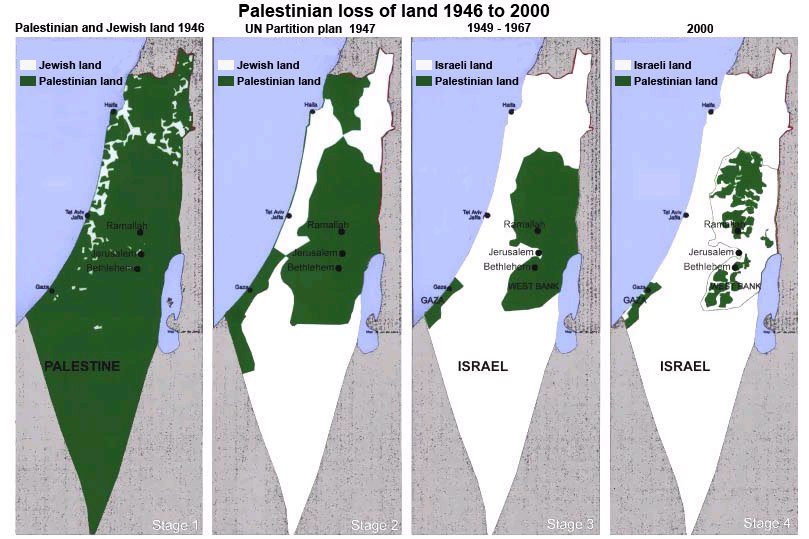
On November 29, 1947, the United Nations, which was dominated by the Allied powers,  voted to divide Palestine into two independent states, one Palestinian and the other Jewish. According to this plan, Jerusalem was declared an international city. The plan was implemented on October 1, 1948, which the Zionists celebrate as "Independence Day." However, the Palestinians and the Arab regimes saw the partition of Palestine as another example of Western imperialism's interference in their land and opposed it. At that time, there were approximately 1,300,000 Palestinian Arabs and 600,000 Jews (some of whom were  Palestinian Jews who thus became citizens of Israel) living in Palestine. 

Thus, the Zionist movement and its imperialist supporters have created a Frankenstein in the Promised Land: a reliable military base of Western imperialism located in the heart of the Middle East and North Africa. 

According to the Federation of American Scientists, Israel began a push to acquire nuclear weapons immediately right after it was established. The search for uranium began in 1949, and the Israeli Atomic Energy Commission was established in 1952. On October 3, 1957, France and Israel signed an agreement to build a 24-megawatt reactor (although the cooling systems and nuclear waste facilities were designed for a reactor with three times this capacity), all under the guise of establishing a chemical plant. All this was carried out secretly outside the International Atomic Energy Agency (IAEA) inspection regime.  In 1968,  the CIA published a report on Israel's nuclear weapons production. Although the United States was aware of Israel's nuclear ambitions and activities, as a strategic ally in the Middle East, it was allowed to join the small group of states with nuclear weapons (the Nuclear Club). 

While Israel is a member of the IAEA, it is not a signatory to the Nuclear Non-Proliferation Treaty (NPT). This is a significant difference because membership in the IAEA gives Israel access to certain benefits and services related to nuclear technologies and fosters international nuclear cooperation. Failure to sign the NPT means that Israel will not be subject to full inspections by the IAEA.  As such, the Israeli government neither officially denies nor acknowledges the possession of nuclear weapons.  Currently, Israel receives $3.8 billion in military aid from the United States annually. Although a UN resolution created Israel, it has never been reprimanded by the United Nations for repeated violations of international law thanks to the veto power of the United States in the Security Council. Israel was a staunch supporter of the apartheid regime in South Africa but has opposed any anti-imperialist and revolutionary movement in the Middle East and around the world.  It has supported the U.S. war in Indochina but opposed the Nicaraguan Revolution of 1979   and is one of the few countries that voted against the U.S. lifting the embargo at the annual meeting of the United Nations General Assembly. 

Thus, the cause of Jews fleeing anti-Semitism in Europe and the Nazi Holocaust, especially those who came to Palestine with socialist ideals, has been betrayed by Zionist leaders. Worse still, many of them have become racist oppressors who serve colonial and imperialist interests while opposing the Palestinian movement for self-determination and the Arab revolution.

In contrast, Iran is a signatory to the Nuclear Non-Proliferation Treaty (NPT). The treaty was signed in 1968 and ratified in 1970 by the Shah's regime. However, due to the hostility of the United States and Western imperialism after the 1979 revolution, numerous concerns and reports about Iran's compliance with the safeguards and obligations of the treaty have been raised to oppose Iran's use of nuclear energy, a right given to other states.

Why Israel and the U.S. are allowed to have a nuclear program and nuclear bombs, but Iran is not even allowed to enrich uranium for peaceful means? 

Did not the Islamic Republic sign the Joint Comprehensive Plan of Action (JCPOA), signed on July 14, 2015, with the P5+1 (China, France, Germany, Russia, the United Kingdom, and the United States) to allow for regular inspection of Iran's nuclear activities to ensure it is for peaceful means? Why did Israel oppose the treaty, and Trump tore it apart? 

Ten years ago, after the signing of the JCPOA, I wrote in an article titled "Their milk wins, our line loses":

"The July 14 agreement between 5+1 and the Islamic Republic reflects the balance of power between Iran and imperialism, headed by the United States.  America's pyrrhic victory in the Gulf wars and subsequent rise and unraveling of the Arab Spring has resulted in region-wide instability where extremist Islamic organizations like Al-Quada and Islamic State in Iraq and Syria (ISIS) that routinely use terror have gained ground.  Meanwhile, the influence of the Islamic Republic has increased in Iraq, Syria, Lebanon, Yemen, and the Gaza Strip.  The Islamic Republic has been an ascending force in the region whose interests have coincided with those of the U.S. when Washington invaded and occupied Afghanistan and Iraq and now that both regimes are engaged in the fight against ISIS.  At the same time, a majority of the Islamic Republic's regime realizes that their immediate interests in dismantling the sanctions regime and pursuing economic development, as well as their strategic regional ambitions, are best served by reaching an understanding with the United States.  Thus, the Iran nuclear agreement is a win-win for American imperialism and its allies and the clerical capitalist Islamic Republic.  However, it would be a mistake to suppose that the agreement will prevent future wars—conflicts can arise over implementation, and the balance of power can change in the future, making Iran vulnerable again.  Nor would the agreement make the Middle East and the world safer from nuclear "accidents" or nuclear wars (emphasis added, Nayeri, 2015)."

Israel's war against Iran has now confirmed my argument that the agreement signed ten years ago is no longer possible due to changing power relations in the region. As Israeli and American policymakers have repeatedly insisted, the Islamic Republic has never been as politically weak as it is today. The dictatorship of Bashir al-Assad in Syria, which was an ally of the Islamic Republic, has been overthrown, and the current Sunni Syrian regime prefers closer ties with Washington and has stayed quiet in the Israeli attack on Iran. Armed forces allied with the Islamic Republic, such as Hezbollah in Lebanon and Hamas in Gaza, have been weakened, and their influence in Iraq has diminished. By creating a tyrannical clerical capitalist regime, oppressing women, religious minorities, oppressed nationalities, interfering in the private lives of citizens, suppressing any independent organization, suppressing all forms of protest, attacking, imprisoning, torturing, and executing its critics and opponents, the Islamic Republic has been discredited in the eyes of most Iranians and the world public opinion.  Adherence to neoliberal policies and the inability to manage the economy, according to official accounts, 40 percent of the population lives below the poverty line. The 1979 revolution made it possible for the redistribution of income, which elevated the lot of many poorer Iranians, but this proved temporary, and now deep class divisions and government corruption are evident everywhere. 


The key motivation for the Islamic Republic's negotiations with the United States has been the lifting of sanctions to reduce the economic crisis. The regime used uranium enrichment as a bargaining chip to reduce, if not end, economic sanctions. 

Thus, the Islamic government project undertaken by Ayatollah Khomeini has reached a dead end. 

This situation provided Israel and the United States an opportunity to launch a military attack on Iran with an eye on the possibility of overthrowing the Islamic Republic. However, unlike Syria, where an alternative force had been established over the years, there is no such an alternative existing in Iran. 

Furthermore, both Israel and the United States are in relative decline. As the year and a half of Israel's genocidal war in Gaza shows, despite killing more than 55,000 Palestinians, injuring nearly 120,000, and displacing the majority of the inhabitants of Gaza, Israel has not yet been able to win the release of all its hostages or defeat Hamas. Israel is politically isolated and more isolated in public opinion than at any time in the past, as its prime minister, Netanyahu, is wanted by the International Court for war crimes. Zionism has proven a dead-end as much as political Islam. 

U.S. imperialism has been facing a relative decline, particularly against the rising power of China as a global power, while it has been challenged by regional powers such as Russia in Ukraine, Iran in the Middle East, and China in the Pacific region. The second election of Trump as president demonstrated the increasing polarization within the political class, as every four years, the newly elected president cancels many of the policies implemented by his predecessor. This trend is entirely the opposite of what the U.S. economic ruling class needs. 


The Ecocentric Socialist Alternative 

The 1979 Revolution was suppressed and eventually crushed by 1983 through Ayatollah Khomeini's project of Velayat-e Faqih (rule of Islamic jurisprudence), which aimed to establish and consolidate the Islamic Republic. At least two generations of Iranians were demoralized in the process: the generation of the 1979 Revolution and the generation that was born and grew up after the Islamic Republic came to power. The former was mainly a victim of despair due to defeat, and the latter has been a victim of ignorance regarding the reality of Mohammad Reza Pahlavi's dictatorship, the secular nature of the 1979 revolution, and the reasons for its failure. Out of ignorance about the democratic anti-imperialist goals of the revolution, this generation holds the revolutionaries responsible for the creation and crimes of the Islamic Republic even though they were the first victims of this regime. As a result, some of them have been attracted to the propaganda of the United States, the remnants of the regime of Mohammad Reza Pahlavi, and even Israel. These same people have become anti-Arab and anti-Palestinian, an echo of the Fars nationalism of the Pahlavi monarchy. 

However, the 1979 Revolution was a great historical movement for independence, freedom, and social justice (استقلال، آزادی، عدالت اجتماعی). It was a movement that had the potential to create the broadest and deepest form of democracy based on the grassroots movements of workers, peasants, oppressed nationalities, youth, and students. Of course, these organizations had weaknesses and flaws.  However, had they not been dissolved or suppressed by the Islamic Republic, it would have been entirely possible for them to develop as the basis of a government of the people, by the people, and for the people, establishing the first democratic government in Iran's history. 


In the Russian socialist revolution of October 1917, it was this process that determined the socialist character of the revolution, not merely the leadership of the Bolsheviks and the nationalization of the economic infrastructure. As Lenin remarked: 

"The socialist character of Soviet, i.e., proletarian, democracy, as concretely applied today, lies first in the fact that the electors are the working and exploited people; the bourgeoisie is excluded. Secondly, it lies in the fact that all bureaucratic formalities and restrictions of elections are abolished; the people themselves determine the order and time of elections, and are completely free to recall any elected person. Thirdly, it lies in the creation of the best mass organization of the vanguard of the working people, i.e., the proletariat engaged in large-scale industry, which enables it to lead the vast mass of the exploited, to draw them into independent political life, to educate them politically by their own experience; therefore for the first time a start is made by the entire population in learning the art of administration, and in the beginning to administer (Lenin, April 1918).”

Policy Framework

Even if the working people take over state power, the question still arises as to what framework should be adopted for policymaking. 

Some Native Indian tribes used a golden rule: choose a policy that will be good for the next seven generations. As the Native Americans considered themselves an inseparable part of nature, the good policy must also be good for the ecosystem of which we are a small part. 

In addition to a consistent policy to create the infrastructure for democracy from below, Iran's economic structure must change to create a society that is compatible with the well-being of its people and the ecosystem of the Middle East and the world, ensuring social justice. The current war demonstrates the dead-end of Islamic fundamentalism, Zionism, and imperialism. However, we know that the world is facing several existential crises, such as global warming and climate chaos, the Sixth Extinction, recurrent pandemics, and nuclear annihilation. The root cause is the anthropocentric industrial capitalist civilization. 

Science and technology are not value-free. They have been, especially since the Scientific Revolution of the 17th century, instruments for the domination and control of nature, allowing for its plunder for wealth and power (Nayeri, 2021). The fossil fuel-based economy contradicts the need for a transition to a green economy in every way.  Nuclear technology, whether for energy or nuclear weapons, is inherently dangerous to the ecosystem and life on the planet  (Friends of the Earth undated). As the Fukushima Daiichi nuclear disaster in March 2011 and the atomic bombings of Hiroshima and Nagasaki by the United States in August 1945 demonstrated. As the recent conflict between Pakistan and India showed and, the danger posed by bombing Iran's nuclear facilities by Israel and possibly the United States demonstrates.  Progress toward a healthier, safer, and better world requires the elimination of all nuclear weapons and nuclear energy.  

Here, I am only referring to the climate crisis in the Middle East. In 2023, the United Nations Climate Change Risk Assessment Group published a report on the future of the Middle East and North Africa. The World Bank provided an analysis of its economic impact (World Bank 2023).

The World Bank predicts that if climate change caused by greenhouse gas emissions is not prevented, real annual GDP in countries in the Middle East and North Africa will decline by 1.1% by mid-century, and poor and vulnerable families will increasingly bear the resulting damage. Despite the unique characteristics of the needs and facilities for water, energy, and food security in the countries of the region, their interdependencies are the only way out of this crisis that requires their cooperation. Structural challenges, primarily related to the lack of financial resources, inadequate reforms, and limited resources, as well as the lack of commitment from capitalist state institutions, increase the likelihood of exacerbating the vulnerabilities caused by climate change in countries in the Middle East and North Africa.

The solutions proposed by the UN research group, including the "green transition" from existing fossil economies to one based on renewable energy (mainly solar and wind), will significantly reduce the costs of electricity generation. Such a transition would entail economic benefits, energy security, and long-term financial and job creation advantages. Eliminating oil and gas flaring and reducing methane emissions in oil and gas-producing countries could lead to significant economic benefits while also reducing greenhouse gas emissions. 

Another scientific study was published this week (Santer et al., 2025) that provides evidence that the onset of atmospheric warming could have been documented as early as 1880. In fact, in 1896, the Swedish scientist Svante Arrhenius had shown that the amount of carbon dioxide (CO2) in the atmosphere had doubled. Today, there is no longer any doubt that atmospheric warming and the climate crisis are caused by the emissions of greenhouse gases resulting from human-centered industrial capitalist civilization (Nayeri, April 2023). 

Of course, the United Nations research group does not address the human-centered industrial capitalist civilization as the root cause of the climate disaster. The United Nations is, in fact, the organization of non-allied capitalist states, not an independent organization of united working people. 

A group of academics and environmentalists has long argued that the current system pursues unlimited economic growth while providing us with limited possibilities on the planet we live on. The confluence of these two realities is the cause of ecosystem crises. Some of them have created the degrowth movement. Unfortunately, most of them do not realize that growth in the capitalist system is driven by the system's need for capital accumulation, and the accumulation of capital depends on profit, which is only possible by creating surplus value (Nayeri, 2022). However, contrary to Marxist belief, the source of surplus value is not only the exploitation of the worker but also the plundering of non-human nature (Nayeri, December 2023). 

As a result, the only way out of the existential crises and other social problems, including the wars in the Middle East, is to transition to Ecocentric Socialism. This vision and goal also represent a redefinition of the type of human life free from all forms of alienation in a society where money and power deteriorate as quickly as love for nature and human solidarity become part of our daily lives.

In Iran, this process will require the rejection of imperialism, Zionism, and religious dictatorship to open a window to the final emancipation of humanity.

References:

Bruno Bauer. The Jewish Question. 1843.

Berman, Lazar. “How an Israeli-American Deception Campaign Lulled Iran into a False Sense of Security.” Times of Israel, June 13, 2025.

Bruno Bauer. The Jewish Question. 1843.

Friends of the Earth. “Is Nuclear Power Bad for the Earth? No date.

Lenin, V.I. “The Immediate Tasks of the Soviet Government.” April 1918.

Marx, Karl. On the Jewish Question. 1843.

Nayeri, Kamran. “Heads They Win, Tails We Lose: On Iran Nuclear Agreement.” Our Place in the World: A Journal of Ecosocialism. August 12, 2015.

______________. “The Case for Ecocentric Socialism.” Our Place in the World: A Journal of Ecosocialism. July 22, 2021.

______________. “On Degrowth.”  Our Place in the World: A Journal of Ecosocialism. July 24, 2021.

______________. “The Labor Theory of Value and Exploitation of Nonhumans: The Case of the Meat Industry.”  Our Place in the World: A Journal of Ecosocialism. December 31, 2022..

______________. “The Anthropocentric Industrial Capitalist Civilization and Ecological Crises.” Our Place in the World: A Journal of Ecosocialism. April 1, 2023..

Santer, Benjamin, Susan Salmon, David W. I. Thomason, Yaowei Li. “Human influence on climate detectable in the late 19th century.” PANS, June 16, 202.

World Bank. MENA Country Climate and Development Report: Climate change Action in the Middle East and North Africa (key insights from the reports).November 2023. 

Tuesday, June 20, 2017

Is Palestinian Right to Self-Determination Compatible with the Israel's "Right to Exist?"

By Kamran Nayeri, March 1, 2017


In discussions and debates about the “Arab-Israeli conflict” the questions of Palestinian right to self-determination and Israel’s “right to exist” come up frequently.  It came up in a Facebook discussion I had with Mark (not his real name) the other day. What do these mean?  Mark has been a life long socialist and for years I rode the subway with him back to Brooklyn where we both lived from political events in Manhattan. A printer by profession, he is a book lover and reads voraciously.  When I knew Mark in the 1980s and early 1990s, he was a staunch supporter of the Palestinian right to self-determination and advocated a secular democratic Palestine where Palestinians, Jews and others would live as equals.  This idea was first raised in the late 1960s by the PLO leadership and was embraced by some Jews. But in our Facebook discussion Mark raised the idea of the “right of Israel to exist.”  This notion is part of the demands of the Zionist movement in the so-called peace process that began in 1993.  I pointed out to him that the two positions are mutually exclusive. The “right of Israel to exist” denies Palestinian right to self-determination. Palestinians have not "accepted" Israel unless when they are under to condition of duress. revolutionary socialist would continue to oppose any imposition of a colonial-settler occupation on any part of Palestine and Palestinian right to self-determination requires dissolution of the Israeli state.  In what follows I expand on the question of the right of self-determination for Palestinians and why it matters to the entire world to support, including the Jewish people, especially the Jewish working class. 

The historical basis of the state of Israel
Zionist ideology 
There are three claimed basis for the “right of the Israel to exist.”  The first is the Zionist ideology itself.  Zionists regularly claim that they have a “right to the Jewish people historical homeland.” By that, they mean when the Israelites inhabited historical Palestine some 3,700 years ago.  But Christians can trace their religious origins to the historical Palestine. Should they also claim to have a right to the historical Palestine?  And Judaism, like Christianity, is a religion open to anyone who wants and is admitted to join it.  To say a European Jew, a Japanese Jew, an African Jew all have a right to Palestine because they are all adherents to the same religion is unreasonable.  In fact, Zionism originated as a colonial ideology in the late nineteenth century in Eastern Europe and with expressed interest of finding a “homeland" for the European Jews who were facing anti-semitic prosecution in the countries of their birth, especially in Tsarist Russia. 

British imperialism and the Balfour Declaration
Despite the prevalent Zionist propaganda that tries to justify the occupation of Palestine on the basis of the Jewish mythology of The Chosen People returning to The Promised Land, the Zionist movement considered a number of other locations for colonization.  For example, in 1903 at the sixth Zionist Congress Theodor Herzl, the “Father of Modern Zionism,” proposed Uganda as the site for the Jewish State.  However, in the aftermath of the First World War and division of the Middle East and North Africa between the English and French imperialism, Palestine became the target of the Zionist movement. This was codified in the Balfour Declaration that was first proposed in a letter from the British Foreign Secretary Arthur James Balfour to the British Zionist financier Baron Walter Rothschild dated November 2, 1917, and later incorporated into the Sèvres peace treaty with the Ottoman Empireand the Mandate for Palestine.

American imperialism and partition of Palestine
Subsequently, the Zionist movement organized settlements of European Jews in the historical Palestine to lay the basis for a Jewish State.  Like in all European colonies, the process of land grab was pursued by any means necessary, including through the use of force and terrorist Zionist groups such as the Irgun, the Lehi, the Haganah and the Palmach.  In fact, Menachem Begin, a leader of the terrorist group Irgun, later became Israel’s Prime Minster (He was succeeded by another terrorist, Ariel Sharon). 

The Nazi persecution of Jews and the Holocaust caused the mass migration of European Jews.  However, key destination countries such as the United States limited Jewish immigration and encouraged their settlement in Palestine, a policy supported by the Zionist leaders.  By the end of the World War II, the United Stated had emerged as the undisputed imperialist power. As part of the consolidation of its empire, the United States moved to establish Israel as its outpost in the Middle East.  The recently formed United Nations very much under the sway of the Allies, especially the United States, drew the partition plan for Palestine voted for by the General Assembly on November 29, 1947.  All existing Arab countries opposed it. On May 14, 1948, David Ben-Gurion, the head of the Jewish Agency, proclaimed the establishment of the State of Israel. U.S. President Harry S. Truman recognized the new nation on the same day.

Thus, the establishment of Israel as the Jewish State in Palestine has been a violation of the right to self-determination of the Palestinian people by the colonial-settler Zionist movement with the support of the British and American imperialism.  No rational human being, no humanitarian, not to mention any revolutionary socialist, can accord Israel a “right to exist” because it’s creation and continued existence has been based on the use of violence against an entire people, the Palestinian people. The very existence of the state of Israel is the negation of the Palestinian people’s right to self-determination. The United Nations Resolution 181 that called for the partition was opposed by all Arab leaders and governments because they argued, it violated the principles of national self-determination in the UN Charter which granted people the right to decide their own destiny.  The Jewish Agency for Palestine that represented the Zionist movement accepted the portion.  The history of Israel as the Jewish State has been a relentless push to expand its territory and its ongoing violence against the Palestinians. It has also been marked by wars with its Arab neighbors (for a history see, "Primer on Palestine, Israel and the Arab-Israeli Conflict," Middle East Research and Information Project).  

Israel: Imperialism’s outpost in the Middle East and North Africa
Today, seven decades later, Israel occupies more of the historical Palestine as well as portions of land from its neighboring states, such as the Golan Height that belong to Syria. What has enabled this historical injustice is the unconditional military, political and diplomatic, and economics support for the Zionist regime as the outpost of imperialism in the strategically important Middle-East and North Africa. 

According to the Federation of American Scientists, Israel began pursuit of nuclear weapons right after its establishment in 1948. It began the search for uranium in 1949 and Israel Atomic Energy Commission (IAEC) was founded in 1952. On October 3, 1957, France and Israel signed an agreement to build a 24 MWt reactor (although the cooling systems and waste facilities were designed to handle three times that power) and, in protocols that were not committed to paper, a chemical reprocessing plant. This complex was constructed in secret, and outside the International Atomic Energy Agency (IAEA) inspection regime.  In 1968, the CIA issued a report about Israel’s successful production of nuclear weapons. Although United States was aware of Israel’s nuclear ambitions and activities it turned a blind eye allowing its strategic ally in the Middle East to join the Nuclear Club outside the purview of the IAEA.  Today, it is an open secret that Israel is armed with 300 nuclear weapons. Israel is the largest cumulative recipient of U.S. foreign assistance since World War II. To date, the United States has provided Israel $127.4 billion (current, in non-inflation-adjusted, dollars) in bilateral assistance. Almost all U.S. bilateral aid to Israel is in the form of military assistance, although in the past Israel also received significant economic assistance (for a detailed discussion, see, Jeremy M. Sharp, “U.S. Foreign Aid to Israel,” Congressional Research Service, December 22, 2016).  In his waning day, Obama administration that was shunned by the Israeli government ensured the Zionist regime gets a record $38 billion military aid package for the next decade.   

Today’s Zionist settlers movement
Those who speak of the right of the State of Israel to exist support this bloody colonial-settler and imperialist legacy that has denied the right to self-determination of Palestinians and has become a pillar of oppression and exploitation in the Middle East and North Africa. Seven decades after imposition of the State of Israel, and almost quarter of century after the Oslo Accord where the demoralized PLO leadership recognized the State of Israel in exchange for a promised Palestinian state, the so-called two-state solution, an estimated 400,00 Zionist settlers live on occupied land in the West Bank (there were only 480 in 1948), about 350,000 live in East Jerusalem (2,300 in 1948) , and 21,000 live in the Golan Height (it belongs to Syria and no Jews lived there in 1948 or in 1967).  No Jews live the Gaza Strip now but 30 lived there in 1948.

What do these Zionist settlers think about the Palestinian people whose land they forcibly takeover and what they foresee as the future of Israel?  In an Op-Ed piece in the New York Times (“A Settler’s View of the Future of Israel,” February 14, 2017), Yishai Fleisher who describes himself as the “ international spokesman of the Jewish community of Hebron,” offers some insight.  Mr. Fleisher marshals the same facts as noted above, wrapped in Zionist phraseology, to argue that the so-called “two-state” solution “will never come to pass”  “because Judea and Samaria belong to the Jewish people.” 

Now, this honest but openly racist expression of the Zionist ideology faces the reality of the Palestinian people who were the great majority of those who lived in Palestine before the Zionist movement to occupy it to build a Jewish State got underway.  The estimated number of Palestinians in the world at the end of 2012 is 11.6 million, of whom 4.4 million are in the West Bank, Gaza Strip and East Jerusalem and 1.4 million live inside Israel (Palestinian Central Bureau of Statistics, cited in Haaretz, “Palestinians to Outnumber Jewish Population by 2020, Says PA Report,” January 1, 2013)  Mr. Fleisher offers a catalogue of Zinonist  “solutions” to deal with this reality.
  • Proposed by two former members of parliament, Aryeh Eldad and Benny Alon, Israel would assert Israeli law in “Judea and Samaria” while Palestinians living there would have Israeli residency and Jordanian citizenship. That is, they are considered Jordanian living inside Israel as expats.
  • Proposed by Israel’s education minister, Naftali Bennett, Israel will annex Area C — the territory in the West Bank as defined by the Oslo Accords (about 60 percent by area), where a majority of the 400,000 settlers live — while offering Israeli citizenship to the relatively few Arabs there. But Arabs living in Areas A and B — the main Palestinian population centers — would have self-rule but no Israeli citizenship and continue to live by the "good grace" of Israel.
  • Proposed by Professor Mordechai Kedar of Bar-Ilan University, near Tel Aviv, seven non-contiguous “emirates” will be established in major Arab cities, as well as Gaza.  Israel would annex the rest of the West Bank and offer Israeli citizenship to Arab villagers outside those cities. Most West Bank Palestinians will not have Israeli citizenship and continue to live under occupation. 
  • Proposed by Caroline Glick, a Jerusalem Post journalist, “Judea and Samaria” will be annexed because new demographic research shows, she claims, that thanks to falling Palestinian birth rates and migration, combined with opposite trends among Jews, a stable Jewish majority of above 60 percent will exist between the Jordan River and the Mediterranean (excluding Gaza); and this is projected to grow to about 70 percent by 2059.  Israel’s president, Reuven Rivlin, and deputy foreign minister, Tzipi Hotovely, back a variety of this proposal.
  • Proposed by Israel’s deputy foreign minister, Tzipi Hotovely, Israel will annex “Judea and Samaria” but offers residency to the Palestinians there with a pathway to citizenship. 
  • Proposed by the head of the new Zehut party, Moshe Feiglin, and Martin Sherman of the Israel Institute for Strategic Studies, Israel will pay “generous” compensation for Palestinians in Judea and Samaria to emigrate “voluntarily.” 
I do not need to point out to the reader that all of these “proposals” to solve the “Palestinian problem” and to expand the Jewish State are based on the assumption of Israel’s right to exist and in open defiance to the principle of the right of the Palestinian people to self-determination. 

Palestinian right to self-determination matters to the world
It must now be entirely clear to the reader that Zionism and its state, Israel, is part and parcel of the history imposed on the humanity by colonialism and imperialism. If revolutionary politics concerns itself with the art and science of understanding and changing oppressive power relations in the interest of human emancipation (which also depends on harmony with the rest of nature) then defending the right to self-determination of all the oppressed and exploited, including the Palestinian people, must be evident as central to the progress of humanity.  While revolutionary socialists have concerned themselves primarily with social class power relations because of the centrality of the working class in the capitalist world economy and the potential and desirability of replacing capitalist social relations with socialist ones, they have also realized that to unite the working classes of the world it is absolutely necessary to educate the working classes of the oppressor nations to respect and defend the right to self-determination of the oppressed nationalities and nations.  That is why the wave of anti-colonial revolutions after the Word War II were of historic importance.   Notable in this context were two historic events: creation of Israel as the Jewish State in 1948 as the imperialist outpost in the strategically important Middle East and North Africa where most of the known oil reserve was located and the Cuban revolution of 1959 that demonstrated that any consistent fight for national self-determination in the capitalist world requires going beyond capitalist social relations in the direction of socialism.  Revolutionary socialism condemned the former without giving up its long-held position against anti-Semitism and upheld the latter. 

This is how the Socialist Workers Party, a revolutionary socialist current at the time, explained it in a 1971 political resolution:
“Our revolutionary socialist opposition to Zionism and the Israeli state has nothing in common with anti-Semitism, as the pro-Zionist propagandists maliciously and falsely assert. Anti-Semitism is anti-Jewish racism used to justify and reinforce oppression of the Jewish people. Marxists have been and remain the most militant and uncompromising fighters against anti-Semitism and the oppression of Jews.
“The source of the oppression of the Jewish people in this era is the capitalist system, which in its period of decay carries all forms of racist oppression to the most barbarous extremes. This was horribly illustrated in the holocaust directed against the Jews of Europe by German imperialism under the Nazi regime. Today, anti-Semitism remains widespread in all of the Western imperialist countries. Until the capitalist system is abolished in these countries there is the ever-present danger that a new variety of virulent anti-Semitism can arise.” (Socialist Workers Party, “Resolution on Israel and the Arab Revolution,” 1971). 
Seven decades later, we must add that Zionism itself is a source of anti-Semitism since the Jewish State has been an instrument of racist, colonialist oppression of the Palestinian people and directly and indirectly involved in a myriad of imperialist campaigns in the Middle East and North Africa and beyond.  To blame the existence of anti-Semitism among some Palestinians and Arabs and in groups that campaign for Palestinian rights ignores this reality.  

Revolutionary socialists confront prejudice in every social movement we participate in, including labor unions. Working people are not immune from racism, sexism, homophobia, xenophobia, Islamophobia or anti-Semitism.  But to turn one’s back to these social movements because some who participate in them are prejudiced neither helps to fight against such prejudices nor contribute to the fight to remove the root-cause of them, the class society in general and the capitalist system in particular. Why should we treat fight for the liberation of the oppressed nationalities and nations any differently?

By becoming the best builders of the solidarity movement with the Palestinian struggle, we can and must educate about the problem of anti-Semitism.  However, this educational and political campaign unfolds only in the context of unconditional support for the right of Palestinians to self-determination.  Any support for Zionism and for its institutional form, Israel, undermines both efforts. 

To root out anti-Semitism, Jewish people, especially Jewish workers, must become staunch supporters of the Palestinian right to self-determination and opponents of the colonial-settler ideology of Zionism. 

The rock solid support of the U.S. ruling class for Zionism certainly has its pragmatic reasons; it has served as the beachhead for imperialism in the Middle East and North Africa for decades.  But there is also an ideological synergy.  Having moved to the front and center with the rise to power of Donald Trump,  American White Nationalism is actually as old as the colonial-settler occupation of the Pre-Columbus America that eventually became the United States.  The entire Euro-centric narrative that has filled the history textbooks begining with the of “discovery” of the Americas by Christopher Columbus to today, as radical historians have pointed out (e.g. Howard Zinn’s A People History of the United States: 1494 to Present, 2003), serve the colonial-settler dominant power relations that has served the ruling capitalist class to this day.  In the United States, White Nationalism has been a movement to dispossess America Indians, plunder the ecosystems, super-exploit African slaves, and waves of immigrants that were brought in to do hard labor. Until 1965, immigration policy in the United States was a “whites only” policy (see, May M. Ngai, Impossible Subjects: Illegal Aliens and the Making of Modern America, 2014).

Thus, the unwavering support of the U.S. ruling class for Zionism is based on a shared common colonial-settlers ideology.  That is why Israel is the “best friend” of the ruling class the United States and the latter is the ultimate protector of the former.  How else can one explain the grip of the Zionist lobby on the U.S. politics where both Democratic Party and Republican Party outcompete each other in their support for Israel? 

Israel’s right to exist or Palestinian right to self-determination?
But why has Mark changed his mind about unconditional right to self-determination for Palestinians? Of course, only Mark himself can answer that question.  But allow me to make an educated guess.  Mark has been a dedicated active supporter of the Socialist Workers Party (SWP) for decades, the fact that the SWP has just recently fundamentally changed its position on Israel and the Palestinian fight for self-determination perhaps has something to do with it.

In its editorial of July 25, 2014, The Militant, SWP’s weekly paper, took an adaptationist position towards Zionism that essentially gave up its historic position of unconditional defense of the Palestinian right to self-determination. The editorial sums up its new position as follows: 
    “Recognition of a Palestinian state, as it is today, as a stepping stone to fight for a single, viable geographical homeland for the Palestinian people.
“Recognition of Israel, as it is today, both a Jewish and increasingly multinational secular state. This includes the right of return for the Jews, which will become increasingly relevant as the world crisis of capitalism kindles Jew hatred as a reactionary bludgeon against fighting labor.” (The Militant, July 25, 2014)
Notice that The Militant editorial comes in the middle of Israeli war against the 1.8 million Palestinians who are squeezed into less than 141 square miles in the Gaza Strip who have no army, no air force, no navy to defend themselves against the most modern and powerful air force, navy and army in the Middle East, courtesy of U.S. imperialism.  According to the United Nations, Operation Protective Edge (Israel’s name for its military offensive), at least 2,104 Palestinian died, including 1,462 civilians, of whom 495 were children and 253 women. Only 66 military personnel and 7 civilians were killed on the Israeli side.  Yet, the editorial places the primary responsibility on "Hamas terrorism and murderous retaliation of Tel Aviv’s armed forces." Thus, the Militant editors were following the Israeli propaganda by turning the victim into the criminal to justify a genocidal war. 

The Militant editors call for the "right of return" for Jews citing the capitalist world crisis but they fail to call for the right of return for Palestinians after seven decades of Zionist ethnic cleansing.  Are not Palestinians not affected by the capitalist world crisis?  This is how radically the editors negate the SWP's historical position.  But the entire idea of a supposed "right of return" for Jews to Palestine was cooked up by the Zionist colonial-settler movement after it gave up plans for creating a "Jewish Homeland" somewhere else after reaching an agreement with British imperialism after World War I to carve up Palestine for a Jewish State.  There is no other basis for any "right of return" of Jews to Palestine.  Jews have lived for thousands of years in many other countries of the world and they are from various races and ethnic groups just like Muslims and Christians. But the Palestinians were forced from their home and homeland in millions by the Zionist colonial-settler terrorism and war only in the contemporary history. The poorest are still living in refugee camps in the Middle East.  Those in the West Bank in effect live under military occupation and their land is gradually being taken from them for new Zionist settlements.  Those in the Gaza Strip are even worse off even though the Israeli army dismantled settlement and withdrew in 2005 because the Zionist State has then imposed a harsh land and sea blockade and has waged three murderous wars against its population in the last 12 years. In reality, the Gaza Strip is the largest open-air prison in the world.  The Palestinians who still remain inside Israel have been second class citizens subject to ongoing racism--how else can life be for non-Jews in the Jewish State?  In brief, the new SWP position is to support the Zionist colonial policy. 

Writing about the Second International Congress in Stuttgart in 1907, Lenin commented on the dispute in the Colonial Commission where a majority led by representative of the German Social Democracy included 
“…the following monstrous phrase appeared in the draft resolution: ‘The Congress does not in principle and for all time reject all colonial policy, which, under a socialist regime, may have a civilising effect.’ In reality, this proposition was tantamount to a direct retreat towards bourgeois policy and a bourgeois world outlook that justifies colonial wars and atrocities.   It was a retreat towards Roosevelt, said one of the American delegates. The attempts to justify this retreat by the tasks of a ‘socialist colonial policy’ and of constructive reform work in the colonies were unfortunate in the extreme. Socialism has never refused to advocate reforms in the colonies as well; but this can have nothing in common with weakening our stand in principle against conquests, subjugation of other nations, violence, and plunder, which constitute ‘colonial policy’. The minimum programme of all the socialist parties applies both to the home countries and the colonies. The very concept 'socialist colonial policy' is a hopeless muddle. The Congress quite rightly deleted the above-quoted words from the resolution and substituted for them a condemnation of colonial policy that was sharper than that contained in former resolutions.” (V. I. Lenin, "The International Soialist Congress in Stuttgart", Marxist Internet Archive, 1907), 
The revisionist SPW position is similarly proposing a “Marxist colonial policy” by recognizing Israel’s right to exist and thereby denying the Palestinian right to self-determination.  But why such a revision?  Part of the answer lies in a fundamental revision of the SWP’s historic program, strategy and tactics, as well as organization principles and norms, that began in the early 1980s and continues to this day (for a discussion of these see, Art Young, “Decline and Fall: The US SWP’s Final Embrace of Zionism,” 2014; John Leslie. “The U.S. Socialist Workers Party Accommodates to Zionism,” 2016; Kamran Nayeri, “The Historic Women's Marches of January 21, 2017,” 2017 that discuss particular cases of the political crisis of the Socialist Workers Party).  Why a majority of the SWP leadership and membership opted for this revision of the party’s revolutionary heritage is a more complex question.  The interested reader can find a number of arguments about the root-causes of the SWP’s demise of which I would recommend Paul Le Blanc’s incisive essays “Leninism in the United States and the Decline of American Trotskyism,” and “Trotskyism in the United States: The First Fifty Years,” in Trotskyism in the United States (Paul Le Blanc, ed., 2016).  

The pressure to cave into Zionism is greater today as the shift to the right in capitalist politics continues and political polarization puts small socialist groups to test. Some like the SWP are more prone to give in and embrace a pro-Zionist position. Others that have tried to maintain their revolutionary heritage have embraced the new generation of working people that are waking up to the plight of the Palestinian people as evidenced by the massive support for the Palestinian-led Boycott, Divest, Sanction movement. The conversation with Mark began with me posting a BDS-related news item on Facebook which he opposed initially with a myriad of excuses.  When the conversation continued a bit, he came out with the argument that the BDS undermines Israel’s right to exist, which he, to my surprise endorsed. 

For an ecosocialist Middle East and North Africa
Of course, unconditional defense of the Palestinian right to self-determination is as important today as it has always been as is the vision of a democratic secular Palestine where Palestinians, Jews, and other peoples residents in the historical Palestine to live as equals.  However, today as the world is becoming aware of the ecological crisis that poses a threat to human survival and much of other life on earth, we must envision an ecological socialist Middle East and North Africa.  That is why it is such a shame that the people who dedicated their lives to socialism are now caving in to the colonial-settler ideology of Zionism.  Zionism is not only the scourge against the Palestinian. It is also a barrier to the union of all peoples of the Middle East and North Africa who should unite in the fight for an ecological socialist region. Instead of fighting for a nineteenth-century colonial-settler racist ideology of a “Jewish Homeland,” Jews and all opponents of anti-Semitism must be fighting for our common humanity and the future of our true homeland, the planet Earth and life in all its magnificent variety.  It is time to contemplate that we are really one species that has been fractured by the rise of class societies since the dawn of Agricultural Revolution into many feuding social groups.  The promise of Marx’s socialism was to emancipate humanity. Consistent with Marx's own understanding (Paul Burkett, Marx and Nature: A Red and Green Perspective, 1999; John Bellamy Foster, Marx's Ecology: Materialism and Nature, 2000) ecological socialism promises to do so by returning humanity to the wisdom of ecocentriccultures that our ancestors shared for 95% of our existence, cultures that value and celebrate all life and the Mother Earth (Kamran Nayeri, "Economics, Socialism, and Ecology: A Critical Outline, Part 2, 2013).  

References:
Burkett, Paul. Marx and Nature: A Red and Green Perspective, 1999.
Fleisher, Yishai. “A Settler’s View of the Future of Israel,” The New York Times, February 14, 2017. 
Foster, John Bellamy. Marx's Ecology: Materialism and Nature, Monthly Review, 2000.
Le Blanc, Paul. Trotskyism in the United States. Haymarket Books, 2016. 
Lenin. V. I. “The International Socialist Congress in Stuttgart,” Marxist Internet Archive, 1908. 
Leslie, John. “Israel, Palestine, Anti-Semitism and the US Left,” Left Voice, September 13, 2016. Republished as “The U.S. Socialist Workers Party Accommodates to Zionism,” in Our Place in the World: A Journal of Ecosocialism. 
Middle East Research and Information Project. "Primer on Palestine, Israel and the Arab-Israeli Conflict." No date. 
Nayeri, Kamran. "Economics, Socialism, and Ecology: A Critical Outline, Part 2, Our Place in the World: A Journal of Ecosocialism, 2013.
-------------------.“The Historic Women's Marches of January 21, 2017,” Our Place in the World: A Journal of Ecosocialism, February 2, 2017. 
Ngai, May M. Impossible Subjects: Illegal Aliens and the Making of Modern America, 2014.
Palestinian Central Bureau of Statistics, “Palestinians to Outnumber Jewish Population by 2020, Says PA Report,” Haaretz, January 1, 2013.
Sharp, Jeremy M. “U.S. Foreign Aid to Israel,” Congressional Research Service, December 22, 2016.
Socialist Workers Party. “Resolution on Israel and the Arab Revolution,” Marxist Internet Archive, 1971. 
————————————. Editorial: "Chart Road Forward for Toilers of Palestine and Israel,” The Militant, July 25, 2014.
Young, Art. “Decline and Fall: The US SWP’s Final Embrace of Zionism,” Links International Journal of Socialist Renewal, September 18, 2014.  Republished in Our Place in the World: A Journal of Ecosocialism.